TL;DR – App Store Optimization in 2026
- Semantic Dominance: Apple’s search engine now ranks apps based on user behavior and intent matching rather than exact string matches. Your App Store keyword strategy must target problem-solution pairs, not just high-volume terms.
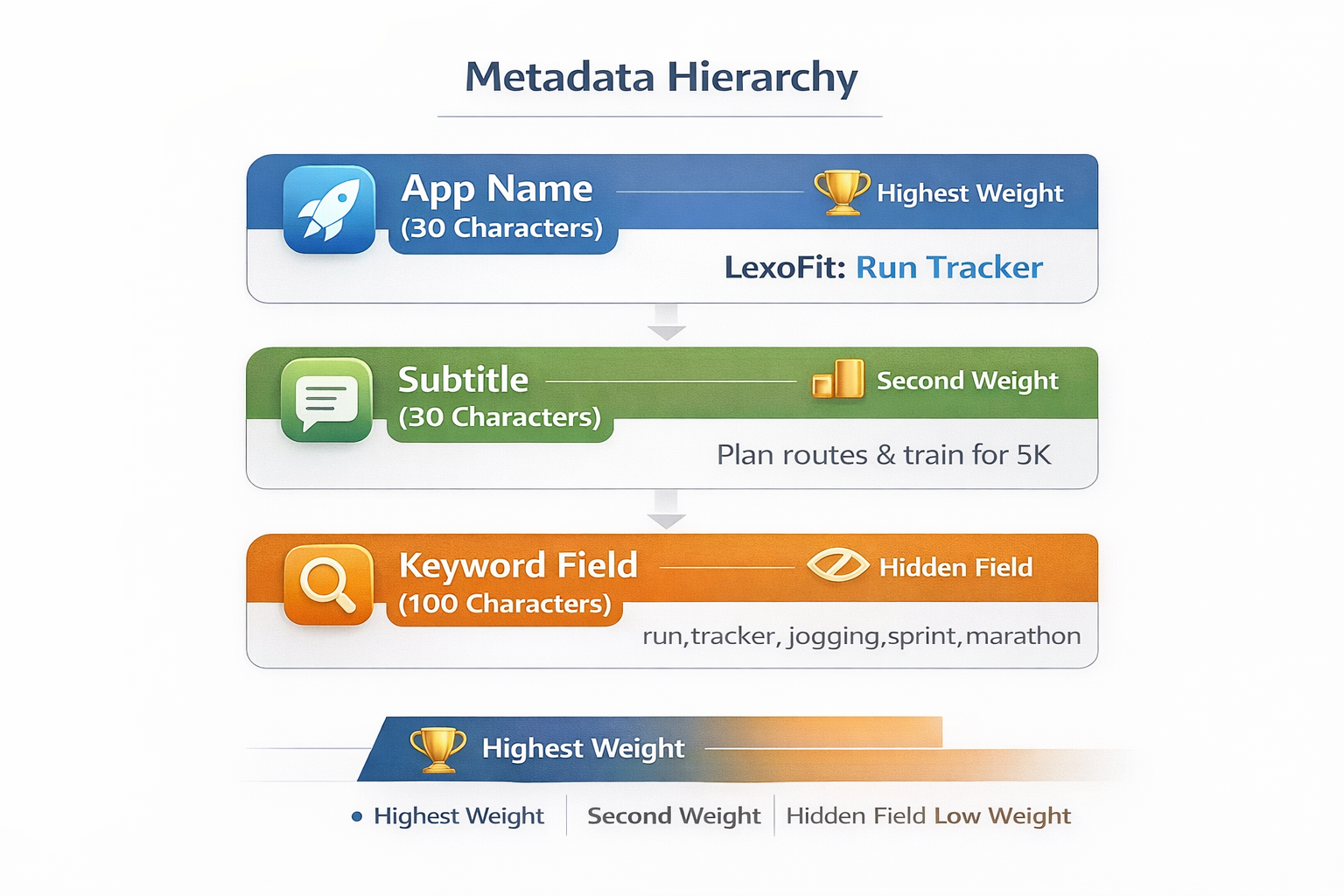
- Strict Metadata Hierarchy: Ranking weight is distributed by field specificity: App Name (30 chars) carries the most weight, followed by the Subtitle (30 chars), and finally the Keyword Field (100 chars).
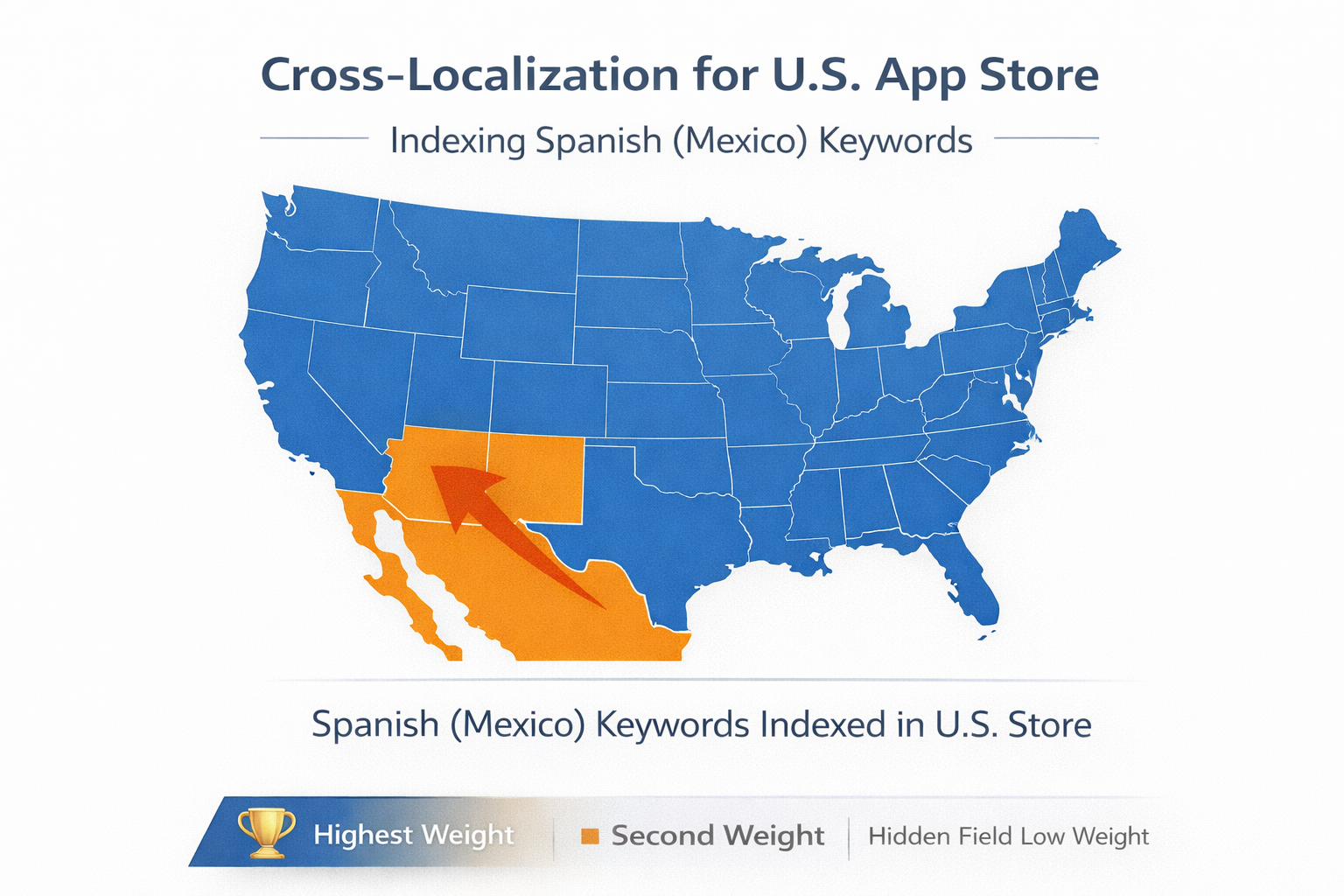
- Cross-Localization: You can double your keyword indexing capacity by utilizing secondary locales. For the US market, the App Store indexes the Spanish (Mexico) keyword field, allowing you to place additional English keywords in that space.
- Continuous Iteration: Professional ASO services for iOS are not one-time setups. They require iterative testing of visual assets and metadata to adapt to shifting search trends and agent-based discovery.
- Technical Foundation: High retention rates signal quality to the algorithm. Partnering with a high-performance React Native development company like Lexogrine ensures the app architecture supports the speed and stability needed to convert traffic into long-term users.
App Store Keywords Optimization (Definition for 2026)
App Store Keywords Optimization in 2026 is the engineering process of aligning an app’s metadata, visual assets, and technical architecture with the semantic intent of users and AI discovery agents. It moves beyond simple keyword matching to focus on "intent clusters" - groups of queries that signal a specific user problem or desire.
This shift matters because the entities searching for your app have changed. Modern discovery often involves AI agents rather than just human queries. Agents differ from standard chatbots in their fundamental capabilities: while chatbots engage in passive conversation based on pre-trained data, agents demonstrate autonomy, reasoning, and action. They do not just read your description - they analyze your app's code structure and deep links to determine if it can autonomously solve a user's request.
The State of iOS Search in 2026
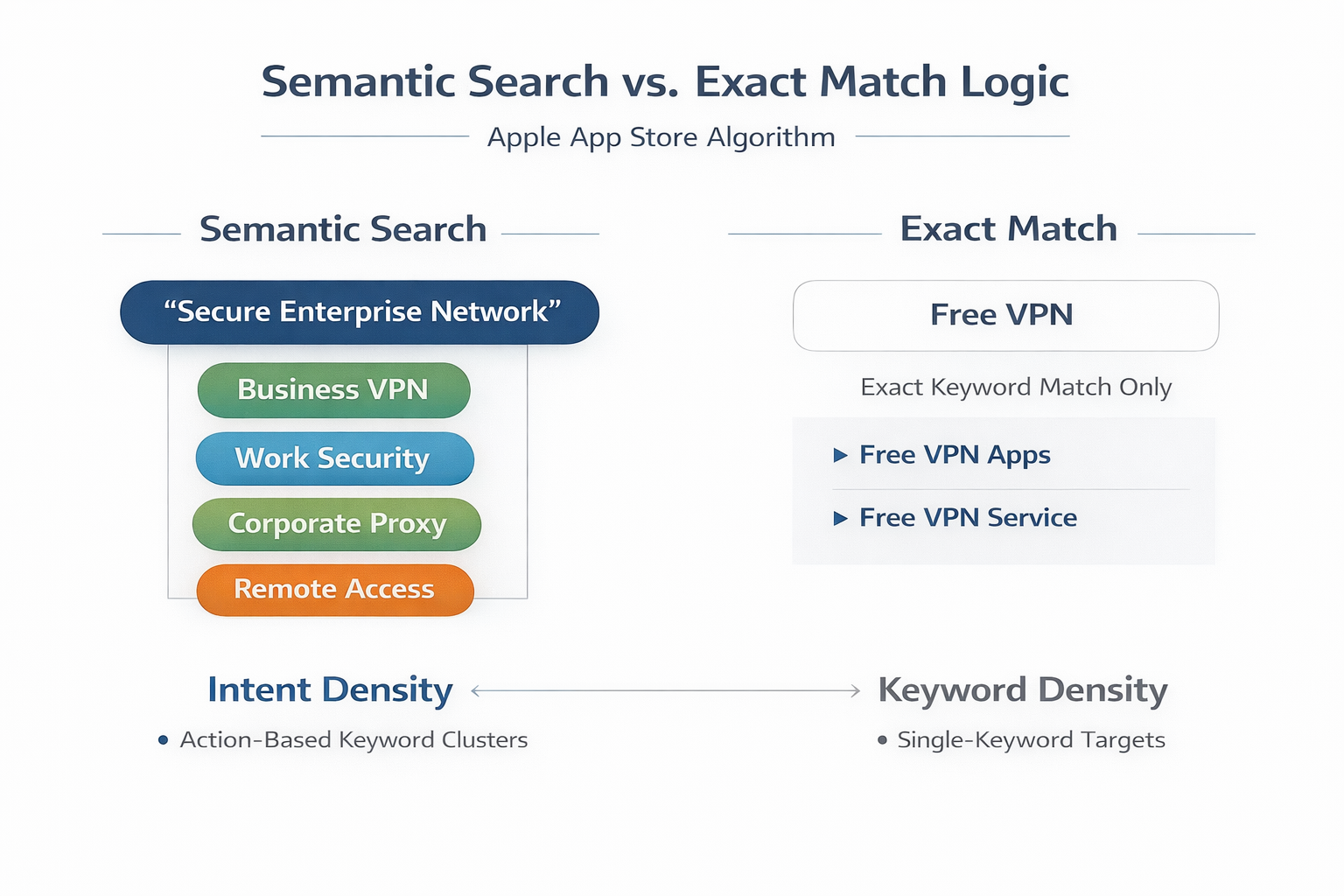
The Apple App Store search algorithm has evolved from a lexical engine to a semantic understanding system. In previous years, ranking relied heavily on exact-match strings. If a user searched for "budget planner," the engine looked for those exact characters in the title or keyword field.
In 2026, Apple’s algorithm employs Large Language Models (LLMs) to interpret context. It understands that "expense tracker," "money manager," and "personal finance tool" satisfy the same user intent as "budget planner." This semantic layer means an app can rank for terms it does not explicitly contain in its metadata, provided the overall signal strength (reviews, engagement, category relevance) aligns with the user's goal.
Optimization is now a continuous engineering loop. The App Store refreshes its index constantly, and competitors adjust their metadata daily. Static keywords decay in value as user search behaviors shift. Maintaining visibility requires regular "code pushes" to your metadata—testing new intent clusters, updating visual assets to match seasonal trends, and refining the keyword field based on performance data.
Core Keyword Strategies for 2026
Semantic Relevance & Intent
High-volume keywords often lead to low-quality installs if they fail to match user intent. A user searching for "free VPN" has a different intent than one searching for "secure enterprise network."
Focus on Intent Density rather than Keyword Density. Group your target keywords into clusters that describe specific actions your app performs. If you build a fitness app, do not just target "fitness." Target action-based clusters like "track marathon training" or "build muscle at home."
Review your app's "retention-to-keyword" ratio. Apple’s algorithm down-ranks apps that generate installs from specific keywords but suffer high uninstall rates shortly after. This signal indicates a mismatch between the keyword's promise and the app's delivery.
The Metadata Hierarchy
Apple enforces strict character limits and ranking weights. You must follow these technical rules to maximize indexing potential.
- App Name (30 Characters): This field holds the highest ranking weight. Place your brand name and your single most valuable keyword here.
- Format:
Brand Name: Core Keyword - Example:
LexoFit: Run Tracker
- Format:
- Subtitle (30 Characters): This field has the second-highest weight. Use it to describe the primary value proposition or a secondary keyword phrase. Avoid repeating words from the Title; Apple does not credit duplication.
- Example:
Plan routes & train for 5K
- Example:
- Keyword Field (100 Characters): This hidden field allows for comma-separated values.
- No spaces:
run,tracker,jogging,sprint,marathon(saves characters). - No plurals: Apple automatically matches plurals for English. Use the singular form to save space.
- No brand repetition: Do not repeat the brand name or words from the Title/Subtitle.
- No spaces:
Localization (L10n)
Localization is the most effective method to expand your keyword capacity. The App Store indexes specific secondary languages for each primary market. For the United States storefront, the algorithm indexes keywords from the Spanish (Mexico) localization.
This technicality allows you to double your keyword field limit. You can place English keywords in the Spanish (Mexico) keyword field, and they will rank in the U.S. search results. This strategy, known as "Cross-Localization," effectively gives you 200 characters of hidden keyword space for the U.S. market.
Note: This rule applies to other regions as well. The UK store indexes French (France) data; the Canadian store indexes French (Canadian).
Leveraging Apple Search Ads (ASA)
Organic and paid search strategies work best when integrated. Apple Search Ads (ASA) provides precise data on keyword conversion rates, which organic tools cannot offer.
Use Search Match to uncover high-value keywords. Launch a "Discovery Campaign" with Search Match enabled and no specific keywords. Apple’s algorithm will match your app to relevant queries based on your metadata. After two weeks, mine the "Search Terms" report to identify queries that led to conversions.
Move these high-converting terms into your organic metadata (Title or Keyword Field) and add them as "Exact Match" keywords in your ASA campaigns. This creates a feedback loop: paid ads validate the keyword's value, and organic implementation cements your long-term ranking for it.
Partnering with Lexogrine
Lexogrine stands as a premier React Native development company for technical leaders who demand performance and discoverability. We do not just write code - we build mobile products engineered for growth.
React Native is the ideal framework for modern iOS application development. With the rise of AI Agentic mobile development and tools like Expo, we ship iOS apps faster without sacrificing quality. Our engineering workflow integrates technical SEO & ASO principles directly into the app architecture - ensuring deep links, load times, and rendering patterns are tuned for both user retention and algorithmic visibility.
We combine high-performance engineering with a deep understanding of the App Store's semantic requirements. Whether you need IT staffing and outsourcing to scale your team or a full-cycle partner to build your product from scratch, Lexogrine delivers code that ranks and converts.
Ready to scale your mobile presence?

Sources we used
Our strategies rely on verified data, official documentation, and technical market intelligence. The following resources shaped our 2026 App Store optimization framework:
- Search Results - Help, Apple Ads. (n.d.).
- 2026 ASO Trends: AI and Intent Driven Strategies, AnalyticaHouse. (2026, February 5).
- How AI is changing relevance in app store search, AppTweak. (2026, January 20).
- App Store Ranking Factors - The Guide for Success, Moburst. (2025, December 22).
- Guide To App Store Optimization Cross-Localization, Outrank Apps. (2025, October 21).