


Software development team augmentation helps companies add skilled engineers without changing how they run product work. It works when your internal team needs more capacity, missing technical skills, or temporary delivery help, but still wants to own product choices, architecture, code standards, and priorities.
The model is useful, but it is not magic. Adding developers only helps when the team has clear direction, fast feedback, and enough senior review. Here is why.
What is software development team augmentation?
Software development team augmentation is an engagement model where external engineers or specialists join your existing software delivery process for a defined period, usually under a commercial services agreement rather than as direct employees.
Compared with ad hoc freelance hiring, a structured team augmentation setup can provide stronger vetting, continuity, backup, and partner support, depending on the provider and the contract.
Companies use it when they have a product plan but lack enough engineers or a needed skill. A CTO might add two React developers. A founder might add a React Native developer and a QA engineer. A scaleup might add a backend engineer, a cloud engineer, and an AI engineer for one product track.
A better way to think about it: team augmentation extends your team structure. It should not replace leadership, product ownership, or engineering judgment.
Why companies use software development team augmentation
Hiring software engineers still takes time, and demand remains high in many skill areas. The U.S. Bureau of Labor Statistics projects employment for software developers, QA analysts, and testers to grow 15 percent from 2024 to 2034. McKinsey also estimates that the European Union tech talent gap could reach 1.4 million to 3.9 million people by 2027.
That pressure shows up in day-to-day product work:
- Hiring takes longer than product deadlines allow.
- Internal engineers are split across too many priorities.
- The team lacks skills in React, React Native, Node.js, Python, AI, DevOps, or cloud work.
- Product leaders need to ship a mobile app, admin panel, API, or AI feature without pausing other work.
- Startups and scaleups need flexibility before expanding payroll.
- Leaders want more output but do not want to lose control of the product plan.
AI-assisted development added another layer. Gartner expects 90 percent of enterprise software engineers to use AI code assistants by 2028. Stack Overflow’s 2025 survey found that AI tool usage is widespread, yet trust is mixed: more developers distrust AI output accuracy than trust it.
The takeaway for technical leaders is simple. AI tools can speed up parts of coding, but they increase the need for senior review, clear architecture, test habits, and product context. Team augmentation should add people who can work with those standards, not bypass them.
Team augmentation vs outsourcing vs dedicated team vs freelancers
These models often appear under the same vendor menu, but they give you different levels of control.
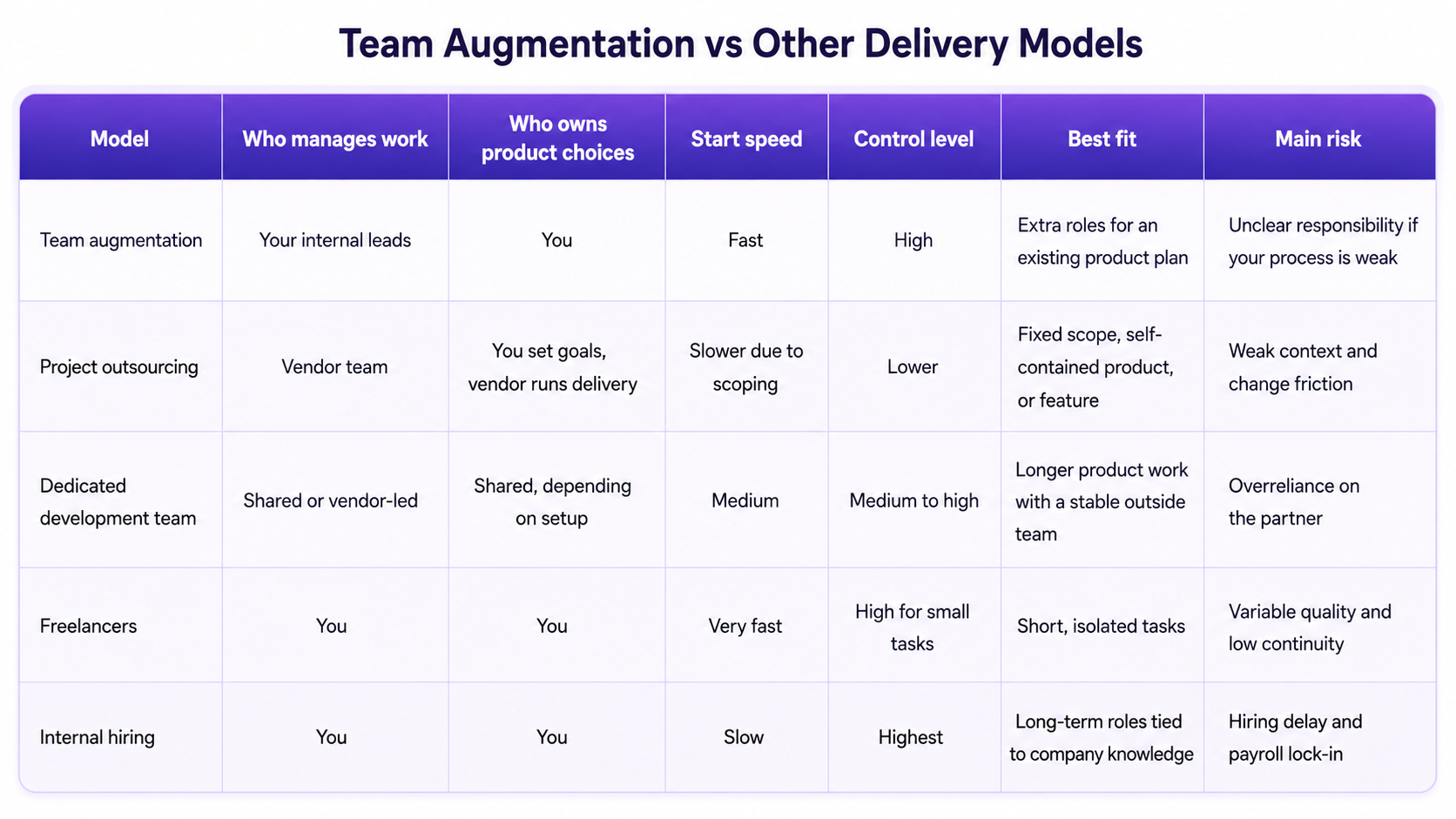
Use this test. If you want to keep daily control and already know what needs to be built, team augmentation is usually a good fit. If you want a partner to run the whole build, outsourcing or a dedicated team may fit better.
When team augmentation works best
Team augmentation works best when your company already has some product and technical leadership. You do not need a large engineering department, but someone must own priorities, architecture, and review.
Strong fit cases include:
- You have a clear product plan and need more developers for the same backlog.
- Your internal team owns backend architecture but needs mobile or frontend help.
- You need specialist skills for AI, LLMs, cloud, DevOps, React Native, or Python.
- You want to keep product and architecture ownership inside the company.
- You need to scale delivery for a defined period, such as a launch window or funding stage.
- Your product spans web, mobile, backend, cloud, or AI work.
A quick scenario: a SaaS company has a strong backend team but no React Native skill. It adds two mobile developers through team augmentation to build a companion iOS and Android app. The internal team keeps backend ownership, API choices, and product calls. The external mobile engineers join planning, use the same repository rules, and work through code review with the internal lead.
That is the model at its best: added capacity without losing control.
When team augmentation is not the right model
Team augmentation can fail when the client expects external developers to create order where no internal order exists.
It may not work when:
- There is no product owner.
- There is no technical lead.
- Requirements change daily with no decision path.
- Nobody can review code.
- The client expects developers to fix business strategy.
- Communication is slow or unclear.
- Access to repositories, test data, docs, or environments is blocked.
- Security rules are vague.
In those cases, a different model may be safer. You may need product discovery, end-to-end software development, a managed team, CTO advisory plus development, or a technical audit before adding people.
Team augmentation extends a working system. It does not repair a broken operating model by itself.
What roles can you add through team augmentation?
Companies can add one role, several roles, or a small delivery pod. Common roles include:
- Frontend developers for React, Next.js, TypeScript, and design system work.
- Backend developers for Node.js, Python, APIs, databases, and system design.
- Full-stack developers who can move across frontend and backend tasks.
- Mobile developers for React Native, iOS, and Android.
- AI and LLM engineers for agents, retrieval, model tool use, and evaluation.
- Cloud engineers for AWS, Google Cloud, serverless, containers, and CI/CD.
- DevOps engineers for release flow, observability, and infrastructure as code.
- QA engineers for test plans, automation, regression checks, and release support.
- Product designers for UX flows, prototypes, and product screens.
- Technical leads for architecture help, review, and mentoring.
The right setup depends on the gap. A company with strong leadership may only need two developers. A founder-led startup may need a mixed pod with engineering, design, QA, and technical lead support.
How AI-assisted development changed team augmentation
AI coding tools changed expectations around speed. They can help with boilerplate, test drafts, refactors, documentation, and first-pass code. Some agentic development tools can now help create pull requests, search codebases, and work through multi-step engineering tasks, but their output still needs human review, testing, and security checks before it reaches production.
Speed alone is not enough.
The 2025 DORA research frames AI as a force that magnifies existing strengths and weaknesses. Strong teams can get more from AI because they already have clean code paths, good review habits, clear goals, and trusted tooling. Weak teams may get more noise, more rework, and more code to check.
That changes what buyers should expect from augmented teams. You do not only need someone who can prompt a coding tool. You need engineers who know when not to accept AI output, how to test it, how to review security impact, and how to keep the codebase understandable.
Agentic development raises the bar for engineering discipline. Faster code generation only helps if the team can also review, test, secure, and maintain the code.
A strong augmented team should combine AI-assisted delivery with senior human supervision, architecture judgment, code review, testing, and product thinking.
How to run an augmented team well
Team augmentation works when external engineers are treated as part of the delivery system, not as a separate queue for leftover tickets.
Set the basics early:
- Give access to repositories, docs, test data, and issue tracking before work starts.
- Share coding standards, branch rules, naming patterns, and review expectations.
- Define who owns product calls, architecture calls, and release approval.
- Set a daily or weekly communication rhythm.
- Write a Definition of Done for each type of task.
- Agree how code review, tests, QA, and security checks happen.
- Make documentation part of the work, not a cleanup task later.
- Start with a controlled first scope before adding more people.
A simple workflow helps:
- Define the business goal.
- Define the roles needed.
- Select the partner.
- Bring engineers into tools, docs, and repositories.
- Set communication rules.
- Start with a controlled first scope.
- Review code quality and delivery pace.
- Add more people only if the model works.
The first scope matters. Pick something real, bounded, and easy to review. Avoid using the first month for the hardest architectural change in the product.
Cost factors and pricing models
Team augmentation cost depends on more than an hourly rate. The main cost factors are:
- Seniority and role type.
- Region and time-zone overlap.
- Skill set, such as AI, cloud, mobile, or backend work.
- Contract length.
- Team size.
- Urgency.
- Product context needed.
- Management layer.
- Security, access, or compliance needs.
Common pricing models include hourly billing, monthly retainer, dedicated developer, dedicated team, or a mixed model.
The lowest rate can cost more when it creates review load, rework, churn, or missed context. A senior engineer who needs less supervision may be cheaper than a low-rate developer who takes time from your best internal people every day.
Cost should be judged against delivery risk, code quality, time-zone fit, and how much help your internal team must provide.
Risks of team augmentation and how to reduce them
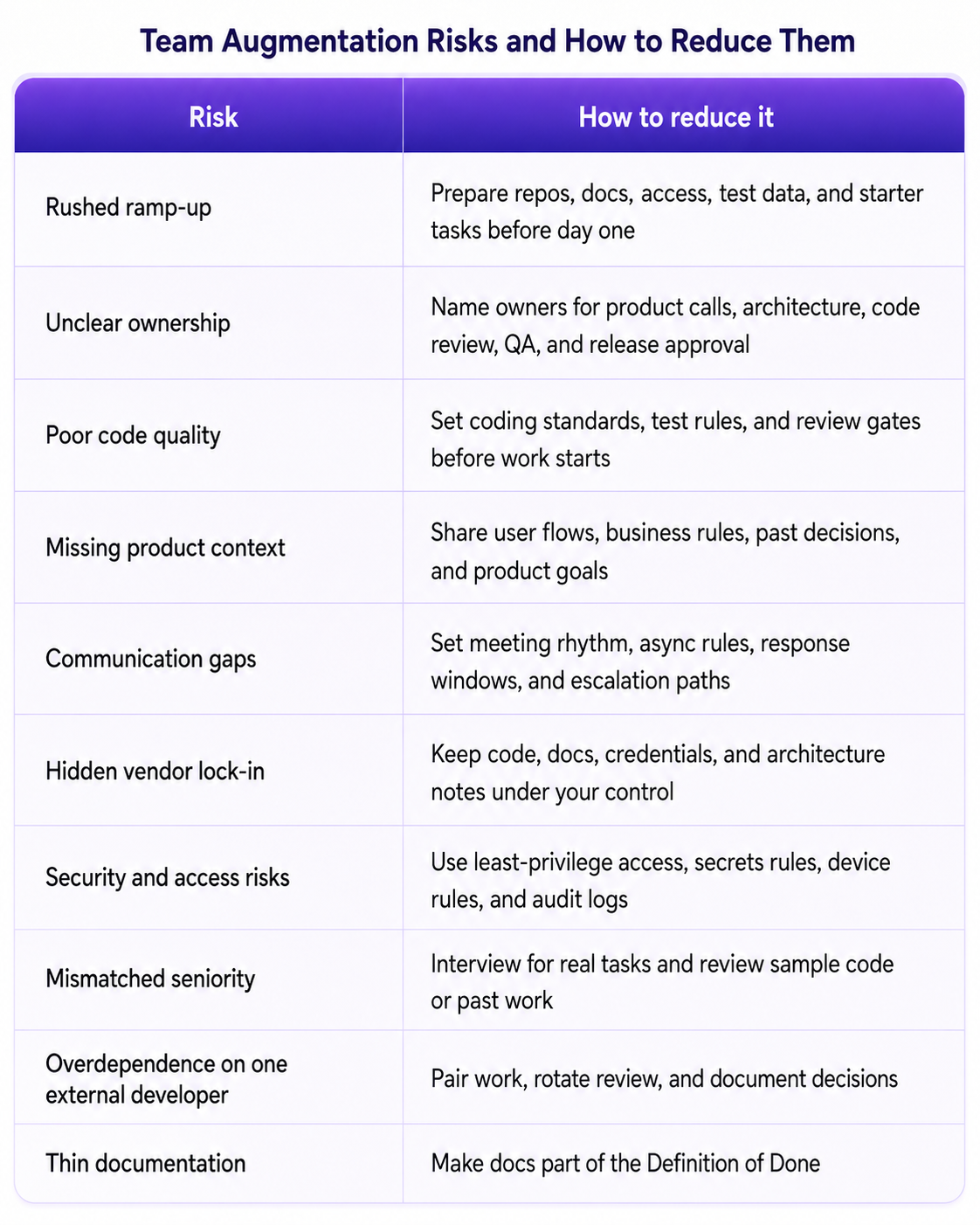
The biggest risk is not the external team. It is unclear ownership. When everyone assumes someone else owns a decision, delivery slows and quality drops.
How to choose a software development team augmentation partner
A good partner should make your internal team stronger, not busier.
Use this checklist during vendor calls:
- Do they have recent work in your tech stack?
- Can they join your tools, workflow, and communication habits?
- Do they have senior people who review work and coach developers?
- How do they handle code review, testing, and release support?
- Can they explain tradeoffs in plain language?
- Do they understand product context, not only tickets?
- How do they use AI coding tools, and how is output checked?
- What security rules do they follow for devices, secrets, and access?
- Can they provide web, mobile, backend, cloud, and AI roles if your needs change?
- Do they have references or case studies?
- Can you start with a first delivery phase before expanding?
Ask about failure cases too. A mature partner can explain when team augmentation is not the right choice.
Where Lexogrine fits
Lexogrine supports companies that need software development team augmentation and end-to-end product delivery. The fit is strongest when you need extra engineering capacity but still want product thinking, architecture help, and senior technical review.
Lexogrine can extend existing teams with developers across React development, React Native development, Node.js development, AWS and Google Cloud Platform development, and AI Agents Development.
That support can be narrow, such as adding a mobile developer to an existing team. It can also grow into broader product work, such as web apps, mobile apps, internal tools, admin panels, cloud backends, or AI systems.
The main point is control. A good partner should fit your workflow, help you move faster, and leave your team with clearer code and better product knowledge.
Final checklist before you use team augmentation
Before you contact vendors, answer these questions:
- Do we know what we need to ship?
- Which skills are missing?
- Who owns product calls?
- Who reviews code?
- How will external engineers access documentation?
- What should improve after 30, 60, and 90 days?
- Which risks need control from day one?
If you cannot answer these questions, fix that first. If you can answer them, team augmentation can be a practical way to add capacity without changing your whole engineering setup.
Next steps
If your internal team needs more delivery capacity, Lexogrine can help you add experienced engineers without giving up product control. We support teams across web, mobile, backend, cloud, and AI development, from focused team augmentation to full product delivery.