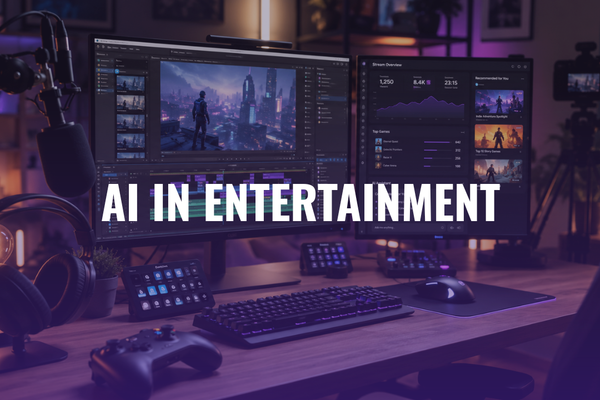
What is AI in entertainment?
AI in entertainment means using machine learning, generative models, recommendation systems, search, automation, and AI agents to create, classify, deliver, moderate, and personalize media experiences. It includes customer-facing systems, such as recommendations, search, virtual characters, and player support, as well as internal workflows, such as editing support, localization, asset tagging, trailer testing, and production analytics.
In plain English, AI helps entertainment companies decide what to show, what to create, how to translate it, how to moderate it, and how to learn from audience behavior.
It can support:
- Streaming recommendations and personalized homepages
- Search and catalog discovery
- AI-generated images, video, music, voice, and scripts
- Game NPC behavior, procedural assets, and player support
- Editing, VFX, post-production, and media asset management
- Subtitles, dubbing, translation, and localization
- Content moderation and brand safety
- Audience analytics, churn signals, and marketing tests
- AI agents that assist internal production and operations teams
AI does not solve creative strategy, rights ownership, user trust, product-market fit, or production rules by itself. Entertainment companies still need humans to decide what should be made, what can be used legally, what the audience should see, and when AI output needs review.
Disclosure: We are not affiliated with the vendors, platforms, or companies mentioned in this article, unless explicitly stated.
Trademarks and references: Product, platform, and company names may be trademarks of their respective owners. References are for identification and informational purposes only and do not imply endorsement, sponsorship, or partnership.
Why AI matters to entertainment companies in 2026
AI matters because entertainment companies now compete in a market where content volume, audience fragmentation, and production pressure keep rising.
Deloitte’s 2026 Digital Media Trends survey reports that the average U.S. consumer spends about six hours per day on media and entertainment activities. The same survey reports high paid streaming adoption, frequent SVOD churn, and growing competition from social content and creators. PwC projects global entertainment and media revenue to reach $3.5 trillion by 2029, with video games forecast to grow from $224 billion in 2024 to nearly $300 billion in 2029.
Here is why that matters.
Entertainment companies no longer compete only with direct peers. A streaming service competes with gaming, short-form video, podcasts, music, live events, creator channels, and social feeds. A game studio competes for attention not only against other games, but also against TikTok, YouTube, Netflix, Discord, Twitch, and mobile apps. A music platform competes through discovery, playlisting, social sharing, artist tools, and voice-driven assistants.
AI changes the cost and speed of many workflows. It can classify media, tag scenes, find clips, draft variations, recommend titles, support players, translate scripts, test thumbnails, and help teams compare audience segments. It can also flood the market with low-cost synthetic content, which raises the bar for taste, rights control, brand safety, and product quality.
Technical teams should treat AI as product infrastructure, not as a creative add-on. A one-off prompt tool may help an editor draft ideas, but a real entertainment product needs event tracking, catalog metadata, model routing, rights checks, human review, logs, dashboards, fallback paths, and cost control.
The companies that benefit most will not be the ones that “add AI” to every screen. They will be the ones that connect AI to clear product goals: better discovery, faster production, safer moderation, richer game worlds, stronger localization, and more useful internal tools.
Main use cases of AI in entertainment
AI in entertainment works best when each use case has a clear job, known data inputs, a product location, and a review path. Let’s break it down.
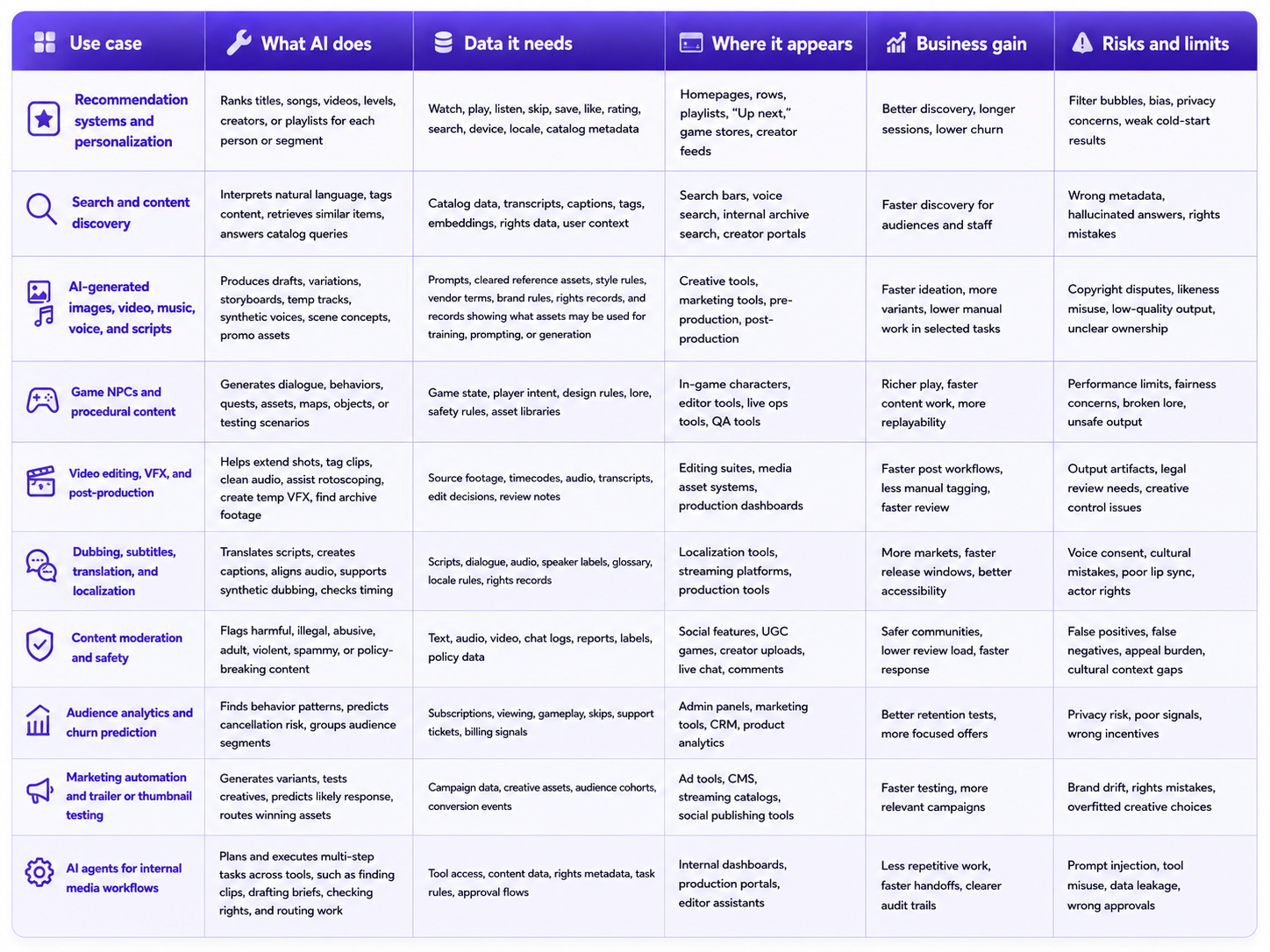
The pattern is clear: AI creates the most business benefit when it connects with product data, rights data, workflow rules, and human approval. It creates the most risk when it acts as an uncontrolled generator.
AI in streaming platforms
AI in streaming supports recommendations, personalized homepages, search, thumbnail selection, watch-time prediction, churn signals, localization, catalog tagging, and metadata enrichment.
A streaming platform usually depends on four inputs:
- User behavior events, such as starts, stops, skips, rewatches, saves, likes, dislikes, search terms, and device context
- Catalog metadata, such as genre, cast, rating, language, release year, duration, topics, tone, and rights windows
- Experiment data, such as which rows, thumbnails, trailers, and search results perform better for each segment
- Product rules, such as age ratings, regional rights, editorial priorities, brand safety, and subscription tier rules
Recommendations are not just model scores. They are product decisions. A model may predict that a viewer is likely to click a certain title, but the platform still has to decide whether to show that title now, whether to promote diversity in the row, whether the content is available in the viewer’s country, whether the rating is suitable, and whether editorial teams want to promote a new release.
Netflix has published technical work on personalized recommendation models and artwork personalization. YouTube says its recommendation system uses signals such as watch behavior, likes, dislikes, subscriptions, direct user feedback, satisfaction surveys, and quality signals, while also applying responsibility-focused controls around recommendations. Google Cloud’s media search and recommendations docs also show that media recommendation systems need user events and media metadata.
Streaming AI is also moving beyond rows. It can support natural-language catalog search, trailer discovery, subtitle and dubbing workflows, scene tagging, and internal archive search. Reuters reported in March 2026 that Canal+ signed multi-year agreements with Google Cloud and OpenAI to support AI-driven production workflows, content library indexing, recommendations, and natural-language search. This should be treated as a reported company example, not as evidence that every streaming platform should adopt the same vendor architecture.
The privacy concern is real. Streaming platforms collect sensitive behavior signals: what people watch, when they stop, what they search for, what they watch with children, and what they replay. Teams should collect only what they need, keep retention rules clear, and give users meaningful controls where possible.
AI in gaming
AI in gaming supports NPC behavior, procedural content, player support agents, anti-cheat tools, moderation, live operations, matchmaking, playtesting, balancing, and designer tools.
Game AI differs from streaming AI because it often needs to respond inside a live interactive system. A recommendation can take a moment to compute before a homepage loads. An NPC action, combat response, dialogue turn, moderation flag, or matchmaking decision may need to fit within strict response-time and performance budgets.
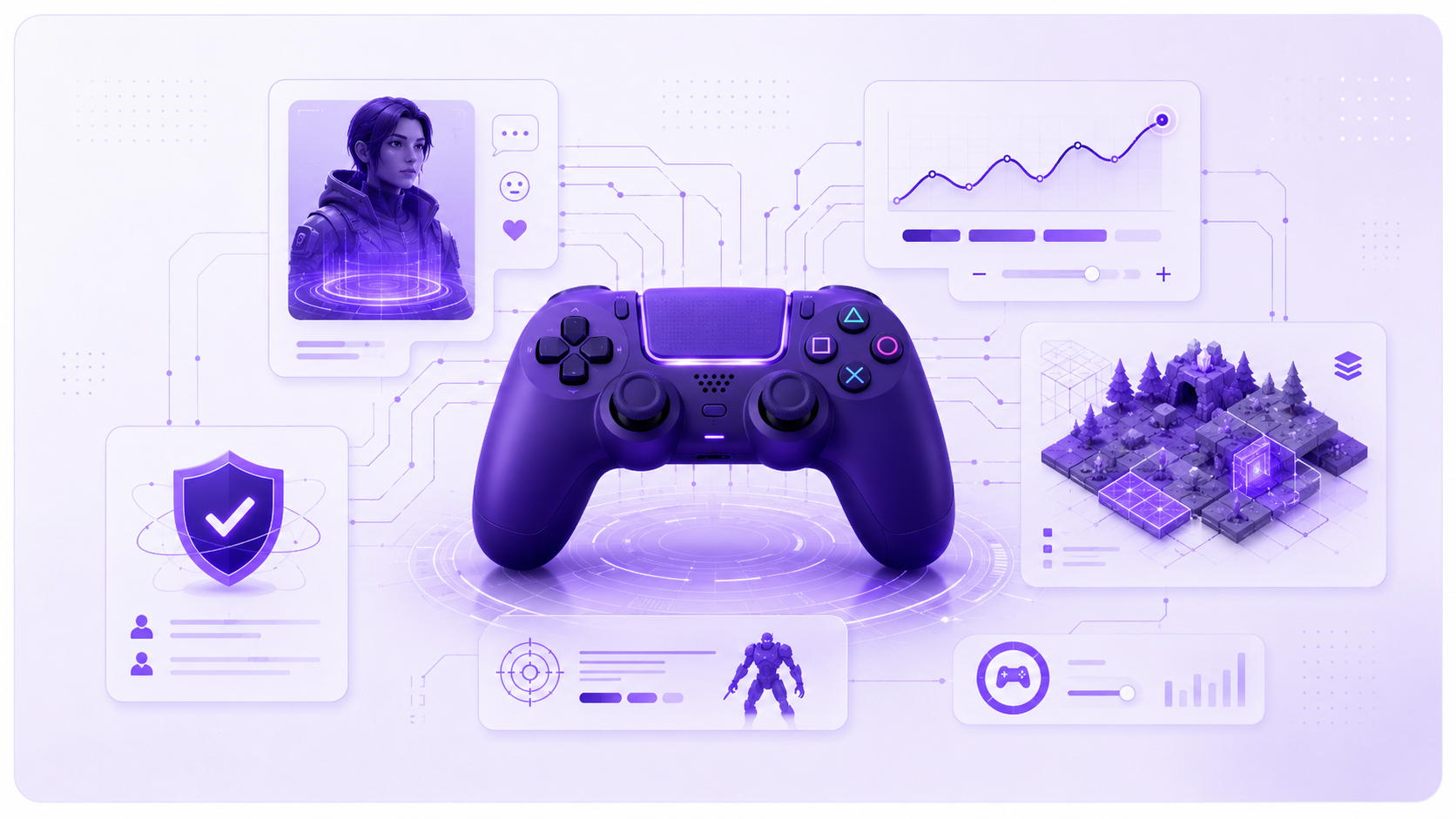
Current examples show several paths:
- NVIDIA ACE focuses on conversational and autonomous game characters, with speech, intelligence, and animation components that can run in the cloud or on device.
- Roblox is building generative 3D and 4D creation systems through its Cube foundation model, including tools for generating 3D objects and interactive objects.
- Unity is adding AI assistants, model access, permissions, and tagging for AI-generated assets inside game creation workflows.
- McKinsey notes that game companies are testing AI in software engineering, testing, debugging, asset creation, animation, background generation, and scenario design.
The value is not limited to “smarter enemies.” AI can help a live game team detect toxic chat, find balance issues, triage support tickets, create draft quests, test map collisions, summarize player reports, or generate localized item descriptions.
A practical esports example is Scout AI by LHM.gg, an AI observer for Counter-Strike 2 broadcasts. Instead of treating AI as a player-facing mechanic, Scout AI supports the production layer around the game. It analyzes the match, automatically chooses the best point of view for the action, shows cinematic camera moments, and can provide round and match predictions for viewers. Scout AI is a system trained and fine-tuned on thousands of games to capture exciting moments without human input.
This is an important distinction for entertainment teams. In gaming, AI does not have to generate quests, dialogue, or art to create value. It can also help production teams, tournament organizers, observers, and broadcasters turn raw gameplay into a better live viewing experience. For esports, that may mean automated observing, replay support, dynamic HUDs, predictive overlays, cinematic camera paths, and faster broadcast workflows. Scout AI shows how AI can sit between the game engine, live match data, broadcast tools, and the audience experience, reducing manual production work while keeping the final broadcast focused on what viewers actually care about: the key moments of the match.
Generated content still needs review. A generated quest can break lore. A generated weapon skin can look too close to protected artwork. A support bot can give wrong account advice. A moderation model can punish the wrong player. A matchmaking model can harm fairness if it serves monetization goals too aggressively.
Player trust matters most when AI affects fairness, spending, moderation, or identity. If AI changes ranking, matchmaking, loot, bans, or prices, players need guardrails, appeals, and clear rules.
AI in film, TV, video, and post-production
AI supports film, TV, and video teams across pre-production, production, post-production, localization, and archive work.
In pre-production, AI can help with research, script analysis, shot planning, visual references, storyboards, budget drafts, and schedule support. In production, it can help teams plan coverage, organize notes, and search reference material. In post, it can assist editing, VFX, rotoscoping, cleanup, color support, sound work, synthetic voice tests, subtitles, dubbing, metadata extraction, and archive search.
McKinsey’s 2026 film and TV research maps AI across development, pre-production, storyboarding, script breakdowns, casting and rehearsal planning, physical production, post-production, image generation, audio-visual sync, editing, logging, tagging, sound, music, subtitles, and dubbing.
Adobe’s Generative Extend in Premiere shows a practical post-production use case: editors can extend the beginning or end of short video and audio clips, with generated sections labeled in the timeline. Microsoft and Google media tools show another common pattern: indexing video and audio to extract searchable insights, transcripts, objects, people, scenes, and metadata.
Production teams need strong review rules because entertainment assets carry legal and creative constraints. A film company needs to know whether a generated voice uses a performer’s approved likeness, whether a reference image can be used, whether an AI output enters final delivery, and whether the source asset belongs to the production. Netflix’s partner guidance for productions made for Netflix asks production partners to share intended GenAI use with their Netflix contact and states that written approval is required before proceeding when the output includes final deliverables, talent likeness, personal data, or third-party intellectual property.
AI can reduce manual work in selected production tasks, but it cannot replace taste, direction, legal clearance, or creative accountability. The safest pattern is to use AI for drafts, options, search, tagging, and repetitive work, then keep final choices under human control.
Teams should also check the terms of each AI tool before commercial use, because output ownership, training rights, indemnities, confidentiality, and restrictions on likeness or third-party IP can differ significantly between vendors.
AI in music and audio entertainment
AI in music and audio supports recommendation, playlist personalization, audio mastering, sound design, voice generation, synthetic vocals, music tagging, rights detection, creator tools, and listener assistants.
Spotify’s AI Playlist lets listeners create playlists from prompts and refine them with follow-up text. Spotify’s DJ combines personalized music selection with commentary and supports voice or text requests in many markets. YouTube’s Dream Track and AI Music Experiments show how text prompts can create soundtracks or assist artists with melody, instrumentation, and style tests.
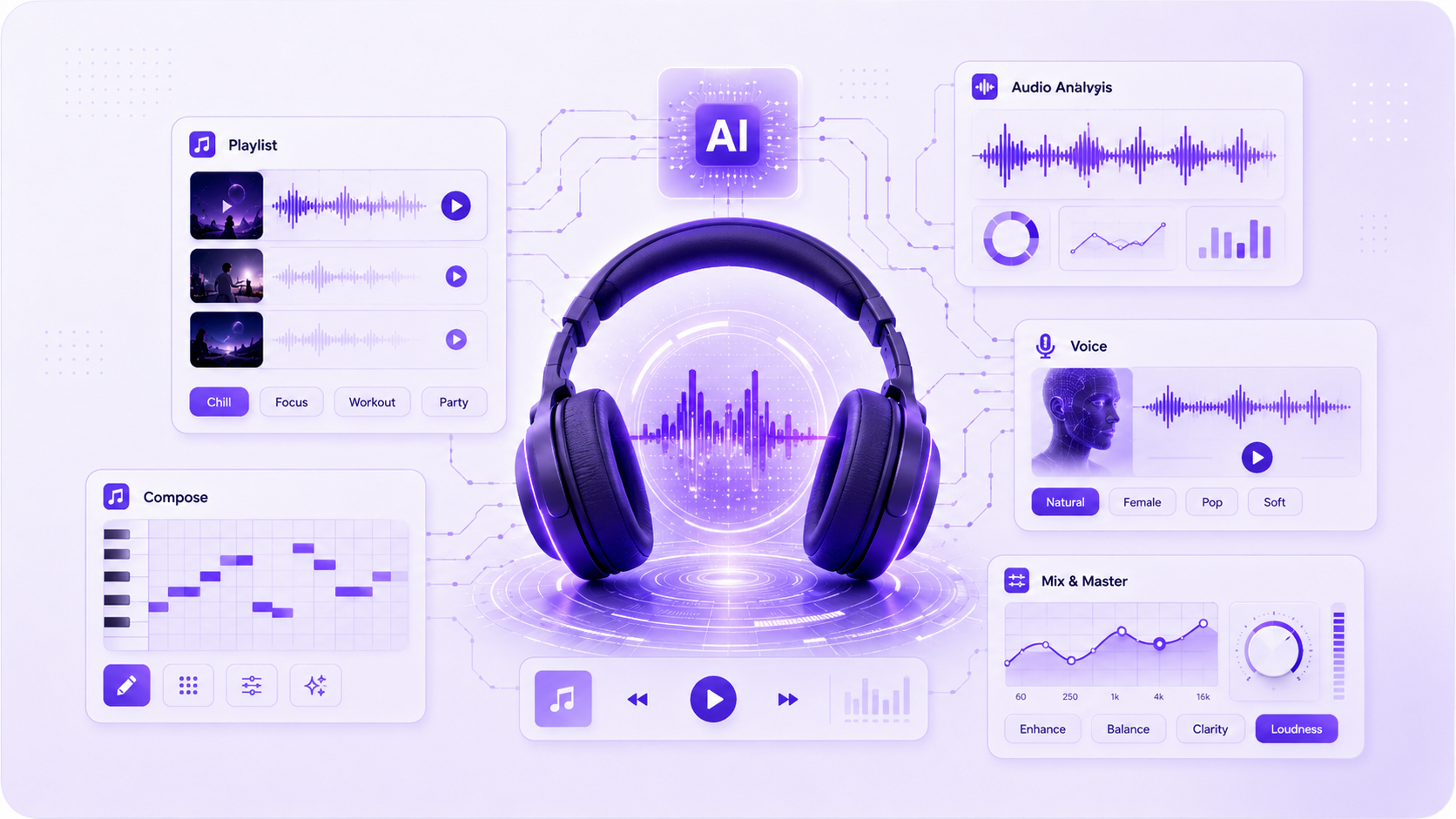
AI music also has sharper rights questions than many text workflows. A synthetic vocal can sound like a living artist. A generated song can imitate a style too closely. A model may have been trained on recordings without clear permission. Platforms also need to prevent spammy AI music from crowding catalogs and distorting royalties.
These risks are not limited to copyright. Depending on the jurisdiction and contract, synthetic vocals and voice clones may also raise rights of publicity, performer consent, unfair competition, consumer protection, platform policy, and collective bargaining issues.
Parts of the music sector are moving toward licensed and rights-aware AI systems. For example, Universal Music Group announced agreements with Udio and Stability AI focused on licensed AI music creation, authorized training data, attribution, artist compensation, and controls such as fingerprinting and filtering. These deals show one possible direction for commercial AI music products, but they do not remove the need for case-by-case rights review.
For product teams, the lesson is direct. Music AI needs more than a generation endpoint. It needs catalog rights, artist consent, voice and likeness records, output labels, content ID checks, takedown flows, and audit logs.
Reference architecture for AI entertainment products
This architecture is a reasoned pattern based on common media AI systems and official provider docs. It is not a claim that every company uses every layer.
A modern AI entertainment system often connects:
- Frontend apps: web app, mobile app, player, game client, creator tool, or internal portal
- Backend services: identity, catalog, subscriptions, entitlements, billing, game state, support, and notifications
- Content management system: titles, episodes, clips, levels, songs, metadata, translations, tags, thumbnails, trailers, and campaign assets
- Data collection: watch events, listen events, play events, search events, skips, saves, ratings, reports, support tickets, and moderation actions
- Search and vector indexes: semantic search over titles, transcripts, captions, assets, docs, lore, support content, and archive material
- Recommendation or ranking layer: models that rank titles, songs, videos, creators, quests, products, or help content
- Generative model layer: text, image, video, audio, voice, code, or 3D generation services
- AI agent orchestration layer: agents that plan tasks, call tools, retrieve data, draft outputs, and route work for approval
- Moderation and safety layer: policy checks, harmful content detection, age checks, brand rules, abuse detection, and appeal support
- Rights and consent layer: ownership, licensing, territory, release window, voice rights, likeness consent, talent approvals, and training-use rules
- Human review tools: approval queues, comparison views, comments, version history, and escalation paths
- Analytics and experimentation: tests, quality scores, cost tracking, session metrics, conversion, retention, and human review outcomes
- Cloud infrastructure: storage, queues, model endpoints, compute, databases, observability, secrets, and deployment controls
- Admin panel: model settings, prompts, policy rules, logs, approvals, content status, vendor usage, and incident review
A simplified flow may look like this:
Viewer, player, or creator action
→ event service records the signal
→ catalog metadata, rights data, and context are loaded
→ search, ranking, generation, or agent layer returns an output
→ policy layer checks safety, age, region, rights, and consent
→ human review runs when the risk level requires it
→ product shows a row, clip, quest, answer, subtitle, tag, or draft
→ analytics records outcome, cost, errors, and review decisions
This flow matters because entertainment AI is rarely a single model call. It is a product system. A recommendation needs catalog and event data. A generated trailer needs source assets, rights, brand rules, and review. A player support agent needs account context, knowledge retrieval, policy controls, and a safe handoff to a human.
Data requirements for AI in entertainment
AI systems in entertainment depend on data quality. More data does not always mean better systems. Better structure, cleaner consent records, and clearer labels often matter more.
Entertainment teams may need:
- User behavior data: views, plays, listens, skips, likes, saves, searches, reports, session history, device type, and locale
- Content metadata: title, genre, cast, crew, mood, themes, ratings, tags, release date, duration, language, and formats
- Transcripts and captions: dialogue, speaker labels, timecodes, subtitles, translations, and accessibility assets
- Asset libraries: raw footage, stills, thumbnails, trailers, stems, sound effects, music, 3D assets, levels, skins, and archive files
- Rights and licensing metadata: territory, release windows, ownership, performer consent, voice rights, training permissions, and reuse limits
- Moderation labels: harmful content flags, abuse labels, appeals, reviewer decisions, policy versions, and confidence levels
- Feedback signals: ratings, likes, dislikes, saves, session completion, purchase behavior, playlist edits, and support outcomes
- Performance data: response time, model cost, failure rates, generation time, queue depth, and device constraints
- Production workflow data: tasks, approvals, notes, versions, edit status, localization status, and delivery dates
Teams should avoid collecting personal data without a clear need. Consent, retention, and deletion rules matter because entertainment behavior can reveal sensitive interests, family habits, location patterns, and minors’ media use.
Rights metadata deserves special attention. If a system cannot tell whether a clip, voice, song, actor likeness, or training asset can be used, it should not generate final content from it.
Benefits and tradeoffs
AI can create real business gains in entertainment, but each gain comes with a tradeoff.
Benefits include:
- Better personalization: viewers, listeners, and players find content faster when ranking systems use behavior, metadata, and product rules.
- Faster content workflows: teams can draft, tag, translate, search, and compare assets with less manual effort.
- Lower manual review burden in selected tasks: moderation and asset tagging can route routine cases faster, while humans handle edge cases.
- Stronger discovery: semantic search and recommendations help large catalogs feel less overwhelming.
- Better localization: AI can speed captions, translation, timing, and dubbing drafts across markets.
- Richer game and app experiences: AI can support responsive characters, player help, procedural content, and live operations.
- Faster experimentation: teams can test thumbnails, promos, rows, trailers, quests, and onboarding flows with more variants.
- More useful internal tools: agents can help teams find assets, summarize feedback, prepare briefs, and manage handoffs.
Tradeoffs include:
- Copyright and licensing risk: generated output may raise questions about training data, ownership, or similarity to protected works.
- Synthetic likeness and voice concerns: actors, musicians, and creators may require explicit consent and compensation.
- Moderation errors: AI can miss harmful content or flag harmless content.
- Biased recommendations: ranking systems can over-promote familiar content and bury niche or diverse voices.
- Stale or low-quality training data: models can repeat old patterns or misclassify new formats.
- Model cost: video, voice, and real-time game systems can become expensive at scale.
- Vendor lock-in: teams may depend on a provider’s models, tools, pricing, and policy terms.
- Review burden: AI can generate more drafts than teams can approve.
- User trust issues: people may reject AI content if labeling, consent, or quality feels unclear.
- Unclear ownership: final rights to generated assets can vary by tool, contract, jurisdiction, and human authorship.
The balanced view is simple. AI can speed selected work and improve selected product flows. It cannot remove the need for rights checks, creative judgment, product controls, and human accountability.
Security, privacy, copyright, and governance concerns
Entertainment AI systems deal with sensitive data, protected works, paid subscriptions, minors, creators, performers, and brands. Teams should decide the rules before launch, not after a public incident.
The main concerns include:
- Personal data risk: watch history, listening history, gameplay behavior, search terms, and support tickets may reveal sensitive patterns.
- Consent and likeness rights: synthetic voice, face, body, and performance replicas need clear permission and usage scope.
- Copyright ownership and AI-generated output: In the United States, the U.S. Copyright Office has stated that generative AI outputs may be copyrightable only where a human author determines sufficient expressive elements. Mere prompting is not enough, although human-authored elements, creative arrangement, or meaningful modification may support protection. This is a U.S.-specific position and does not settle all questions about training data, licensing, infringement, or other jurisdictions.
- Retention and deletion: teams must know how long they keep events, prompts, generated outputs, logs, and review records.
- Multi-tenant separation: platforms serving many clients must keep content, prompts, assets, and analytics separated.
- Prompt injection: AI agents can be tricked by malicious text inside transcripts, chat, metadata, or uploaded files.
- Unsafe generated content: image, video, voice, and text systems can create harmful, adult, violent, defamatory, or brand-breaking material.
- Hallucinated metadata: AI can invent tags, cast names, rights claims, summaries, or age guidance.
- Incorrect moderation: automated systems can punish the wrong creator, player, or viewer.
- Audit and review needs: teams need logs, approvals, reviewers, appeals, and version history.
- Brand safety: generated promos, thumbnails, voiceovers, or music can conflict with brand rules or partner contracts.
The EU AI Act creates transparency duties for certain providers and deployers of AI systems, with Article 50 rules due to apply from 2 August 2026. These rules include informing people when they are directly interacting with an AI system, marking certain AI-generated or manipulated content in a machine-readable format, and disclosing deepfakes or certain AI-generated public-interest text, subject to specific exceptions and role-based obligations. Entertainment teams operating in or targeting the EU should review whether they act as a provider, deployer, or both for each AI feature.
The U.S. Copyright Office continues to examine AI copyrightability, digital replicas, training data, licensing, and liability. Labor concerns are active as well, especially where AI affects performers’ voices, likenesses, movements, or union-covered work. SAG-AFTRA’s 2023 TV, theatrical, and streaming agreement added digital replica terms and AI protections for covered work, while Reuters reported in 2025 that video game voice and motion-capture performers ratified a new contract with consent and disclosure requirements for AI digital replica use. These examples are important signals, but they apply within specific contractual and jurisdictional contexts rather than as universal legal rules.
Before launch, entertainment companies should answer:
- What data can the system use?
- What content can AI generate?
- Which outputs require human review?
- How can users report mistakes?
- How are generated assets labeled?
- What logs are kept?
- How are rights and consent tracked?
- Which models and vendors are approved?
- Who can change prompts, policies, and tool access?
- What happens when the model fails or the vendor is unavailable?
Legal review triggers for entertainment AI
Teams should involve legal review before launch when an AI workflow:
- uses a performer’s voice, face, body, likeness, or performance style;
- uses copyrighted music, scripts, footage, artwork, game assets, or third-party IP as inputs or references;
- generates final commercial assets, not only internal drafts;
- affects minors, age ratings, sensitive content, or user safety;
- makes automated moderation, ranking, pricing, ban, or eligibility decisions;
- uses personal data, watch history, listening history, gameplay behavior, biometric data, or support tickets;
- publishes AI-generated or AI-manipulated content to users;
- relies on vendors whose terms allow training, retention, or reuse of customer inputs or outputs;
- operates in the EU, UK, U.S., or other markets with specific AI, privacy, copyright, consumer protection, or labor rules.
Legal and accuracy note: This article is for general informational purposes only and does not constitute legal, regulatory, privacy, security, copyright, or procurement advice. AI-generated and AI-assisted entertainment workflows may involve copyright, likeness, voice, performer consent, privacy, platform policy, labor, and AI transparency obligations. Rules vary by jurisdiction, contract, platform, and use case, and vendor features, pricing, policies, and legal requirements may change over time. Teams should verify current details with official sources and qualified advisors before making product, legal, or procurement decisions.
Buy, adapt, or build: which path fits?
Not every AI need requires a custom system. Some teams should buy tools. Some should adapt APIs and cloud services. Some should build custom software around their own data, rights, and product rules.
Buy off-the-shelf tools when
Use ready-made tools when the task is common, low-risk, and not central to your product edge.
Good fit:
- Drafting internal copy
- Creating early concept images
- Transcribing meetings
- Translating rough drafts
- Extending short edit gaps
- Tagging small asset sets
- Summarizing production notes
Watch out for vendor terms, training permissions, output ownership, and whether the tool can work with your rights rules.
For entertainment use cases, off-the-shelf tools should not be treated as legally safe by default. Before using outputs in public or commercial materials, teams should confirm confidentiality, data retention, training use, output rights, indemnity, watermarking, takedown, and likeness restrictions.
Adapt existing AI services when
Use model APIs or cloud media services when you need AI inside a product or workflow, but the model itself is not your unique advantage.
Good fit:
- Catalog search
- Media recommendations
- Video indexing
- Transcription
- Translation
- Moderation
- Metadata extraction
- Player support
- Creator support
- Internal archive search
This path often needs custom backend work, CMS or DAM connections, admin screens, logging, cost controls, and review queues.
Build a custom AI system when
Build custom software when AI is part of the product’s identity, revenue model, rights system, or user-facing logic.
Good fit:
- Proprietary recommendation layer
- Rights-aware generative media workflow
- Custom game NPC behavior tied to game state
- AI agent for production operations across internal tools
- Multi-market localization platform
- Creator marketplace with moderation and approval
- AI assistant for editors, producers, or live ops teams
- Entertainment app with mobile and web AI modules
Custom build makes sense when you need control over data ownership, workflow, response time, moderation, cost, audit logs, and user-facing behavior.
Custom software does not remove legal risk by itself. It gives the team more control over data flows, review steps, logs, permissions, rights metadata, and vendor boundaries, which can make compliance and auditability easier when the system is designed correctly.
When an AI agent makes sense
An AI agent makes sense when the task has multiple steps, uses several systems, and requires decisions along the way.
Good fit:
- “Find clips from episode 4 that include a specific actor, check whether the clip is cleared for Germany, draft three promo captions, and send the assets to an editor.”
- “Review player support tickets, retrieve account data, suggest a response, and escalate cases involving bans or payments.”
- “Scan a new creator upload, generate tags, check policy risk, prepare a review summary, and route it to moderation.”
A plain automation or search tool is better when the task follows fixed rules, needs exact outputs, or does not require reasoning.
30-minute AI fit checklist
Use this checklist before funding a build:
- Is the task frequent enough to matter?
- Can the output be judged clearly?
- Do you own or license the data needed?
- Are rights, consent, and privacy rules clear?
- Can mistakes be caught before they reach users?
- Does the system need human review?
- Is there a safe fallback when AI fails?
- Can you estimate cost per session, render, or task?
- Does the feature improve the product in a way competitors cannot copy easily?
- Do you need admin tools, logs, approvals, and alerts?
- Will the system connect to CMS, DAM, CRM, analytics, or backend services?
- Do web and mobile apps need the same AI behavior?
Minimal mental model
Consider a streaming platform that wants better discovery.
A viewer opens the app and watches eight minutes of a science fiction trailer. The viewer saves one title, skips a comedy row, turns on Polish subtitles, and searches for “slow mystery series set in space.”
The product records those events through an event service. The backend links them to a pseudonymous viewer profile, the catalog system loads metadata, and the rights service checks which titles are available in the viewer’s region. A search and ranking layer compares the query with titles, transcripts, tags, and embeddings. A recommendation model returns a ranked list.
Before anything appears on the homepage, a policy layer removes titles outside the viewer’s subscription tier, age setting, and region. If a generated row label or promo copy is used, the content goes through safety checks and may require editor approval. The app then shows a row such as “Slow-burn space mysteries,” with titles the viewer can actually watch.
After the viewer clicks, saves, or ignores the row, analytics records the outcome. Product teams can compare quality, cost, watch starts, saves, and complaints. The system improves only when the loop is measured.
That is the real shape of AI in entertainment: action, signal, model, policy, review, product output, measurement.
How entertainment teams should start with AI
Start narrow. AI programs fail when teams begin with a broad mandate such as “add AI to the platform.” They work better when a team selects one high-value workflow and defines the data, rules, and review path.
A practical phased approach:
- Pick one narrow use case
Choose a task with clear business value, such as catalog search, subtitle drafting, player support triage, asset tagging, churn signals, or internal archive search. - Define the data needed
List events, metadata, transcripts, rights records, prompts, assets, and review labels required for the first version. - Check rights, consent, and privacy rules
Confirm which assets, voices, likenesses, logs, and user signals can be used. - Choose buy, adapt, or build
Use the lowest-risk path that meets the product need. Do not build a custom model when an API plus custom workflow is enough. - Design review and fallback flows
Decide when output goes directly to users, when staff review is required, and what happens when AI fails. - Build a prototype
Connect the model to real data and product rules. Do not judge the idea only through prompt demos. - Test with real users or internal teams
Measure usefulness, trust, mistakes, speed, and review workload. - Measure quality, cost, and risk
Track model cost, review time, rejected outputs, complaints, wrong answers, and product outcomes. - Prepare production monitoring
Watch response time, cost spikes, vendor failures, abuse, drift, and safety incidents. - Expand only after the system proves useful
Add more markets, formats, users, or teams after the first workflow works reliably.
Next steps: treat AI like a product system. Define the job, wire it to real data, protect rights, add review, measure results, and expand only when the benefit is proven.
Partner with Lexogrine
Lexogrine is an AI agent development company and software development partner for entertainment teams that need custom AI systems, not just prompts or isolated model calls. We build AI agents, recommendation workflows, generative AI systems, internal automation, web platforms, mobile apps, admin panels, and cloud infrastructure for media, gaming, streaming, and creator products.
With React, React Native, Node.js, AWS, and Google Cloud, Lexogrine can deliver end-to-end entertainment software, including AI user modules, internal tools, production dashboards, customer portals, and mobile experiences.
We can also help teams design AI workflows with practical safeguards such as human review, rights metadata, audit logs, role-based access, monitoring, and fallback paths.