Latest Trends in Software Development: What to Watch in 2026
Software development in 2026 is changing fastest around AI-assisted engineering, business agents, internal platforms, production telemetry, and secure delivery.
AI now affects coding, testing, documentation, code review, customer support workflows, and internal business tools. Yet AI is not the whole story. Architecture, cloud choices, security, data access, mobile delivery, and maintainability still decide whether a product becomes easier or harder to run after launch.
The strongest teams will not chase every new tool. They will choose trends based on workflow gain, risk, operating cost, team fit, and product stage.
For CTOs, founders, and product teams, the main question is “Which trend changes how we build, release, secure, and maintain our software?”
What counts as a real software development trend?
A real software development trend changes how teams plan, build, test, release, or run production systems.
A trend matters when it meets at least one of these conditions:
- Engineering teams use it in real projects.
- It affects delivery speed, cost, quality, or maintainability.
- Major platforms, open-source projects, or developer ecosystems support it.
- It changes architecture, cloud, security, mobile, or data decisions.
- It applies to business software, not only demos.
This article focuses on trends that affect real product choices: web apps, mobile apps, SaaS platforms, internal tools, AI agents, customer portals, cloud backends, and enterprise systems.
Some trends are already mature. AI-assisted coding, managed cloud services, cross-platform mobile, and production observability fit this group. Some trends are growing fast but still need discipline, such as business AI agents and platform engineering. Others, such as broad agent autonomy, need more evidence before most companies should rely on them for sensitive work.
Trend 1: AI-assisted development moves from autocomplete to engineering workflows
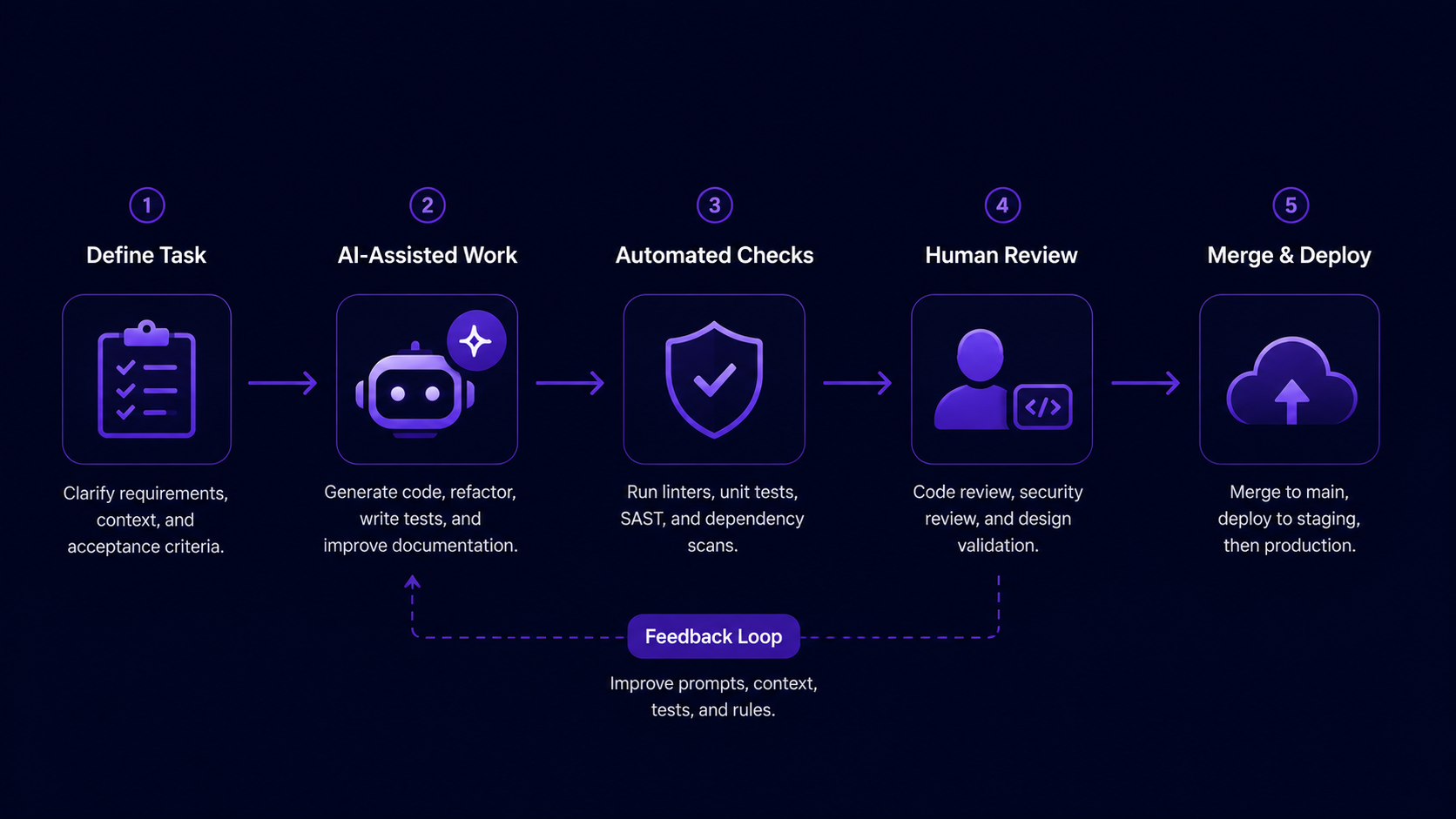
AI-assisted development has moved beyond autocomplete. Modern tools can inspect repositories, suggest multi-file edits, draft tests, explain code, generate documentation, help with migrations, and support pull-request review.
GitHub, Stack Overflow, JetBrains, DORA, and Thoughtworks all point to the same pattern: developers use AI more often, but trust remains limited. That is the right tension. AI can speed up bounded engineering tasks, but it can also create plausible code that hides security, logic, performance, or maintainability problems.
AI helps most when the task is clear. It works well for repetitive code, unit tests, refactoring support, migration drafts, API wrappers, documentation, and debugging suggestions. It performs worse when the task depends on unclear product rules, weak tests, hidden business logic, or security-sensitive flows.
What this means for teams:
- Treat AI output like code from a junior developer with fast typing.
- Keep human review for architecture, security, data rules, and product behavior.
- Use tests, static checks, dependency scanning, and code review before merging.
- Keep changes small enough to inspect.
- Measure review time, rework, defects, and release flow, not only generated lines of code.
The practical move is to approve clear AI use cases inside the engineering process. Do not let every developer invent their own risk model. Define which tasks AI can support, which checks are required, and which work always needs senior review.
Trend 2: AI agents become part of business software
AI agents are becoming part of business systems, not only standalone chatbots.
An AI agent combines a model, tools, memory or state, rules, data retrieval, and a loop that can take several steps toward a goal. In a business product, this may mean reading a customer record, checking documentation, drafting a message, calling an API, asking for approval, and updating a system.
This is where companies often outgrow generic chat. A chatbot can answer questions. A custom agent can act inside a business workflow, with the right permissions and guardrails.
Common business cases include:
- A support agent that checks helpdesk tickets, CRM records, and product documentation before drafting a reply.
- An operations agent that detects exceptions and prepares the next action for a human reviewer.
- A sales assistant that reads CRM context, drafts follow-ups, and updates deal notes after approval.
- A healthcare assistant that retrieves only records allowed for the logged-in person.
- A real estate assistant that matches property data, lead context, and communication history.
The risk is clear. An agent connected to real tools can make real mistakes. That risk grows when it can send messages, change data, trigger payments, delete records, or access private documents.
What this means for teams:
- Start with one bounded workflow.
- Use read-only or draft mode before write access.
- Add approval steps for sensitive actions.
- Log data sources, model outputs, tool calls, and human decisions.
- Set permissions per user, not only per app.
- Test the agent against failure cases, not only happy paths.
The best first agent is not the most impressive one. It is the workflow with frequent demand, clear inputs, limited actions, and a measurable result.
Trend 3: Platform engineering and internal developer platforms mature
Platform engineering helps growing software teams avoid repeated setup work.
A platform team creates shared paths for environments, deployments, service templates, secrets, telemetry, access control, and infrastructure. Some companies call these “golden paths.” The goal is to make common engineering work repeatable without forcing every product team to rebuild the same delivery setup.
This differs from classic DevOps. DevOps describes shared responsibility between software and operations. Platform engineering turns shared delivery capability into an internal product that other teams consume.
Platform engineering helps when teams lose time on repeated environment setup, unclear ownership, broken release scripts, inconsistent monitoring, duplicated infrastructure, or slow access requests.
It becomes overhead when the company is too small, the product has one stable stack, or the platform team builds a portal before solving real delivery friction.
What this means for teams:
- Start by naming the three delivery problems that slow teams every month.
- Create templates only for repeated needs.
- Document ownership and support paths.
- Keep self-service paths narrow at first.
- Measure environment setup time, failed releases, and support requests.
Platform engineering should start as a response to repeated friction. A portal is not the strategy. Faster, safer, repeatable delivery is the strategy.
Trend 4: Cloud-native development becomes more selective
Cloud-native development is mature, but teams are becoming more selective about how much infrastructure they own.
Kubernetes is widely used in production, especially by larger engineering groups. That does not mean every new product should start with Kubernetes. Many products can launch faster and cost less with managed databases, managed identity, managed queues, object storage, serverless functions, or managed container services.
The 2026 pattern is practical cloud choice rather than cloud complexity.
Use managed services when the platform can remove maintenance work your team should not own. Use serverless for short-running tasks, scheduled jobs, event processing, and uneven traffic. Use managed containers for long-running APIs and workers when you need more control than functions provide. Use Kubernetes when you have enough services, teams, workload needs, and operational skill to justify it.
Microservices deserve the same caution. They can help when teams need independent releases, separate scaling, or strong service boundaries. They also add distributed data, network failure, tracing, versioning, and release coordination.
What this means for teams:
- Do not start with Kubernetes only because it looks mature.
- Do not split services before domain boundaries are clear.
- Choose managed services when they cut maintenance.
- Track cloud spend from the first release.
- Review idle resources, logs, storage, data transfer, database tiers, and model calls.
For founders, the best cloud architecture is often the one the team can understand, secure, and run after launch.
Trend 5: Security becomes part of software delivery from day one
Security can no longer wait until the end of a project.
Modern software depends on open-source packages, cloud permissions, third-party APIs, CI/CD pipelines, containers, secrets, mobile stores, AI models, and business data. Each layer can introduce risk.
Secure delivery now starts during planning and architecture. It continues through coding, review, testing, release, monitoring, and maintenance.
Teams should cover:
- Threat modeling for users, admins, APIs, data, files, and third-party services.
- Least-privilege access for people, services, and agents.
- Managed secrets instead of hardcoded tokens.
- Dependency scanning and patch ownership.
- Container and build checks.
- Signed artifacts and build provenance where needed.
- Software bill of materials for regulated or enterprise contexts.
- Audit logs for sensitive actions.
- Backup and incident plans.
AI adds new risks. AI-generated code may miss authorization rules. Agents may expose private data through retrieval. Prompt injection may manipulate tool use. Over-permissioned agents may act beyond the user’s authority.
What this means for teams:
- Review AI-generated code with the same care as human code.
- Scan dependencies and secrets automatically.
- Test authorization, file upload, input handling, and business rules.
- Give agents only the tools and data each workflow needs.
- Add approval before high-risk agent actions.
Trend 6: Modular monoliths return as a serious architecture choice
Many teams are reconsidering microservices for early and mid-stage products.
A modular monolith is one deployable application divided into clear domain modules. It can preserve boundaries without forcing the team to run a distributed system from day one.
This approach often fits startups, SaaS products, portals, admin panels, internal tools, and products with one or a few teams. It keeps local development simpler, reduces network failure, and makes transactions easier to reason about.
Microservices still make sense when a product has separate teams, separate release cycles, different load patterns, stronger isolation needs, or clear domain boundaries. Serverless fits event jobs, scheduled tasks, and uneven traffic. Event-driven architecture fits async work across systems.
Architecture choice should follow product reality.
A modular monolith fits when:
- The product domain is still changing.
- One team owns most of the code.
- Releases happen as one product.
- The team needs fast changes and simpler debugging.
- Data consistency matters more than service independence.
Microservices fit when:
- Separate teams own separate domains.
- Services need independent release cycles.
- Some parts need different scaling or security boundaries.
- The company can support distributed tracing, versioning, queues, and incident response.
Serverless fits when:
- Workloads are event-based or scheduled.
- Traffic is uneven.
- The team wants less server management.
- Runtime limits do not block the use case.
Event-driven architecture fits when:
- Systems need async communication.
- Work can happen outside request-response flows.
- Events need replay or several consumers.
- Teams can handle eventual consistency and tracing.
The practical rule is simple: start with the least complex architecture that protects the next two years of product work.
Trend 7: Observability becomes a product quality requirement
Production visibility is now part of product quality.
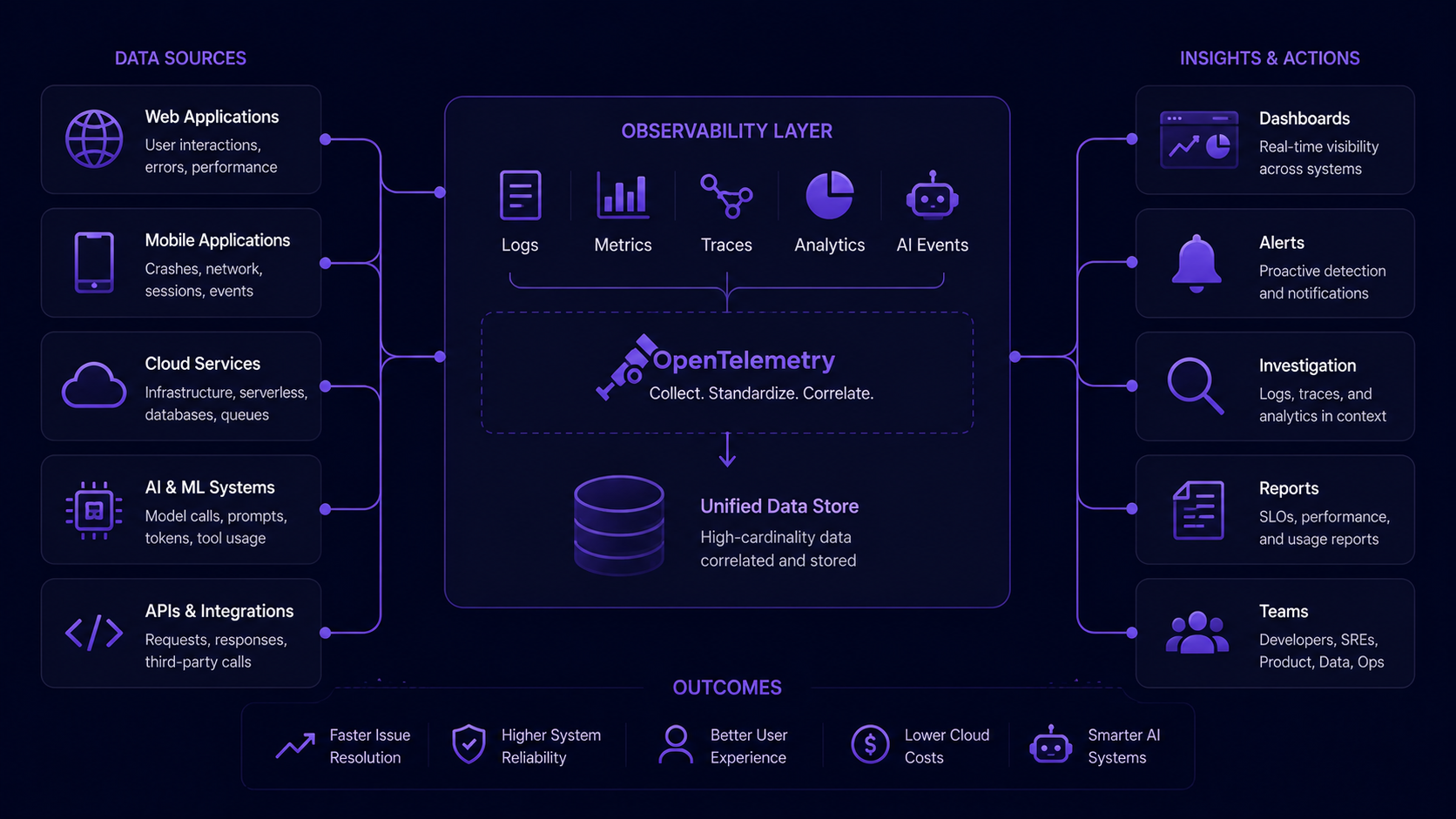
Logs, metrics, traces, error monitoring, product analytics, and AI system events help teams understand what happens after release. OpenTelemetry has become a standard path for collecting telemetry across systems and vendors.
Without observability, teams guess. With it, they can see where requests fail, which routes are slow, which app versions crash, which third-party calls break, and which AI agent steps produce errors.
Web apps should track request errors, slow routes, database calls, queue delays, and completion of major flows. Mobile apps should track crashes by version, OS and device problems, network errors, offline sync, and store release health. AI systems should track model calls, tool calls, retrieved sources, response time, token cost, rejected answers, approvals, and task completion.
What this means for teams:
- Add traces to one business flow first.
- Carry request IDs across services.
- Connect backend telemetry with product events.
- Set clear alert owners.
- Filter private data from logs.
- Review AI traces during prompt, retrieval, and tool changes.
For product teams, observability is not only an engineering concern. It helps decide whether people can complete the work the product was built to support.
Trend 8: Cross-platform mobile development stays relevant
Cross-platform mobile remains a strong option when a company needs iOS and Android without two fully separate native teams.
React Native and Flutter continue to receive active platform work. React Native is especially attractive when a company already works with React and TypeScript. Shared code can cover product logic, API access, state, design components, analytics, and tests.
React Native often fits:
- Startup apps.
- Customer portals.
- Internal mobile tools.
- Companion apps for SaaS products.
- Products that need both iOS and Android with one shared product team.
Cross-platform does not remove native work. Products that depend on advanced camera flows, audio, Bluetooth, background work, graphics, health data, or new OS features may still need Swift, Kotlin, or native modules.
Mobile release work also remains real work. Teams still need signing, store listings, privacy declarations, permissions, test devices, review notes, phased releases, crash monitoring, and update plans.
What this means for teams:
- List every device feature before choosing a framework.
- Test the hardest native requirement early.
- Keep native skills available.
- Plan App Store and Google Play work before launch.
- Track crash-free sessions and release health after every update.
Cross-platform mobile can reduce duplicated work, but it should not be treated as a shortcut around mobile product discipline.
Trend 9: Data architecture becomes central to AI products
AI product quality often depends less on the model alone and more on the data layer around it.
Retrieval-augmented generation, often called RAG, gives a model selected company context at request time. A production RAG system may include source connectors, document parsing, chunking, embeddings, search, metadata filters, reranking, source references, and access checks.
A vector database is only one piece. The hard work sits around it: source quality, permissions, freshness, audit records, evaluation sets, and failure handling.
Structured data may require exact filters and SQL. Documents may require hybrid keyword and vector search. Sensitive data requires permission-aware retrieval before text reaches the model.
A support assistant may need help center articles, contracts, tickets, CRM records, and product status. If it retrieves data without user-level permissions, it may answer with information the requester should not see.
What this means for teams:
- Map every source the AI system will use.
- Define owner, refresh method, and access rule for each source.
- Separate public, internal, customer-specific, and restricted data.
- Build evaluation sets with expected answers and forbidden disclosures.
- Store source references, prompt versions, model versions, and tool actions.
- Test stale, missing, conflicting, and private data cases.
AI architecture is now data architecture. The model matters, but the retrieval and permission layer often decides whether the product can be trusted.
Trend 10: Custom software teams focus more on product outcomes
Faster coding increases the cost of building the wrong thing.
A strong custom software process starts before development. It covers product discovery, technical feasibility, workflow design, architecture, data rules, release slicing, analytics, and maintenance. The goal is to define what should be built, how it should work, and how it will operate after launch.
This matters even more with AI. A team can now generate screens, code, and workflows faster than before. That speed helps only when the product direction is sound.
Strong teams ask:
- What user problem does this product solve?
- What work should the product remove or shorten?
- Which assumptions can fail?
- Which technical risks should be tested early?
- Which data, security, and cloud choices shape the product?
- What must be measured after release?
- Who owns maintenance after launch?
The best software partner is not only a coding vendor. It is a team that can translate business goals into product scope, architecture, delivery decisions, and production ownership.
Which trends matter most by company stage?
Different companies should care about different trends.
An early-stage startup should focus on AI-assisted engineering, managed cloud services, modular architecture, product analytics, and cross-platform delivery when mobile is needed. The goal is to learn fast without creating infrastructure work the team cannot support. This stage should avoid Kubernetes, broad microservice splits, and agent autonomy unless there is a clear reason.
A scaling startup should focus on platform templates, observability, security checks, selective service splits, and cloud cost control. At this stage, repeated delivery friction starts to cost real money. The team should avoid building a large internal platform before common delivery problems are clear.
A mid-market company should focus on custom AI agents, internal copilots, permission-aware retrieval, workflow automation, and connections with existing systems. The goal is to reduce manual work in support, operations, sales, finance, or domain-specific teams. This stage should avoid generic chatbots that cannot access the right systems safely.
An enterprise team should focus on platform engineering, software supply chain security, OpenTelemetry, access control, audit records, and agent guardrails. The challenge is not only speed. It is safe reuse across teams. Enterprises should avoid unapproved AI tools, duplicated internal platforms, and agents with broad write access.
A non-technical founder building a first product should focus on discovery, a simple architecture, managed cloud services, web or cross-platform mobile delivery, and a clear post-launch support plan. This stage should avoid trend-led scope, unclear ownership, and custom infrastructure that the founder cannot maintain.
What these trends mean for companies planning custom software
Do not adopt a trend because it sounds modern. Start with the product goal, the workflow, the people involved, and the cost of a wrong decision.
Use AI where it changes the workflow, not only the interface. A chat box with no safe access to business data adds little. A bounded agent with the right tools, permissions, approvals, and audit records can remove real work.
Choose architecture based on team size, growth plans, data boundaries, recovery needs, and operating skill. A modular monolith may beat microservices for the first release. Managed cloud services may beat owning infrastructure. Kubernetes may pay off later, but only when the product and team justify it.
Validate risky parts early. Test agent permissions, native mobile features, data retrieval, third-party APIs, and load behavior before the full build depends on them.
Build for change after launch. Clear modules, tests, telemetry, ownership, and documented operating tasks make later releases safer and faster.
Partnering with Lexogrine
Lexogrine is a custom software development company that builds end-to-end web applications, mobile applications, AI agent systems, SaaS platforms, internal tools, admin panels, customer portals, and cloud backends. Our teams work with React, React Native, Node.js, AWS, and Google Cloud Platform, from product discovery and architecture through launch and ongoing development.