What Is a Software Framework? How to Choose the Right Framework for Your Web Application
What is a software framework?
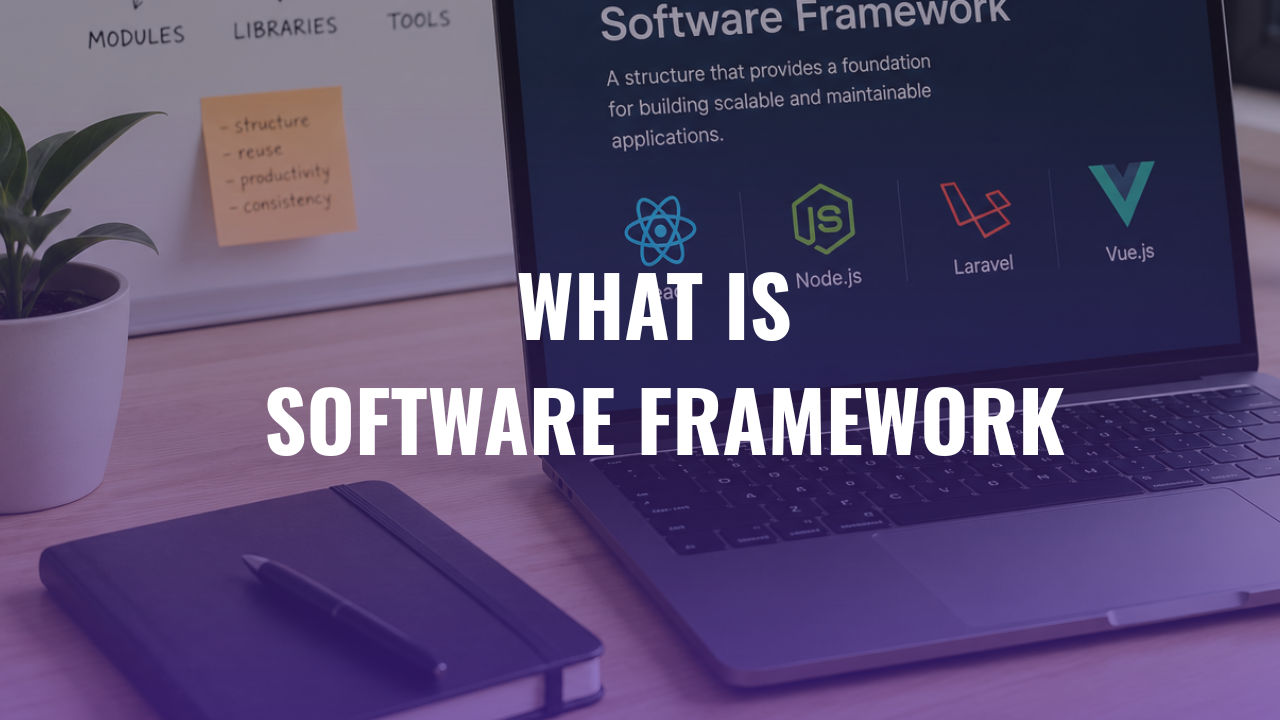
A software framework is a reusable structure for building applications. It supplies conventions, components, tooling, and development patterns, then guides where application code belongs and when that code runs.
A web framework gives developers a prepared way to handle common application concerns such as routing, rendering, data access, forms, authentication, validation, testing, and deployment. Not every framework covers all of these areas, and some teams still need separate libraries, services, or platform tools.
A framework is separate from a programming language. JavaScript, Python, Java, C#, PHP, and Ruby are languages. Next.js, Django, Spring Boot, Laravel, and Ruby on Rails use languages to shape how an application gets built.
A shared structure helps a team ship sooner and makes later changes easier to understand.
Software framework vs library vs platform vs SDK
These terms overlap in everyday conversation, but they describe different parts of a software stack.
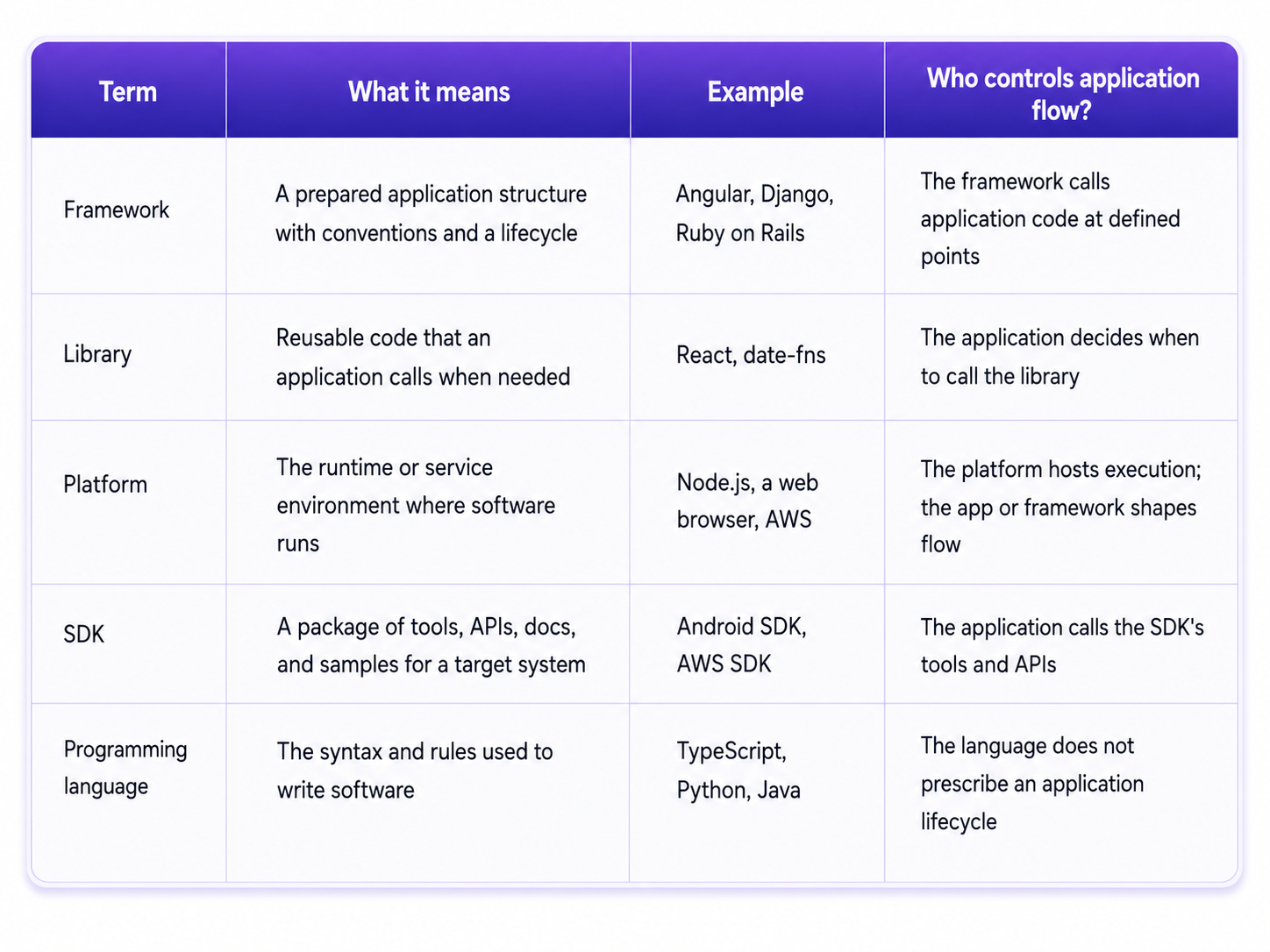
The control-flow distinction is a useful test, not a rigid law.
Is React a framework or a library?
React describes itself as a library for web and native UIs. It handles components and rendering, but it does not prescribe a complete application structure for routing, server rendering, data loading, or deployment.
Teams still compare React with Angular, Vue, and Svelte because all of them influence the front-end architecture. In a production web application, React often sits inside Next.js or React Router framework mode, which add more of the application structure.
Node.js needs the same clarification. It is a JavaScript runtime, while Express and NestJS are server frameworks that run on Node.js.
Why frameworks matter in web application development
Framework choice shapes delivery speed, labor cost, hiring, handover, security work, hosting, and the pace of change after launch.
Here is why. A good fit supplies established answers for repeated work. New engineers can read familiar conventions rather than decode a custom system.
Frameworks can supply controls for request validation, cross-site request forgery, sessions, and output escaping. Those controls help, but teams still need threat modeling, access rules, dependency updates, secure configuration, logging, and testing.
A browser-only front end, a server-rendered app, an API, and a serverless app have different runtime needs. A framework may narrow hosting, process, caching, and observability choices.
Developer surveys and ecosystem reports are useful signals for hiring, onboarding, package availability, and long-term maintainability. For example, self-reported developer surveys show continued use of technologies such as React, Node.js, Next.js, Express, and Vue, while GitHub reported in Octoverse 2025 that TypeScript became the most-used language on GitHub in August 2025. Treat those signals as ecosystem indicators, not as proof that one framework is the right choice for every product.
The wrong framework rarely breaks a product on day one. It becomes expensive later through slow changes, hiring friction, fragile boundaries, awkward hosting, and a poor match with what the product must become.
Main types of software frameworks used in web applications
Frontend frameworks and UI libraries
React focuses on components. Angular supplies routing, forms, dependency injection, and command-line tooling. Vue supports gradual adoption. Svelte compiles components, while SvelteKit adds routing, data loading, server rendering, and deployment adapters.
These choices govern screens, interaction, state, navigation, rendering, and component reuse.
Full-stack and meta-frameworks
Next.js extends React with routing, server and client rendering, data access patterns, and build tooling. Nuxt plays a similar role for Vue. SvelteKit does so for Svelte. React Router framework mode carries the current Remix-style model for routing, loading, actions, and rendering.
Ruby on Rails and Laravel take a server-first full-stack approach. They combine routing, database access, templates, authentication patterns, background work, and command-line tooling in one system.
Backend frameworks
Express offers a small, flexible layer for Node.js servers. NestJS adds modules, dependency injection, decorators, and a stronger application structure.
Django combines Python routing, templates, an ORM, authentication, forms, and an admin site. FastAPI focuses on typed APIs, validation, OpenAPI output, and asynchronous request handling. Spring Boot serves Java teams that want standalone applications plus operational features. ASP.NET Core serves C# and .NET teams building web apps, APIs, real-time services, and identity-aware systems.
Mobile and cross-platform frameworks
React Native lets React teams build native mobile apps. Flutter targets mobile, web, and desktop from one Dart codebase.
Shared technology can reduce duplicated learning, but navigation, device APIs, accessibility, releases, and screen behavior still differ by platform.
How frontend framework choice affects your product
A front-end choice changes rendering, search visibility, state handling, and how much structure the team must define.
Ask:
- Do public pages need server rendering or static generation for search visibility?
- Does the product need a large design system, dense state, live updates, or offline behavior?
- Does the team want one prescribed structure or room to choose tools?
- Can the hiring pool support the stack for several years?
React plus Next.js fits teams that want React's component model with routing, server rendering, static output, and server functions in one project. The tradeoff is simple. The stack can cover many product shapes, but teams must make clear choices about caching, server versus client code, and hosting.
Angular suits teams that prefer one broad client framework with established patterns for forms, routing, dependency injection, and testing. It often fits large product groups or internal systems where consistency matters more than a small learning curve.
Vue plus Nuxt offers a gradual path from focused UI work to a server-rendered application. It can suit lean teams that want readable component syntax and more guidance than a standalone UI library.
Svelte plus SvelteKit can suit teams that value a compact component model and want routing, rendering, and adapters in one stack. Check the available hiring pool, third-party packages, and team familiarity before committing.
How backend framework choice affects your product
The server framework governs API design, authentication, authorization, database access, background jobs, admin screens, third-party system connections, real-time communication, testing, and operational visibility.
Node.js with Express or NestJS: Choose Express when a small service needs freedom and the team can define its own structure. Choose NestJS when a TypeScript team needs modules, dependency injection, testing patterns, and clearer boundaries across a larger server application.
Python with Django or FastAPI: Django fits workflow-heavy products that benefit from an ORM, authentication, forms, and an admin site. FastAPI fits typed API services, asynchronous work, and teams already using Python for data or machine learning.
Ruby on Rails: Rails works well for database-backed products with accounts, permissions, forms, payments, and background jobs. Its conventions can shorten the path to a working release when the team knows Ruby.
PHP with Laravel: Laravel suits business applications that need routing, authentication, queues, database access, and a broad PHP hiring pool. It also works well when an organization already operates PHP systems.
Java with Spring Boot: Spring Boot fits Java teams, long-lived services, and organizations with established JVM operations. Its ecosystem supports large service estates, security modules, metrics, and external configuration.
C# with ASP.NET Core: This choice fits .NET teams building APIs, portals, real-time applications, or identity-heavy products. Built-in dependency injection and close ties to the .NET tooling chain can reduce custom setup.
Match the framework to the server's hardest job. An admin product, high-throughput API, event service, and machine-learning gateway need different structures.
Full-stack frameworks: when one framework should own more of the product
A full-stack framework can speed delivery because routing, rendering, data loading, forms, and server code share one project model.
The cost appears when the product outgrows that model. Tight coupling may make independent deployments, multiple clients, specialized services, or a host change harder. Define likely boundaries before the first release.
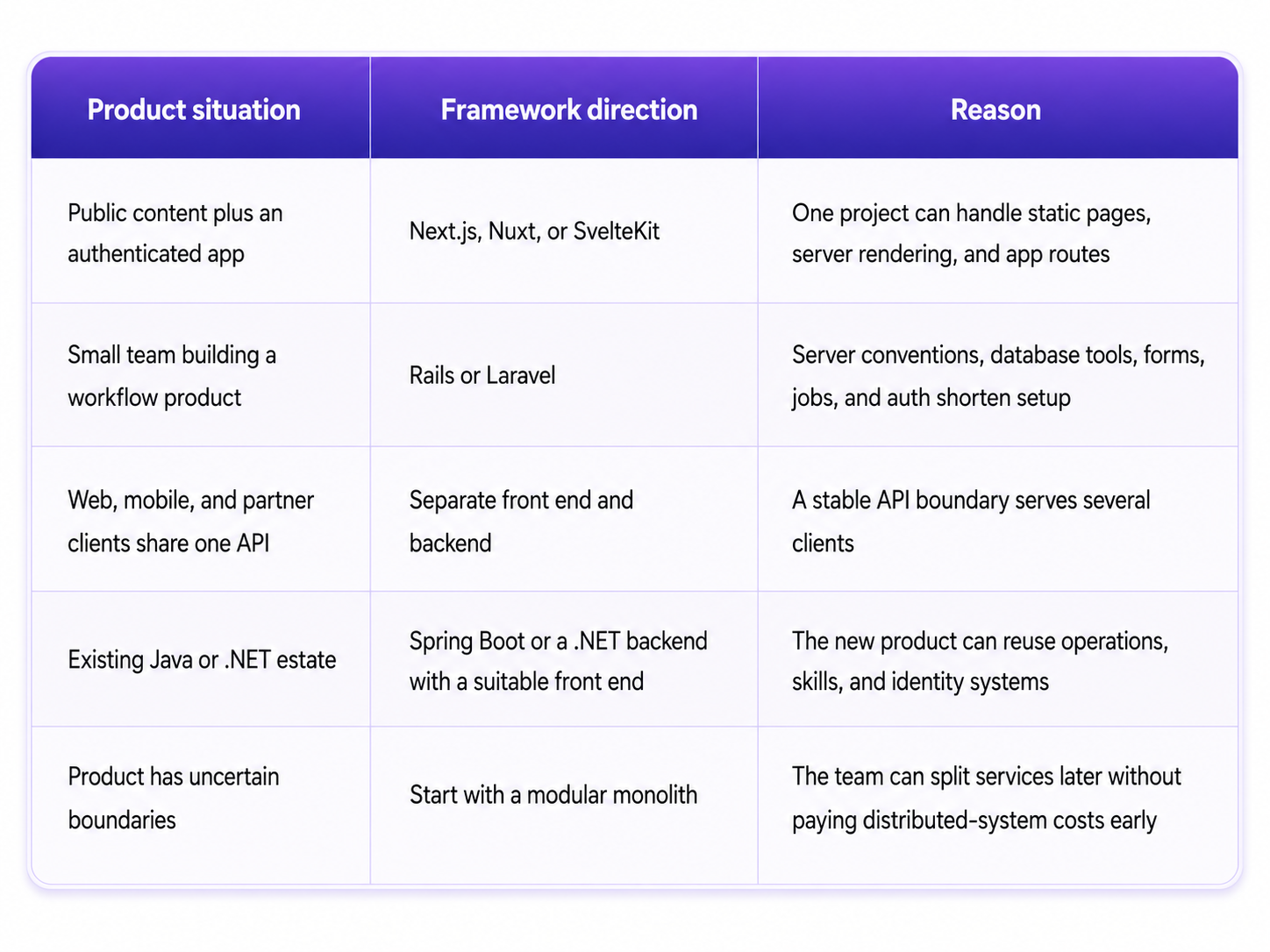
How to choose the right framework for your web application
Start with product constraints, not with a framework name. The right choice depends on what the application must do, who will build it, how it will be deployed, and how the product is likely to change over the next few years.
Begin by defining the product shape. A public content-heavy website, SaaS platform, marketplace, customer portal, internal business tool, API service, and AI-enabled application all place different demands on the stack. For example, a search-led product may need server rendering or static output, while an internal dashboard may care more about authentication, data tables, permissions, and operational reliability.
Next, look at the delivery plan. The framework should help the team reach the first useful release within the available budget and timeline. A technically attractive stack may still be the wrong choice if it requires unfamiliar infrastructure, too much custom setup, or a long onboarding period before the team can move quickly.
The people side matters just as much. Ask whether the current team already knows the framework, whether new engineers can be hired for it, and whether future maintainers will understand the project after the original developers move on. A smaller ecosystem can still be a good choice, but only if the hiring and maintenance plan is realistic.
You should also check how the framework fits existing systems. Identity providers, databases, CRM tools, payment providers, analytics platforms, internal APIs, and cloud infrastructure can all influence the decision. A framework that works well in isolation may become expensive if it does not fit the organization’s current environment.
For the front end, focus on rendering, search visibility, accessibility, state management, design systems, real-time behavior, browser performance, and mobile plans. For the backend, focus on API design, permissions, data access, background jobs, admin workflows, events, testing, logging, and observability.
Security and compliance should be treated as selection criteria, not as later implementation details. Products that handle regulated data, payments, healthcare data, financial records, children’s data, or sensitive personal information should be reviewed against legal, privacy, security, and compliance requirements before implementation begins.
Before committing to a framework, test the strongest option with one real workflow. Build a small working slice that includes login, data access, validation, one background task, logging, and deployment. This will reveal practical tradeoffs much faster than a theoretical comparison.
The best framework is not the one with the highest popularity score. It is the one that fits the product, the team, the operating model, and the expected direction of the business.
Framework choice by product scenario
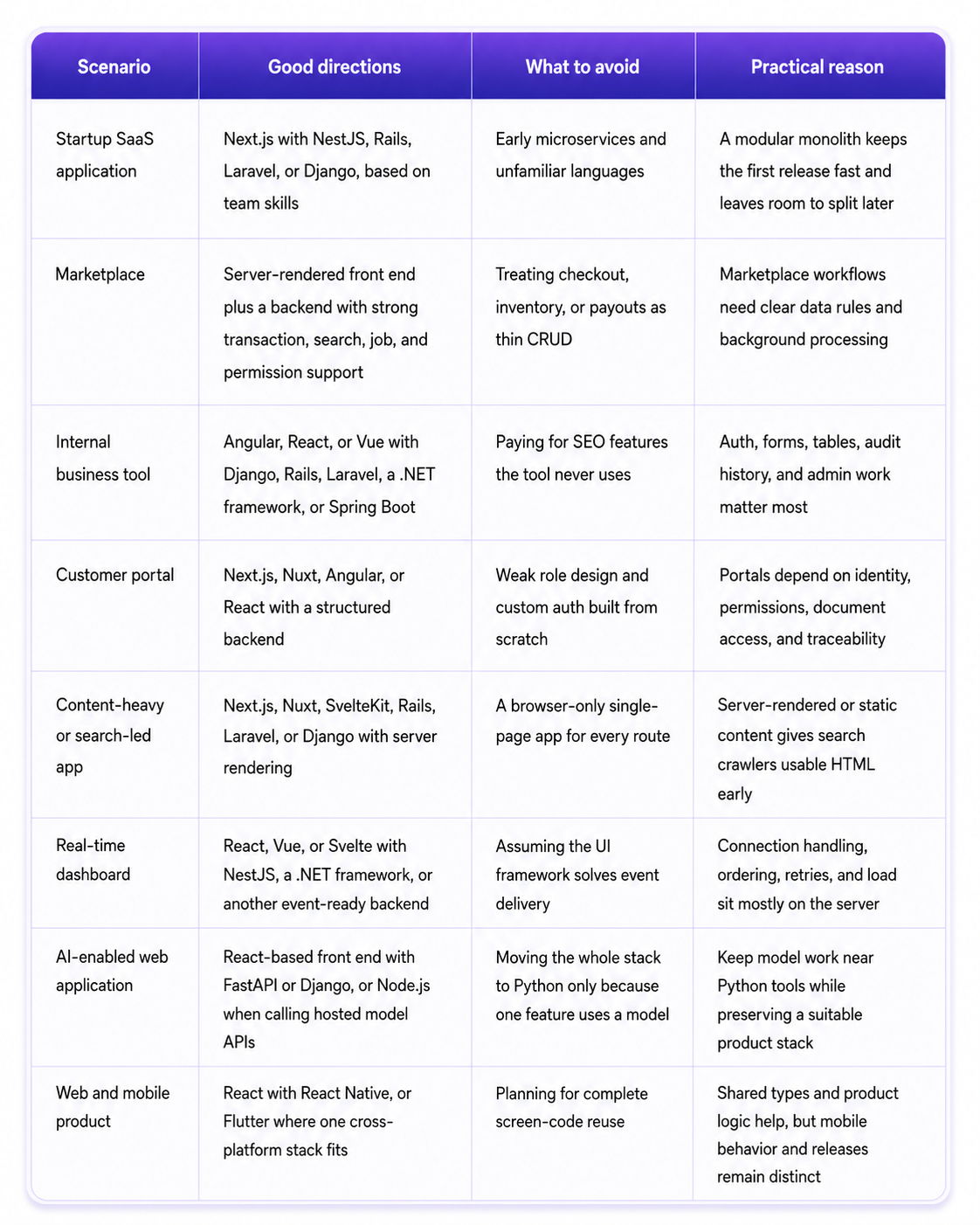
Common mistakes when choosing a software framework
This is where teams often make the wrong call.
- Choosing by popularity alone. Usage signals help with hiring and package availability, but they do not prove product fit.
- Choosing by one developer's preference. The company must maintain the choice after that person leaves.
- Ignoring the hiring market. A smaller ecosystem may work well, but the hiring plan must account for it.
- Ignoring deployment. Rendering mode, runtime, process length, file access, and background jobs affect hosting.
- Ignoring maintenance. Check release policy, upgrade path, dependency health, and ownership.
- Treating built-in security features as a complete security, privacy, or compliance program. Framework defaults help, but they do not replace access-control design, privacy review, dependency governance, secure deployment, monitoring, and application security testing.
- Overengineering the first release with microservices, custom infrastructure, or too many frameworks.
- Picking a stack before defining product requirements and operational limits.
- Treating front-end and backend choices as separate business decisions. Rendering, authentication, API boundaries, and deployments connect them.
A 30-minute framework selection checklist
Use this in one product and engineering meeting:
- What are we building: content site, SaaS product, portal, marketplace, internal tool, API, or mixed system?
- Who will build and maintain it during the next three years?
- How soon must the first working release reach users?
- Which part must handle growth first: pages, API traffic, jobs, data, files, or real-time events?
- Do public routes need search visibility, server rendering, or static output?
- Do we need live updates, offline behavior, or heavy browser state?
- Will mobile apps share APIs, types, or developer skills later?
- Which identity, payment, CRM, ERP, analytics, or vendor systems must connect?
- What security, audit, residency, or regulatory rules apply?
- Can we hire for this stack in the regions and salary bands we use?
- Can our hosting and operations team run it without special treatment?
- Will the framework still fit the likely product shape in three years?
Write down each unknown and test it before selection.
Framework recommendation matrix
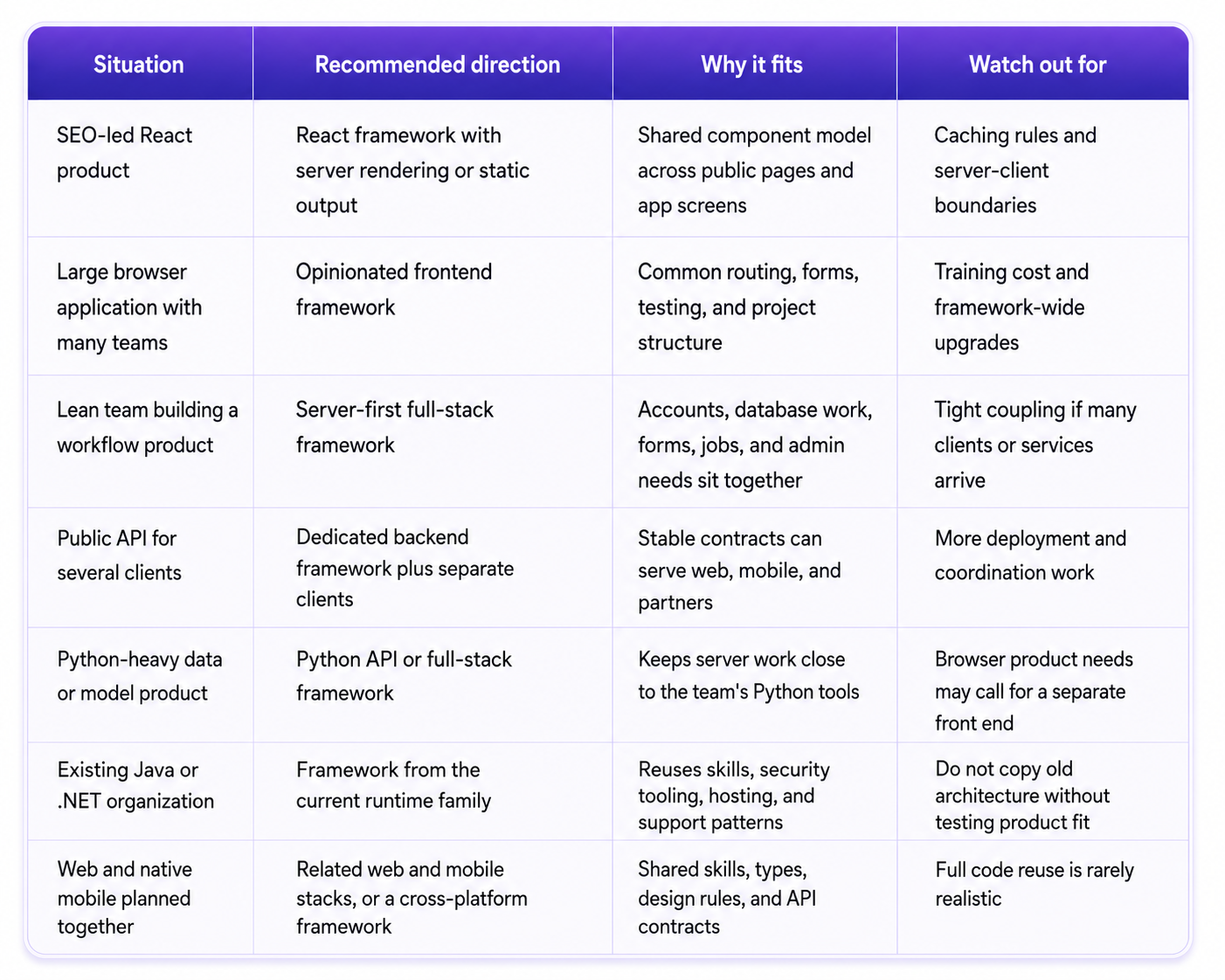
Partnering with Lexogrine
Lexogrine helps teams choose a sound architecture and build production-ready web applications, mobile applications, admin panels, customer portals, internal tools, and AI-enabled software. Our teams work with React, React Native, Node.js, Python, AWS, and Google Cloud Platform, from product discovery through release and long-term development.