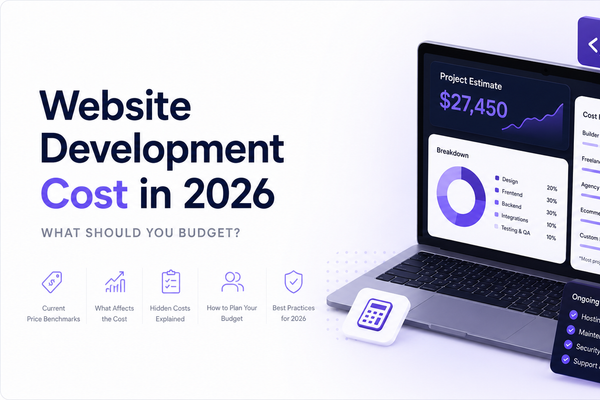
Website Development Cost in 2026: What Should You Budget?
The website development cost in 2026 can range from a few hundred dollars per year for a self-built site to tens or even hundreds of thousands of dollars for a complex custom platform.
Current public references include Wix paid plans at $17-$159 per month when billed annually, Clutch’s $500-$5,000 estimate for a basic freelancer-built website, and an average of $66,499.09 across web development agency projects reviewed on Clutch.
For broader custom software projects, which may include web applications but are not limited to them, Clutch reports an average project cost of $132,480.29.
These figures describe different products and services. A website builder subscription generally covers software and hosting but not professional implementation. Marketplace project data may combine small websites, redesigns, integrations, ecommerce systems, and large software platforms. None of these figures should be treated as a universal quote.
Current Website Cost Benchmarks for 2026
Template-based business website
Clutch lists $500-$5,000 as a reference range for a basic freelancer-built website with approximately five to ten pages.
A project within this range will usually rely on an existing template or component system. It may include theme installation, brand styling, standard pages, basic forms, and responsive configuration.
The quote should clearly state whether it also includes CMS setup, analytics, cookie configuration, content entry, image preparation, search engine optimization, testing, domain configuration, and post-launch support. A low initial price may exclude some or all of these elements.
Web development agency project
Clutch reports that web development projects reviewed on its platform typically cost less than $10,000. However, the average cost across reviewed projects is $66,499.09, with an average project duration of nine months.
The difference between the most common pricing band and the overall average suggests that a smaller number of large projects significantly raises the average. Businesses should therefore not interpret $66,499.09 as the standard cost of every agency-built website.
Clutch also reports that web development companies typically charge $25-$49 per hour. Final project cost depends on the number of hours required, the location and composition of the team, technical complexity, project duration, and the services included.
A web development agency project can cover information gathering, wireframing, frontend and backend development, QA testing, deployment, SSL configuration, and domain setup. The exact scope depends on the contract.
Ecommerce website
Clutch reports that most ecommerce development projects reviewed on its platform cost less than $10,000. At the same time, the average reviewed ecommerce project costs $51,943.13.
Again, the average is affected by larger implementations. A small store based on an existing theme and standard checkout can cost much less than an ecommerce system involving migration, international storefronts, custom product logic, subscriptions, multiple warehouses, or business-system integrations.
Shopify lists its Basic plan at $29 per month on its U.S. annual billing page. Prices vary by country and currency. The subscription provides access to the commerce platform but does not represent the complete cost of designing, configuring, testing, migrating, and launching an online store.
A more advanced ecommerce budget may also need to cover paid themes, applications, transaction fees, payment processing, product data preparation, ERP or PIM integrations, shipping configuration, analytics, and ongoing development.
Broader custom software project
A complex web application can be closer to a custom software project than a conventional company website.
Clutch reports that custom software development projects reviewed on its platform most commonly fall within the $10,000-$49,999 range. The reported average is $132,480.29, with an average project duration of approximately 13 months.
These figures cover the broader custom software category. They are not specific to browser-based applications and may include mobile applications, internal systems, backend platforms, desktop software, and other bespoke products.
For a custom web application, the scope may include product discovery, UX/UI design, frontend and backend engineering, databases, authentication, user roles, APIs, administration tools, cloud deployment, monitoring, security work, QA, and post-launch releases.
What Each Website Type Usually Includes
Website builder
A website builder shifts much of the implementation work to the business owner or internal team. This can include template selection, page assembly, content entry, form configuration, domain connection, analytics, and general platform settings.
Paid professional help may cover initial setup, visual customization, content migration, or custom code. More advanced workflows and integrations may require additional tools or a different technical approach.
Template-based business website
A template-based website starts with an existing theme, page builder, or component library.
The work usually includes adapting the design to the company’s brand, preparing responsive layouts, configuring a CMS, adding standard forms, setting up analytics, and launching the site.
The agreement should specify who provides the final text, images, legal documents, metadata, translations, and content migration.
Custom company website
A custom company website typically adds discovery, information architecture, wireframes, original interface design, reusable frontend components, and a planned content model.
It may also involve a custom or headless CMS, multiple languages, advanced search, CRM integration, recruitment tools, marketing automation, gated content, or connections to internal systems.
A project described as “custom” should still define which parts are being designed and engineered specifically for the client and which parts rely on existing frameworks, libraries, or third-party services.
Ecommerce website
An ecommerce website can include product structures, storefront templates, search and filtering, cart and checkout configuration, payment methods, shipping and tax rules, customer accounts, analytics, and transaction testing.
ERP, PIM, CRM, subscription, warehouse, marketplace, loyalty, accounting, or multi-region integrations increase the scope.
Migration can also become a significant workstream when the existing store contains a large product catalogue, customer accounts, historic orders, custom URLs, or complex product variants.
Custom web application
A custom web application is browser-based software rather than a conventional marketing website.
Its scope can include permissions, operational workflows, dashboards, database design, APIs, authentication, administration tools, cloud infrastructure, monitoring, security testing, and continuous post-launch development.
Page count is not a useful measure of complexity for this type of project. A single interface may contain more engineering work than dozens of informational pages.
What Raises or Reduces Website Development Pricing
Two websites with the same number of pages can have very different costs.
A mostly static website may reuse a small set of components and contain limited business logic. Another project may require user accounts, custom search, payments, approval workflows, structured databases, several integrations, or different interfaces for different user roles.
Discovery and requirements
Discovery affects the accuracy of the estimate and the amount of rework later in the project.
A clear description of users, workflows, content types, permissions, integrations, acceptance criteria, constraints, and ownership decisions gives the delivery team a stronger basis for estimating the work.
Unresolved requirements can add design, engineering, testing, project management, and decision-making time.
Design and accessibility
The workload increases when a project requires original layouts, numerous responsive states, complex data visualizations, interactive animations, or detailed design systems.
Accessibility requirements also need to be considered during design, content preparation, development, and testing.
The W3C’s Web Content Accessibility Guidelines 2.2 provide recommendations for making web content more accessible. Relevant work may include keyboard navigation, focus behavior, semantic structure, form labels, error handling, contrast, text alternatives, target sizes, and testing with assistive technologies.
Engineering
Engineering effort grows with backend logic, CMS customization, ecommerce rules, data migration, integrations, performance requirements, and security controls.
The OWASP Application Security Verification Standard provides a structured basis for defining and testing technical security controls in web applications.
The appropriate security scope depends on the system’s data, users, business risks, regulatory environment, and exposure to external threats.
Quality assurance
QA effort increases with the number of supported devices, browsers, languages, user roles, data states, integrations, payment methods, and deployment environments.
Testing may include functional QA, regression testing, responsive testing, accessibility testing, performance testing, security verification, content checks, and user acceptance testing.
Costs Often Missing From the Initial Quote
An unusually low quote may exclude discovery, UX/UI design, project management, testing, content work, migration, integrations, analytics, accessibility, documentation, maintenance, or post-launch support.
Ask for written information covering:
- included deliverables,
- exclusions,
- assumptions,
- revision limits,
- client responsibilities,
- required third-party access,
- handover materials,
- warranty or defect-fix periods,
- support after launch.
Recurring costs may include domain renewal, hosting, CMS or commerce subscriptions, paid themes, extensions, email delivery, search services, monitoring, backups, payment processing, and third-party APIs.
Hosted website platforms usually include hosting within the subscription. Infrastructure for custom applications is often billed separately, although this depends on the commercial agreement.
AWS’s Lightsail pricing includes an example of a WordPress instance costing $5 per month. The same AWS page shows that a production setup may also require object storage, a CDN, a managed database, containers, or a load balancer.
The $5 instance should therefore be treated as an infrastructure component, not a complete production website budget.
Content migration can also become a separate project when existing material needs to be cleaned, restructured, mapped to new URLs, supplemented with metadata, translated, or reviewed manually.
A maintenance budget should define whether it covers software and dependency updates, security patches, backups, monitoring, incident response, bug fixes, browser compatibility, and minor improvements.
New features and significant changes should usually belong to a separate development budget.
Builder, Freelancer, Agency, or In-House Team
Website builder
A builder keeps direct platform spending relatively low and gives nontechnical employees control over routine edits.
The trade-off is the internal time required to prepare the website and potential limitations around custom functionality, data models, integrations, and unusual publishing workflows.
Freelancer
A freelancer can be a suitable choice for a clearly defined website, migration, redesign, or specialist task.
Upwork lists the following typical web developer rates:
- entry-level: $15-$25 per hour,
- intermediate: $30-$50 per hour,
- expert: $50-$200 per hour.
These are marketplace reference rates rather than guarantees of quality, availability, communication, or final project cost.
When one freelancer is expected to cover research, design, frontend development, backend work, content migration, QA, infrastructure, and support, responsibilities and continuity should be defined carefully.
Agency
An agency can combine discovery, UX/UI design, frontend development, backend development, QA, cloud engineering, security, and project management.
Clutch reports an average hourly range of $25-$49 for web development companies. In the separate web design category, Clutch reports $100-$149 per hour for shortlisted web design companies.
These categories should not be treated as interchangeable. A design engagement may focus on research, information architecture, wireframes, layouts, and interface specifications, while a development engagement focuses on building, integrating, testing, and deploying the website.
Location, specialization, team seniority, and delivery model can significantly change the hourly rate.
An agency is not automatically the best choice for every small task, just as a freelancer is not automatically the best choice for a multidisciplinary platform.
In-house team
An in-house team provides continuous ownership and close access to company knowledge.
It also creates ongoing costs related to salaries, recruitment, management, equipment, software, training, and coverage across multiple disciplines.
This model is generally more suitable for a sustained product roadmap than for a single website launch.
How to Prepare a Realistic Budget
Your website development cost in 2026 should be based on a written scope rather than page count alone.
- Define the users, workflows, content types, business goals, and launch requirements.
- List all integrations and assign responsibility for access, data mapping, testing, and vendor coordination.
- Request separate prices for discovery, UX/UI, frontend development, backend development, CMS work, ecommerce work, migration, QA, accessibility, performance, security, project management, deployment, documentation, and training.
- Separate the one-time implementation cost from hosting, licenses, maintenance, support, and future development.
- Compare proposals based on deliverables, assumptions, responsibilities, and exclusions rather than total price alone.
- Confirm who owns the source code, designs, accounts, domains, documentation, and infrastructure after launch.
- Define how scope changes will be estimated, approved, and billed.
At Lexogrine, we build custom websites and web applications, and reliable estimates require a clearly defined scope.
Share the expected workflows, content, integrations, users, and ownership requirements with us. We can discuss the project, identify the main cost drivers, and prepare an estimate based on the actual scope.