Where constraints can occur
- Rendering
- Internal architecture
- Canonicalization
- Fragmented data
- Crawler access
- CMS limitations
- Application-state content
- Inconsistent technical signals

AI Search recommendations eventually meet real software.
Lexogrine diagnoses and implements the technical changes that help search and AI discovery systems access, understand and correctly represent your company's information.
From crawlability and rendering to CMS architecture, APIs and infrastructure, we take Technical AI Search work from diagnosis into production.
Request a technical consultationEvidence from the systems your business runs.
Requirements, dependencies and acceptance criteria.
Production changes with technical verification.
Technical AI Search is the point where strategy becomes engineering work.
Lexogrine's Technical AI Search service, sometimes referred to as Technical GEO, is an engineering engagement for implementing the web, CMS, rendering, data, crawler and infrastructure changes required by an AI Search strategy.
If the problem exists in code, infrastructure or data architecture, producing more content may not solve it.
Mobile can be relevant where it shares APIs, product data or backend systems. Mobile development itself is not a GEO tactic.
Review the technical problem in the context of your systems and buyer discovery.
Technical diagnosisUse observable behavior and supporting evidence to establish what needs to change.
Evidence-backed findingsAgree systems, requirements, dependencies and acceptance criteria before implementation.
Engineering scopeShip the agreed changes through the client delivery process.
Production implementationValidate against acceptance criteria and measure discovery movement where a baseline exists.
Validated outcomeExisting findings or technical problem.
Systems, requirements, dependencies, architecture and acceptance criteria.
Production engineering.
Technical validation and integration into the client delivery process.
Confirm the technical outcome and, where possible, measure subsequent AI Search movement.
Where a baseline exists.
LHM is Lexogrine's own software platform for professional esports broadcast production. It competes in highly specialized B2B categories including CS2 HUDs, Valorant HUDs, League of Legends HUDs, observing overlays and HUD management software.
Lexogrine controls the website, application code, APIs, product data, content architecture, deployment and infrastructure. This makes LHM a product environment we can change end to end.
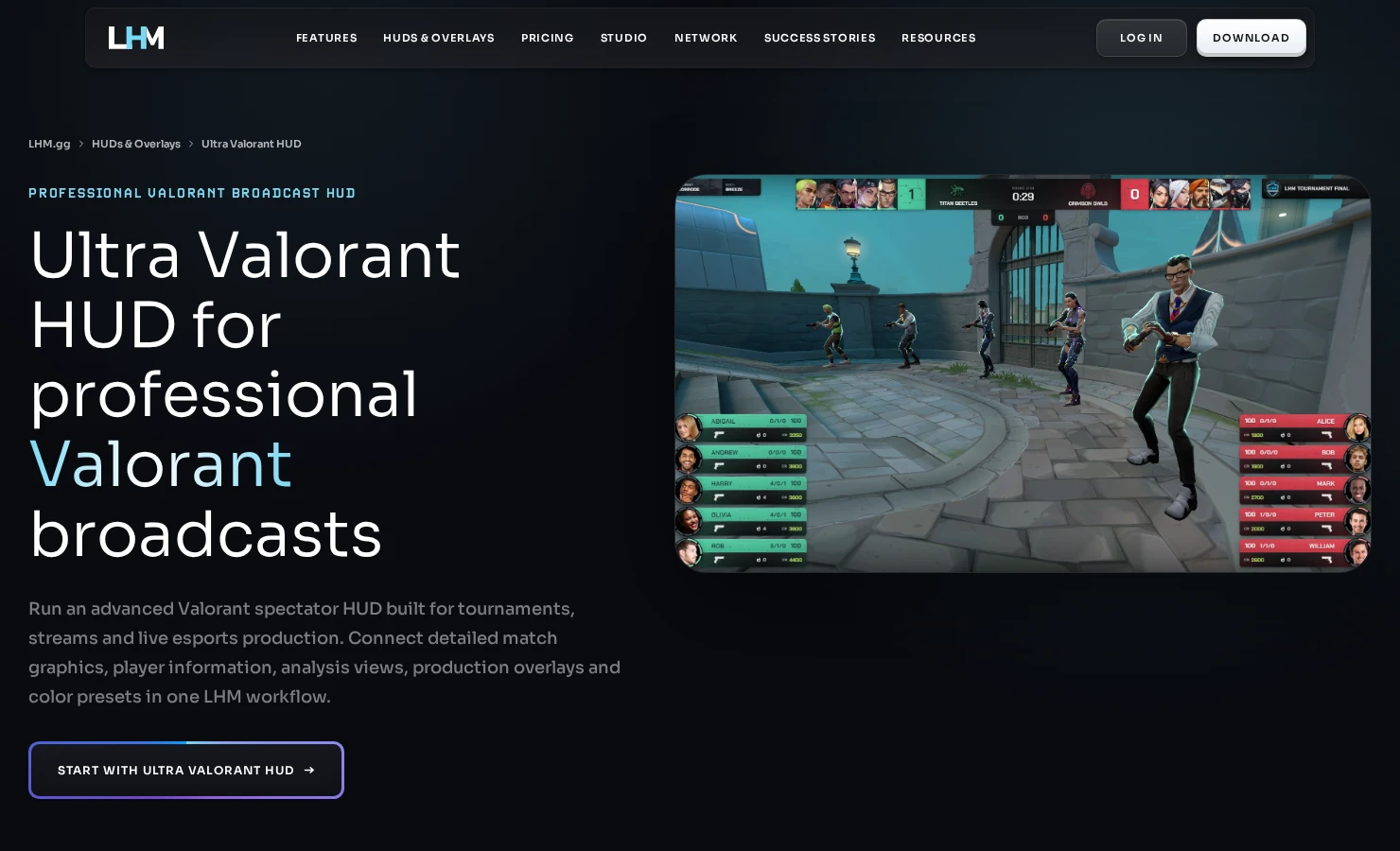
A current example of the product-page structure used across LHM's HUD offering.
Product naming and URL structure needed clearer category alignment.
Game-first names such as “Counter-Strike 2 Ultra HUD” separated the game name from “HUD”, while product pages lived under feature-based URLs. We identified an opportunity to align naming, headings and page structure more closely with category queries such as “CS2 HUD”.
Aligned product naming and migrated HUD pages into a consistent overlay structure.
We adopted names such as “Ultra CS2 HUD” and moved /features/ultra-hud/cs2 to /overlays/ultra-cs2-hud. Equivalent changes covered other HUD pages, supported by permanent redirects, updated internal links, metadata, canonical URLs, sitemap entries and structured data.
The new URL appeared in subsequent Google Search reporting.
Google Search Console recorded 718 impressions and 34 clicks for /overlays/ultra-cs2-hud between July 26 and August 22, 2026. These observations document search activity after the migration; they do not isolate its impact or establish an AI Search uplift.
LHM gives us an environment where we control the product, website, technical architecture, content structure and implementation roadmap, while observing how those systems translate into traditional search and AI-driven discovery.
It allows us to apply and validate the same measurement principles we use in client engagements against a product we own and operate commercially.
These existing reviews demonstrate engineering quality, complex problem solving, implementation reliability, responsiveness and collaboration. They are not AI Search case studies.
These reviews describe our software engineering, design and development work. They demonstrate delivery experience, not measured AI Search visibility results.
It was obvious that Lexogrine wanted to create the best possible solution customized for us.Read on Clutch
Lexogrine was even able to add features and improve the platform’s speed in a mere week!Read on Clutch
They’ve stepped out of their way to deliver things out of their interest for the project.Read on Clutch
Their turnaround times were fantastic.Read on Clutch
One of the best agency experiences we have had bar none.Read on Clutch
Lexogrine is an incredibly hardworking and dedicated group of individuals that I rarely see at development companies.Read on Clutch
Their project management skills and problem-solving approach were impressive.Read on Clutch
They knew exactly what we wanted and filled our needs perfectly.Read on Clutch
Lexogrine is good. The team knows what they’re doing and they have a strong aesthetic.Read on Clutch
They listen well and provide feedback to really fulfill the client's overall vision.Read on Clutch
Selected review excerpts from software, design and development projects.
If an AI Search finding requires changes to your website, CMS, application architecture, APIs or infrastructure, it does not need to remain another item in a strategy document. Lexogrine can diagnose the technical problem, define the engineering scope and ship the solution into the systems your business actually runs.
Request a technical consultation