
Lexogrine is now using Conscriba to make the Lexogrine website easier for AI agents to access, understand, and use.
This means Lexogrine.com is not only a website built for human visitors, but also becoming an AI-ready website that can expose selected website actions as structured WebMCP tools for AI agents.
For Lexogrine, this is a natural step. As a custom AI agent software development company working across AI, web platforms, mobile applications, React, Node.js, and custom software development, we believe websites should prepare for how users will interact with digital products in the agentic web era.
What is an AI-ready website?
An AI-ready website is a website designed not only for people browsing with a mouse, keyboard, or touch screen, but also for AI agents that help users complete tasks.
Today, users increasingly ask AI systems to compare vendors, summarize services, check pricing, find documentation, prepare contact messages, shortlist development partners, or evaluate software providers. In those workflows, a traditional website can be difficult for an agent to use reliably.
Without structured tools, an AI agent often has to interpret visible page content, navigation menus, buttons, forms, and page structure. That may work for simple reading, but it becomes less reliable when the agent needs to take a specific action.
An AI-ready website solves this by giving agents clearer access to website functionality. Instead of guessing what a form, search bar, or navigation path is for, the website can expose selected actions in a structured way.
That is where WebMCP comes in.
What is WebMCP?
WebMCP is a proposed web standard that helps websites expose structured tools for AI agents. According to Chrome for Developers, WebMCP helps websites define tools and annotate interface elements so agents know how to interact with page features more reliably. Google describes WebMCP as a way to improve the performance and reliability of agent actuation, meaning the process where an AI agent performs actions on behalf of a user.
In practical terms, WebMCP can help websites expose actions such as:
- Searching the website
- Finding service pages
- Opening a contact path
- Navigating to pricing or documentation
- Browsing product or service categories
- Starting a lead or inquiry flow
For companies that depend on inbound research, product discovery, and B2B lead generation, this creates a new layer of visibility. The website remains fully human-friendly, but it also becomes easier for agents to understand and act on.
Why Lexogrine added WebMCP support
Lexogrine builds custom AI, web, mobile, and software solutions for companies that need reliable digital products. The Lexogrine website presents several service areas, including AI agent development, React development, React Native development, Node.js development, web and software development, mobile development, design, and strategy consulting.
That makes Lexogrine.com a strong use case for WebMCP optimization.
A founder, CTO, product lead, or marketing team may ask an AI assistant to:
- Find an AI agent development company
- Compare custom software development partners
- Shortlist React and Node.js development companies
- Find a team that can build AI-powered web or mobile products
- Prepare a message to contact Lexogrine
- Understand what Lexogrine does before booking a call
WebMCP support can make these workflows easier for AI agents. Instead of relying only on page interpretation, agents can use structured tools where available.
This is especially important for companies like Lexogrine because the buying process for software services is often research-heavy. Potential clients do not always start by filling out a form. They may first ask an AI assistant to collect context, compare vendors, and prepare a shortlist.
An AI-ready website helps support that behavior.
How Conscriba powers WebMCP optimization
Lexogrine uses Conscriba to manage this new WebMCP layer.
Conscriba is a platform for automatic WebMCP tool creation, analytics, tracking, and optimization. It can generate WebMCP tools for a website, map actions such as search, contact forms, and product browsing, analyze AI agent traffic, and support A/B testing for agentic discovery.
For Lexogrine, Conscriba provides a practical way to approach WebMCP optimization services without treating WebMCP as a one-time technical experiment.
The platform supports several key areas:
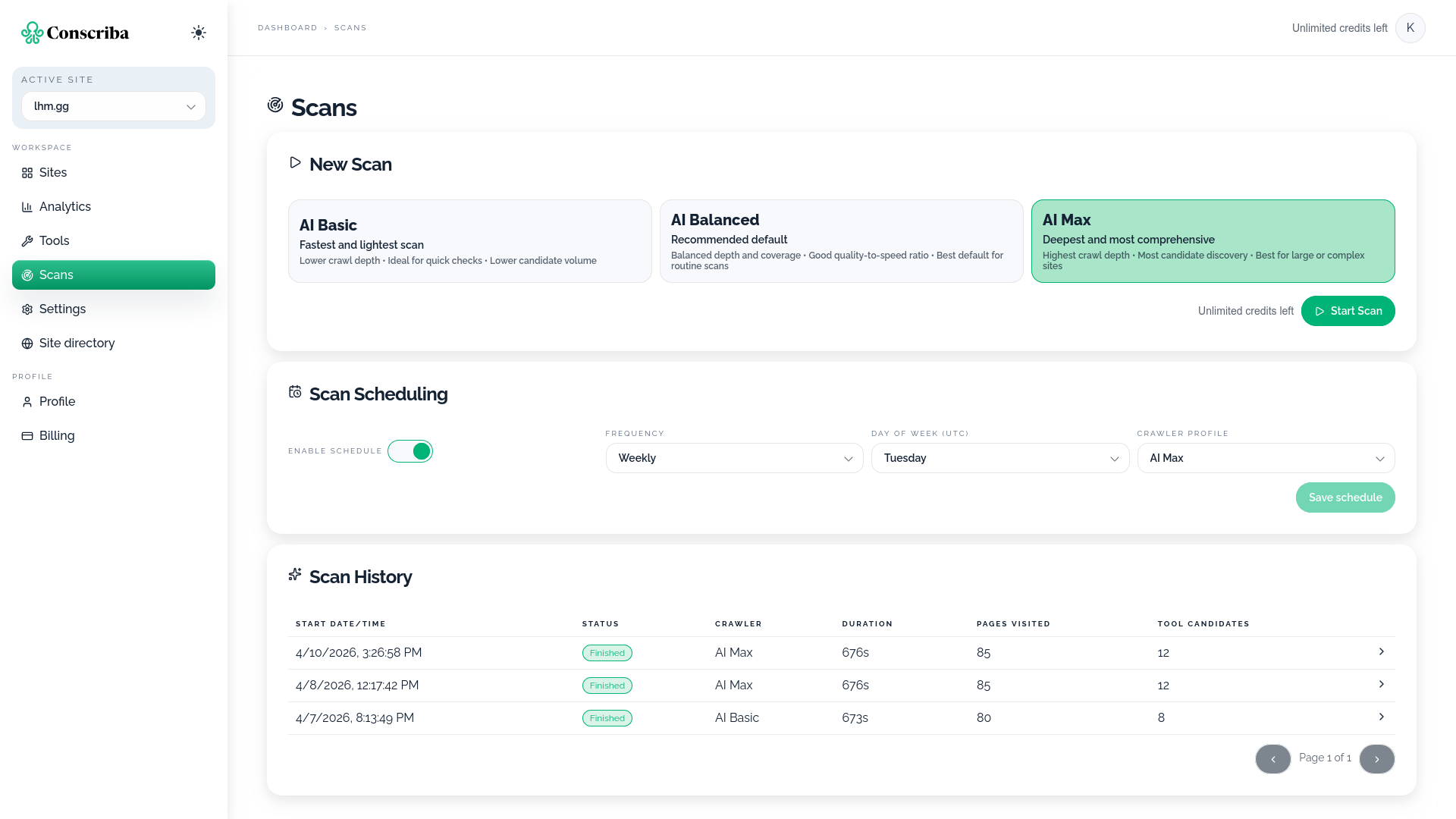
AI scans for WebMCP tool discovery
Conscriba can scan a website to identify actions that may be useful for AI agents. On a service website like Lexogrine.com, this may include service discovery, contact paths, article navigation, and pages related to AI agent development or custom software development.
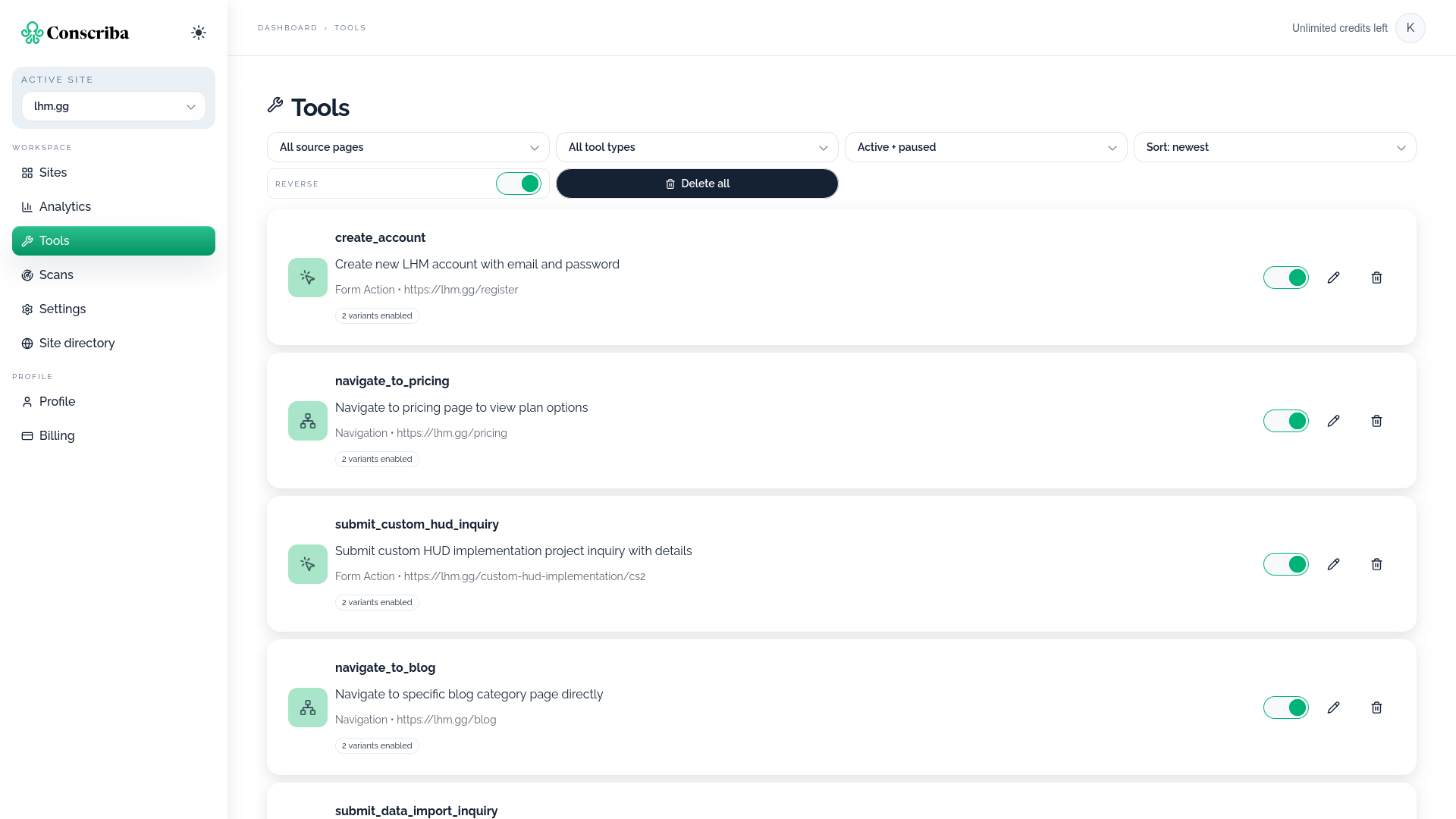
WebMCP tool management
After potential tools are identified, teams can review what should be exposed. This matters because not every website action should automatically become available to agents.
Agent analytics and conversion tracking
Conscriba helps teams understand how AI agents interact with WebMCP tools. It can show which tools are used, which actions attract agent interest, and where agent activity may create business value. Conscriba also describes features such as live WebMCP intelligence, agent conversion tracking, automated site scans, A/B tool testing, and AI source analytics.
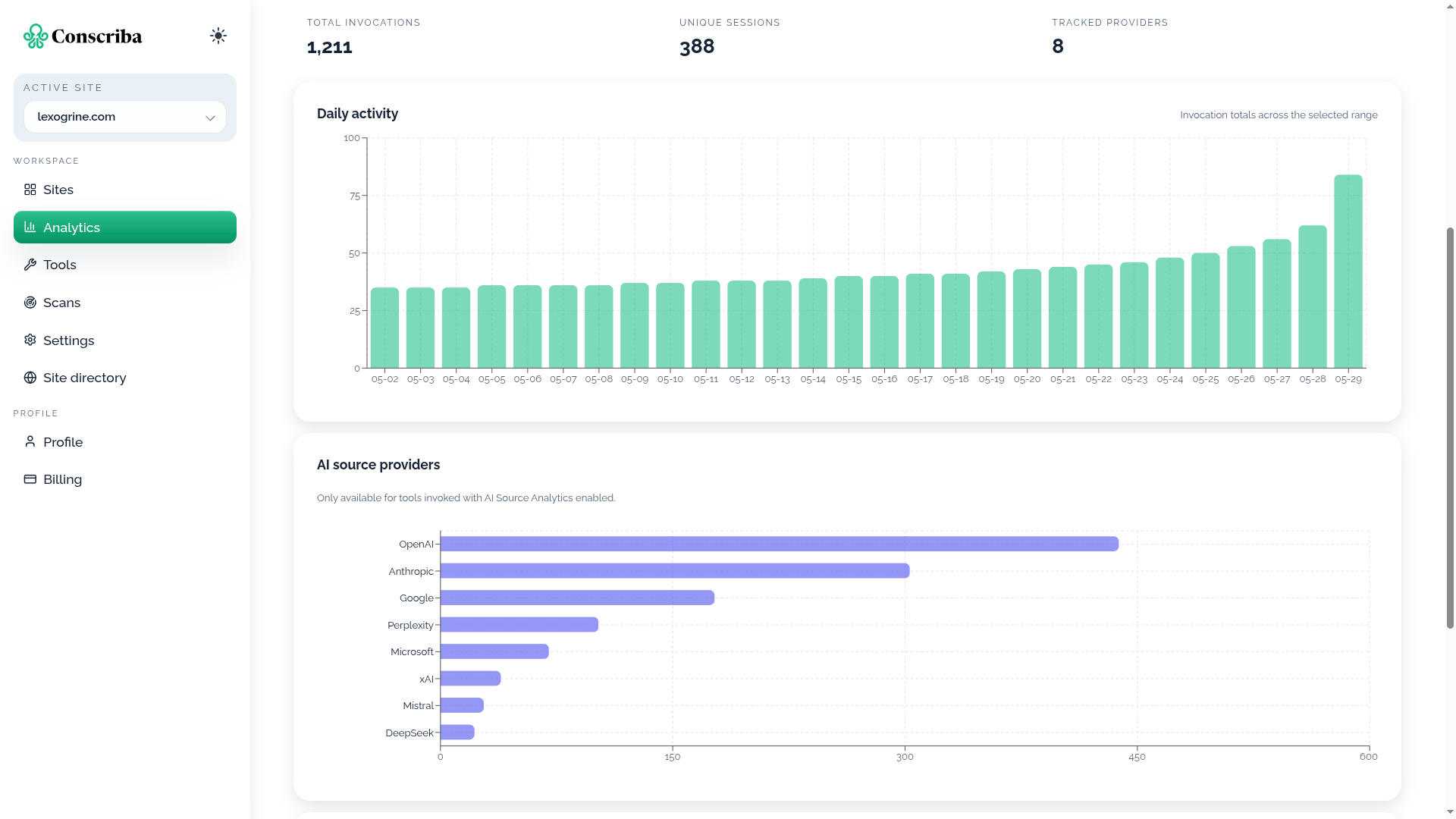
A/B testing for tool descriptions
WebMCP tools need clear descriptions. Those descriptions help agents understand when and how to use each tool. Conscriba lets teams test different tool descriptions and improve them based on usage signals.
That makes WebMCP optimization closer to SEO and conversion optimization. The difference is that the audience is not only a human reader. It is also the AI agent helping that reader.
WebMCP optimization and the future of SEO
Traditional SEO focuses on how search engines crawl, understand, and rank websites. That remains important. But AI agents are changing how users discover information and complete tasks.
In this new layer, websites need to answer a different question:
Can an AI agent reliably understand what this website offers and take the right next step?
For Lexogrine, WebMCP optimization supports three goals:
- Make the website easier for AI agents to use.
- Improve discoverability for agent-driven research.
- Measure how agent interactions develop over time.
This does not mean WebMCP is already a confirmed ranking factor. It is still an emerging standard, and adoption is developing. But for AI-first companies, preparing early makes sense.
Lexogrine builds AI agent systems for clients. By adding WebMCP support to its own website, Lexogrine is applying the same principle to its own digital presence: software should be easier for agents to understand, access, and operate.
Make your website AI-ready with Conscriba
Lexogrine.com now uses Conscriba to expose WebMCP tools and prepare for AI-agent interaction.
If your company depends on product discovery, service inquiries, ecommerce flows, booking paths, documentation, or lead generation, your website may need the same layer.
Conscriba helps turn a traditional website into an AI-ready website by adding WebMCP tools, agent analytics, conversion tracking, and optimization features.
As AI agents become a larger part of how users research products and services, websites will need more than good content and clear design. They will also need structured actions that agents can understand.
That is what WebMCP optimization is for.
And that is why Lexogrine is now using Conscriba.