

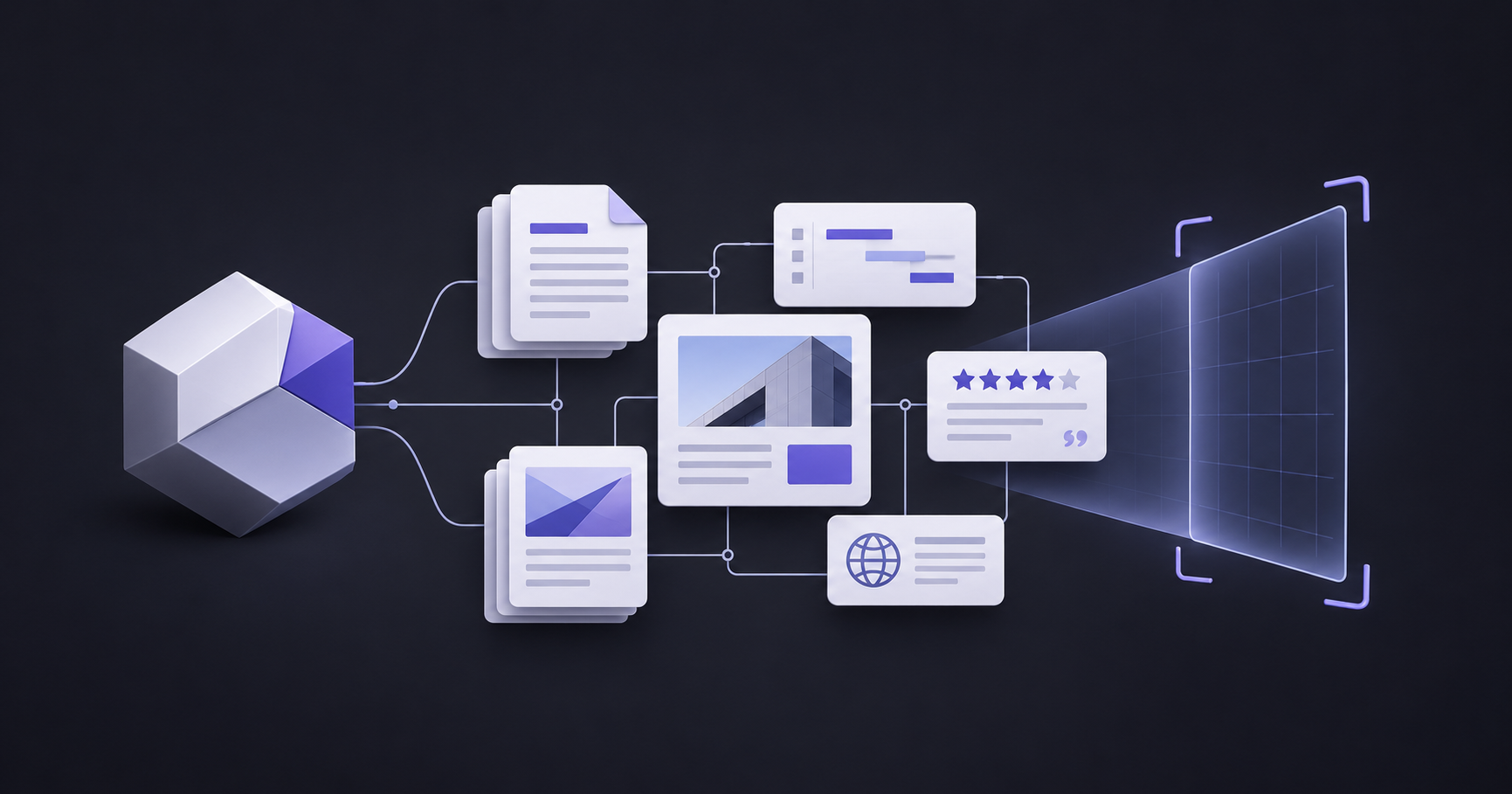
A specialist business can spend ten years solving difficult problems, deliver strong work for demanding customers and still appear unremarkable in AI-assisted discovery. The expertise exists inside the company, but the public evidence does not.
Building brand authority for AI Search means closing that gap. The business needs to make genuine expertise publicly accessible, clearly described and, where appropriate, supported by independent sources. That evidence may include detailed project pages, customer reviews, industry mentions, technical analysis, original data and expert participation in the places buyers already use.
No major platform publishes a universal authority score or a formula that says a certain number of reviews, links or mentions will produce a recommendation. Current AI Search products use different combinations of search indexes, live web retrieval, ranking systems and model-generated synthesis. For a web-grounded answer, a source must be reachable through the product's retrieval path. Eligibility still never guarantees selection.
The practical objective is therefore more disciplined than “rank in ChatGPT.” Make the business easier to understand and evaluate, then test whether the relevant evidence is being retrieved and represented accurately.
Think in evidence layers, not an authority score
Official platform documentation establishes one useful mechanism. OpenAI separates its search crawler from the crawler used for model training. Google says its AI features use Search infrastructure, can issue several related searches and require ordinary Search eligibility. Anthropic also documents separate roles for model-training, search and user-directed retrieval.
Each system exposes a different combination of indexes, activation rules and source-selection processes. A page that is available to one product may not appear in another. Retrieval, citation and recommendation are separate outcomes, and a summary may omit the point the company considers most important.
That is why authority is better treated as an evidence model inside a wider AI Search program. Five layers matter:
- Business reality: the expertise, methods, completed work and customer outcomes that actually exist.
- First-party evidence: the company's own explanation of what it does and what it has delivered.
- Independent context: reviews, directories, media, associations and public discussion relevant to the market.
- Technical availability: whether important information is public, crawlable, indexable where appropriate and easy to discover within the site.
- Validation: whether repeatable buyer questions surface the company, the right sources and an accurate description.
This is an editorial decision model for prioritizing work. No platform publishes these five layers as its own ranking schema.
The layers serve different purposes. A case study can explain the work in depth. A customer review can describe the experience from outside the company. A trade publication may establish category context. Technical accessibility makes those materials eligible for discovery. Measurement shows what happened in a defined test, rather than proving a hidden ranking factor.

Large observational studies do find strong associations between public brand discussion and AI visibility. That is useful enough to investigate, but existing popularity can drive both. Established brands already tend to have more searches, reviews, press coverage, links and community discussion. Publicity volume cannot be treated as a scientific shortcut around that reality.
Start with what your business can genuinely prove
The first authority task is internal. Before opening new profiles or commissioning another content series, identify what the company can substantiate.
Consider a specialist controls integrator. Its engineers may have years of experience connecting production systems, modernizing industrial equipment and resolving failures under operational constraints. Yet its website may contain one generic services page that says the team delivers “innovative end-to-end solutions.” A buyer cannot see which environments the company understands, how it approaches risk or what kind of work it has completed. A retrieval system sees the same absence.
Build the inventory around completed projects, the sectors and environments the team genuinely understands, the methods and technical decisions that distinguish its work, and outcomes that can be stated accurately with permission. Add current certifications, partnerships and specialist capabilities, then identify original data or operational knowledge the company may publish and the people qualified to author or review it.
The inventory also reveals what should not be published. Broad claims such as “industry-leading,” “trusted worldwide” or “best-in-class” add little when the company cannot show the basis for them. A narrower claim supported by a named method, project type or customer context is more useful to buyers and easier to verify.
This stage often uncovers a practical constraint: the strongest evidence may be protected by confidentiality. The defensible response is to seek permission, anonymize the customer where appropriate, describe the technical problem without exposing sensitive information, or publish the methodology instead of the commercial result. A smaller body of defensible evidence is stronger than a large body of vague claims.
Turn completed work into first-party evidence
Expertise becomes legible when the company explains what happened with enough detail for another person to evaluate it.
A useful case study is more than a testimonial wrapped in a design template. It should show the customer context, the problem, the scope of work, relevant constraints, the decisions made, what the company delivered and which outcomes can be substantiated. Dates, authorship and clear ownership help readers understand when the work happened and who stands behind the account.
The same principle applies to project pages, implementation notes, portfolio entries and service documentation. A structured portfolio of success stories gives buyers and retrieval systems a route from a broad capability claim to concrete examples of completed work.
Reviews and case studies play different roles:
- A customer review is an independent account of the experience. It may describe responsiveness, technical competence, collaboration, delivery quality or the practical result from the customer's position.
- A case study is the company's detailed account of the work. It can explain the problem, implementation choices, constraints and evidence in far greater depth.
A professional-services firm might publish a case study explaining how it redesigned a complex operational workflow. The customer might separately review the quality of the collaboration and the team's ability to handle changing requirements. When those accounts are consistent, they corroborate each other in the ordinary sense of the word. There is no documented mechanism showing that an AI system will automatically connect them or reward the pair.
The value is simpler. Important claims become available in more than one appropriate source, with enough detail to withstand scrutiny. That helps a buyer evaluate the business even when no AI product is involved.
Case studies should also resist the temptation to turn every result into a performance claim. If an outcome was observed but causality was not isolated, say what changed and what else may have contributed. If a metric came from the customer, attribute it. If the number cannot be shared, explain the operational improvement without fabricating precision.
Make the evidence independently checkable
A company website is necessary, but it is a self-authored source. Independent information can help a buyer understand whether the public claim matches real customer experience and wider market context.
Reviews are one part of that evidence. Their relevance depends on the business model, category, geography and buyer journey:
- A local business may care about Google Business Profile and the local or vertical directories that repeatedly appear for nearby-service questions.
- An agency or professional-services firm may find Clutch or a specialist marketplace useful when its buyers genuinely consult those sources.
- A software company may prioritize G2, Capterra or TrustRadius because those platforms are built around software evaluation.
- An industrial specialist may gain more useful independent context from trade associations, distributors, certification bodies, customer references and sector publications than from a general review site.
Profile selection should follow real buyer use and the sources that appear around commercially important questions in the target market. Profile count is a poor objective. Incomplete information on ten marginal directories can create more inconsistency without adding much evidence.
The same discipline applies to review collection. Ask real customers after real engagements, use a neutral invitation and let them describe the experience in their own words. A practical request can be as simple as: “Would you be willing to leave an honest review describing the problem we worked on and your experience of the engagement?” Do not prescribe praise or require specific wording.
Purchased or fabricated reviews, selective solicitation of customers expected to be positive, and incentives conditioned on sentiment can breach consumer-protection rules or platform policies. The rules differ: US FTC guidance permits incentives that are not tied to sentiment under the Consumer Review Rule, but says failing to disclose them can violate the FTC Act; UK rules require incentivised reviews to disclose the incentive and reflect genuine experience; Google Business Profile prohibits incentivized reviews altogether. For a cross-market program, the safest default is to ask real customers for honest reviews without an incentive unless the relevant platform and jurisdiction have been checked.
Detailed reviews are often more useful than generic praise because they provide context. “Great company” says little. A review explaining the type of engagement, the problem addressed and the customer's experience gives a buyer more information while remaining the reviewer's account. The business should never write that account on the customer's behalf.
Build visibility where your market already talks
Independent evidence extends beyond formal review platforms. Trade publications, expert communities, podcasts, conference material, YouTube, forums and public professional discussion can all contribute to the information available about a company.
An Ahrefs analysis of 10,000 US brands across roughly 260 million non-branded prompts found strong rank correlations between AI mentions and several forms of public discussion, including general web mentions, news, Reddit and YouTube. Its practical value is comparative: it helps identify public environments worth investigating for a particular market.
The practical lesson is to choose channels by market relevance rather than by a universal hierarchy. A manufacturer selling through engineering relationships may benefit from technical publications, industry associations and conference presentations. A software company may have active comparison communities and review sites. A consultancy may earn authority through expert commentary, detailed client work and respected professional networks.
Participation should add information the market can use. A subject-matter expert answering a difficult technical question, publishing a demonstration or contributing data to an industry discussion creates public context around genuine expertise. Repeating promotional claims across every available channel does not.
Reddit is a useful example of the distinction. Public discussions can appear in search and AI answers, and large datasets associate Reddit mentions with AI visibility. The appropriate response is open participation when the company has something useful to contribute, without manufactured threads, concealed involvement or coordinated fake consensus. Independent communities control the conversation.
Owned distribution and independent coverage should also remain separate in the evidence model. A LinkedIn post can expose an expert idea to the market. An independent publication choosing to cite or challenge that idea adds a different form of context. Both can be useful, but they are not interchangeable.
Publish knowledge only your business can provide
Third-party evidence helps corroborate a company. Original knowledge gives the company something distinctive to contribute in the first place.
The strongest material often comes from original research or anonymized operational data, technical analysis based on real implementations, methodologies refined through repeated use, and lessons from failures, constraints and trade-offs. Product documentation that resolves difficult buyer questions and expert commentary from people accountable for the work belong in the same category.
Google's current guidance emphasizes original information, first-hand expertise, clear sourcing and non-commodity content. Its evidentiary reach is Google-specific, yet the advice aligns with a broader business principle. A buyer gains more from a company publishing a rigorous implementation method than from another summary of familiar industry trends.
Original content needs editorial discipline. Explain how the information was produced, distinguish observation from conclusion, name the author or reviewer and update volatile material when the facts change. Internal links should connect a high-level claim to the detailed page that supports it. The result is a body of knowledge with traceable depth, rather than a collection of isolated articles created to occupy keywords.
Connect the evidence and test what AI Search can retrieve
Strong evidence can still remain difficult to discover. Important project pages may sit behind client-side rendering, lack internal links, compete with duplicate URLs or be blocked by robots, a CDN or a web application firewall. Key facts may exist only in images, downloadable documents or interface elements that are poorly connected to the site's main information architecture.
The technical work is usually familiar: return usable HTML, allow appropriate crawlers, keep canonical and redirect behavior coherent, expose important information in text, maintain sitemaps where useful and link evidence pages from relevant service, industry and navigation paths. There is no need to invent special “AI schema” when ordinary search and information architecture problems remain unresolved. Deeper issues may require a Technical AI Search review across the website, CMS, rendering layer and infrastructure.
Accessibility is still only eligibility. The next step is controlled observation.
Start with a small set of real buyer questions that represent discovery, evaluation and branded verification. Keep branded verification and non-branded discovery separate. A branded question tests how a known company is described; a non-branded problem or category question tests whether it enters the consideration set at all. Test the questions across the platforms, markets and languages relevant to the business. Preserve the date, interface, answer and visible sources. Record separate observations for:
- whether the company is mentioned;
- whether one of its pages is cited;
- how its capabilities are portrayed;
- whether it is presented as a viable option or recommended;
- which competitors and third-party sources appear instead.
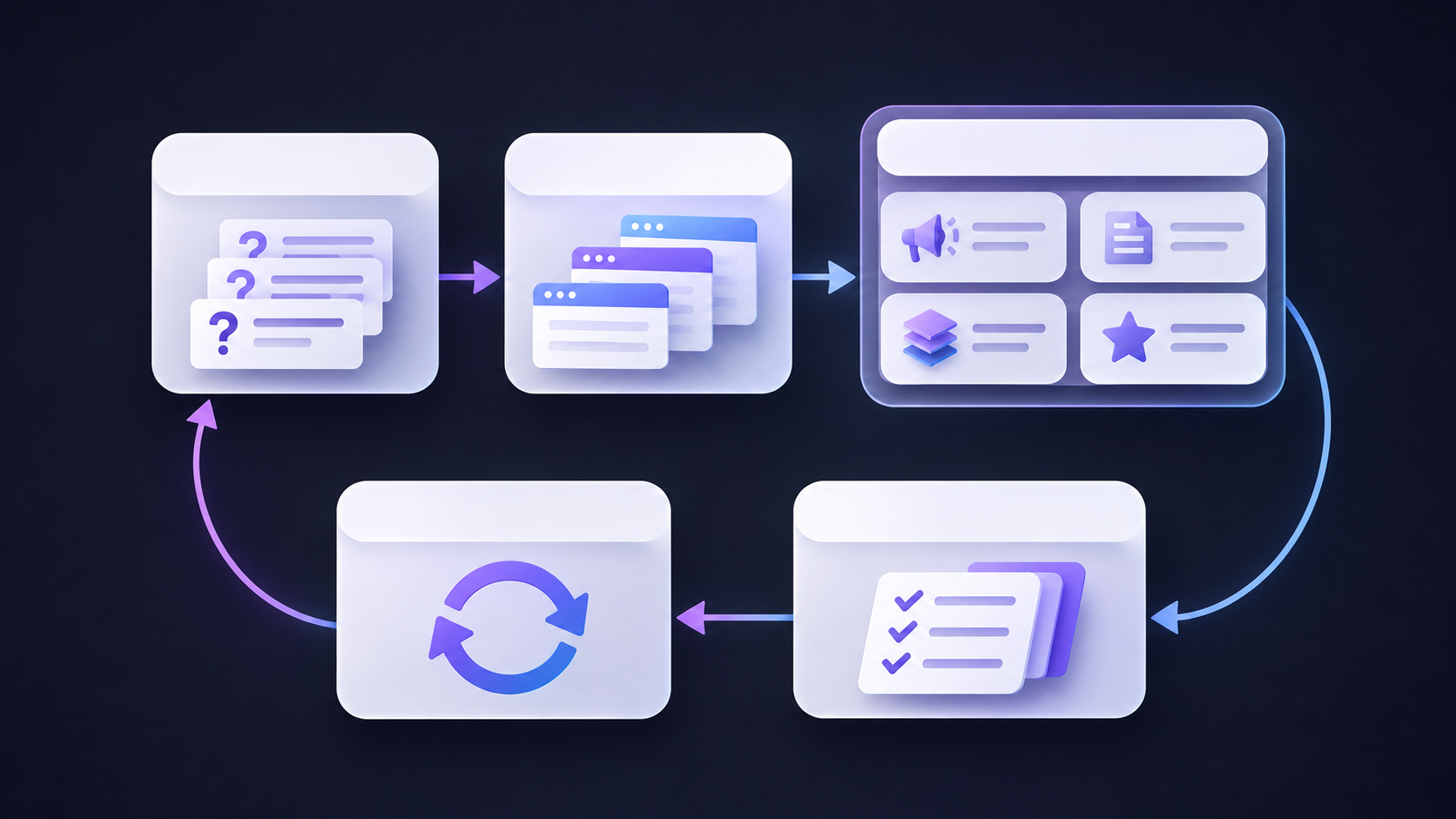
One response is an anecdote. Repeating the same defined question set can reveal patterns, but it still does not isolate causality. A new mention after a case study was published may reflect that change, a crawler refresh, a model update, a different source mix or normal response variation.
This is where measurement must stay separate from implementation. AI Visibility Monitoring observes how the environment changes. An ongoing AI Search Optimization program turns supported findings into prioritized changes and measures the same environment again. Monitoring is evidence for decisions, not a substitute for improving the underlying information.
What should you improve first?
A useful sequence starts with the buyer problem and the evidence already available. Claiming every directory or publishing content at scale comes later, if the evidence supports it.
- Define the buyer questions. Select a manageable set of branded and non-branded questions that reflect how buyers discover, compare and verify providers in the relevant market.
- Establish a baseline. Test those questions across the AI Search experiences, languages and locations that matter. Record mentions, citations, portrayal and recommendations separately.
- Inventory genuine evidence. List completed work, specialist knowledge, methods, publishable outcomes, customer permissions and original data.
- Publish the strongest first-party proof. Build detailed case studies, project pages, service explanations and expert material around evidence the company can substantiate.
- Choose category-relevant third-party sources. Focus on the review platforms, directories, associations and publications that real buyers use. Leave marginal profiles alone.
- Ask customers for honest reviews. Use neutral requests after genuine engagements. Never buy, fabricate, gate or sentiment-condition the response.
- Contribute where the market already exchanges knowledge. Earn external context through useful expert participation, data and commentary rather than covert promotion.
- Fix technical access and internal discovery. Make important pages public, crawlable, indexable where appropriate, current and logically connected.
- Run the same question set again. Compare sources and representation over time. Treat movement as an observation that needs interpretation, not proof that one action caused the result.
For many established B2B companies, the first operational challenge is gaining a reliable view of how the company currently appears, which competitors are being surfaced and which sources shape the answer. A structured AI Search Audit can establish that baseline before the team commits to a larger implementation program.
For a business with genuine expertise, the foundation already exists in completed work, earned knowledge and the experience its customers can describe. The task is to make enough of that reality public, specific and independently checkable that both buyers and retrieval systems can evaluate it.
Sources we used to prepare this article
- Overview of OpenAI Crawlers — OpenAI, accessed November 16, 2026. https://developers.openai.com/api/docs/bots
- Searching the web with ChatGPT — OpenAI Help Center, updated October 2026; accessed November 16, 2026. https://help.openai.com/en/articles/9237897-searching-the-web-with-chatgpt
- AI features and your website — Google Search Central, accessed November 16, 2026. https://developers.google.com/search/docs/appearance/ai-features
- Google's Guide to Optimizing for Generative AI Features on Google Search — Google Search Central, accessed November 16, 2026. https://developers.google.com/search/docs/fundamentals/ai-optimization-guide
- Creating helpful, reliable, people-first content — Google Search Central, accessed November 16, 2026. https://developers.google.com/search/docs/fundamentals/creating-helpful-content
- Enable and use web search — Anthropic Help Center, updated November 2026; accessed November 16, 2026. https://support.claude.com/en/articles/10684626-enable-and-use-web-search
- Does Anthropic crawl data from the web, and how can site owners block the crawler? — Anthropic Help Center, updated November 2026; accessed November 16, 2026. https://support.claude.com/en/articles/8896518-does-anthropic-crawl-data-from-the-web-and-how-can-site-owners-block-the-crawler
- Optimizing Visibility in Generative Engines: A Critical Survey of Generative Engine Optimization (2023-2026) — Olivier Martinez, arXiv preprint, submitted July 15, 2026. https://arxiv.org/abs/2607.14035
- Which Types of Mentions Correlate the Strongest With AI Visibility? (260M AI Prompts Analyzed) — Ahrefs, large-scale vendor observational study, November 3, 2026. https://ahrefs.com/blog/mention-types-ai-visibility/
- What 200k local AI searches tell us about what businesses get recommended, and why your website matters — BrightLocal, local-search vendor study, September 16, 2026. https://www.brightlocal.com/research/local-ai-visibility-study/
- The Answer Economy: How AI Search Is Rewiring B2B Software Buying — G2, vendor buyer survey and research report, April 2026. https://learn.g2.com/g2-2026-ai-search-insight-report
- Prohibited & restricted content — Google Business Profile Help, accessed November 16, 2026. https://support.google.com/business/answer/7400114?hl=en
- The Consumer Reviews and Testimonials Rule: Questions and Answers — US Federal Trade Commission, accessed November 16, 2026. https://www.ftc.gov/business-guidance/resources/consumer-reviews-testimonials-rule-questions-answers
- Fake reviews guidance — UK Competition and Markets Authority, April 4, 2025. https://www.gov.uk/government/publications/fake-reviews