

Top Online Shopping Apps in 2026 and What Makes Them Successful
Online shopping apps support different commerce models. Marketplaces coordinate sellers and buyer protection; retail apps connect inventory with stores and fulfillment; grocery apps handle substitutions during active orders. A generic list hides key product decisions.
This article examines 12 notable apps across five categories. “Top” is not an objective ranking. Selection reflects store presence and distinctive functions. Ratings and install brackets are dated, not evidence of profitability, active users, or feature impact.
App ratings, rating counts, review counts, install brackets, and update information were checked on July 29, 2026. Store data changes over time and should be treated as a dated snapshot.
Editorial note: This is an independent editorial comparison based on publicly available app-store and product information. Unless explicitly stated otherwise, no listed provider paid for inclusion or ranking, and Lexogrine is not affiliated with or endorsed by the companies mentioned. Product names, app icons, and trademarks belong to their respective owners. Features, ratings, availability, offers, and terms may change; verify important details directly with the relevant provider.
Online Shopping Statistics and Consumer Expectations
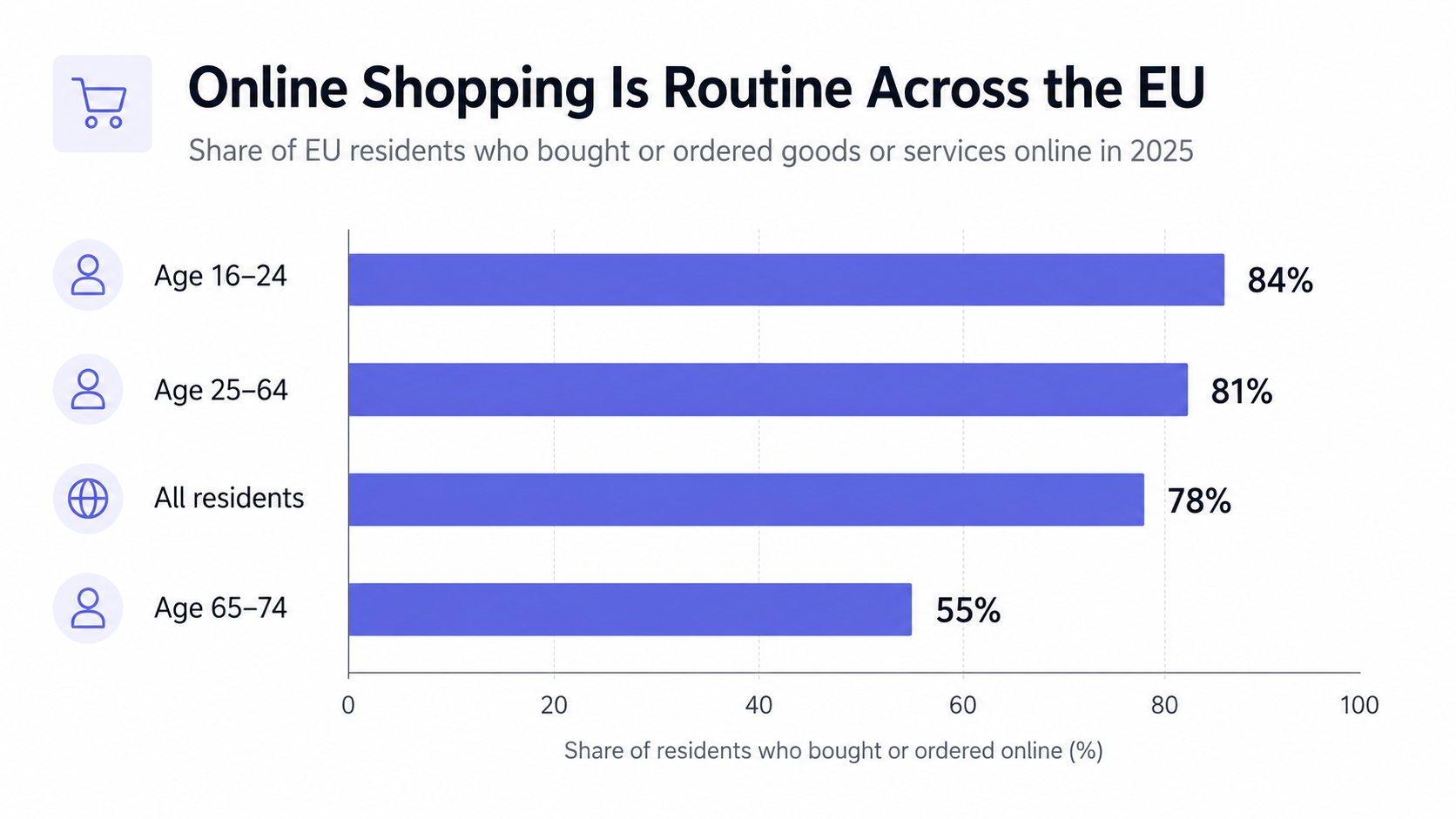
Online buying is routine across the EU. Eurostat reported that 78% of EU residents bought or ordered online in 2025: 84% among people aged 16–24, 81% among those aged 25–64, and 55% among people aged 65–74. The April 2026 publication uses official EU ICT statistics; its summary omits a combined sample. Apps need accessible controls.
Ecommerce accounted for 16.9% of U.S. retail sales in Q1 2026. The U.S. Census Bureau estimated seasonally adjusted ecommerce sales at $326.7 billion, up 9.8% year over year, versus 3.9% for total retail. This is an official retail estimate, not a consumer survey. Treat the app as part of sales, inventory, payment, and fulfillment.
Smartphones produced most U.S. holiday transactions. Adobe found that 56.4% of online transactions during November and December 2025 occurred on smartphones. Its January 2026 analysis covered more than one trillion U.S. retail-site visits, 100 million SKUs, and 18 product categories. Mobile product pages, checkout, authentication, and account recovery are primary flows.
Social commerce affects discovery and purchase. Seven in ten respondents in DHL’s 2025 study had bought through social media, and the same share expected it to become their main shopping destination by 2030. DHL surveyed 24,000 recent online shoppers in 24 markets. Preserve product, creator, offer, and review context when traffic arrives through social content.
Delivery and return choice can stop checkout. In the same DHL sample, 81% said they would abandon a purchase without their preferred delivery option; 79% said the same about returns. These are stated intentions across 24 markets, not observed sessions. Show timing, pickup choices, costs, and return conditions before payment.
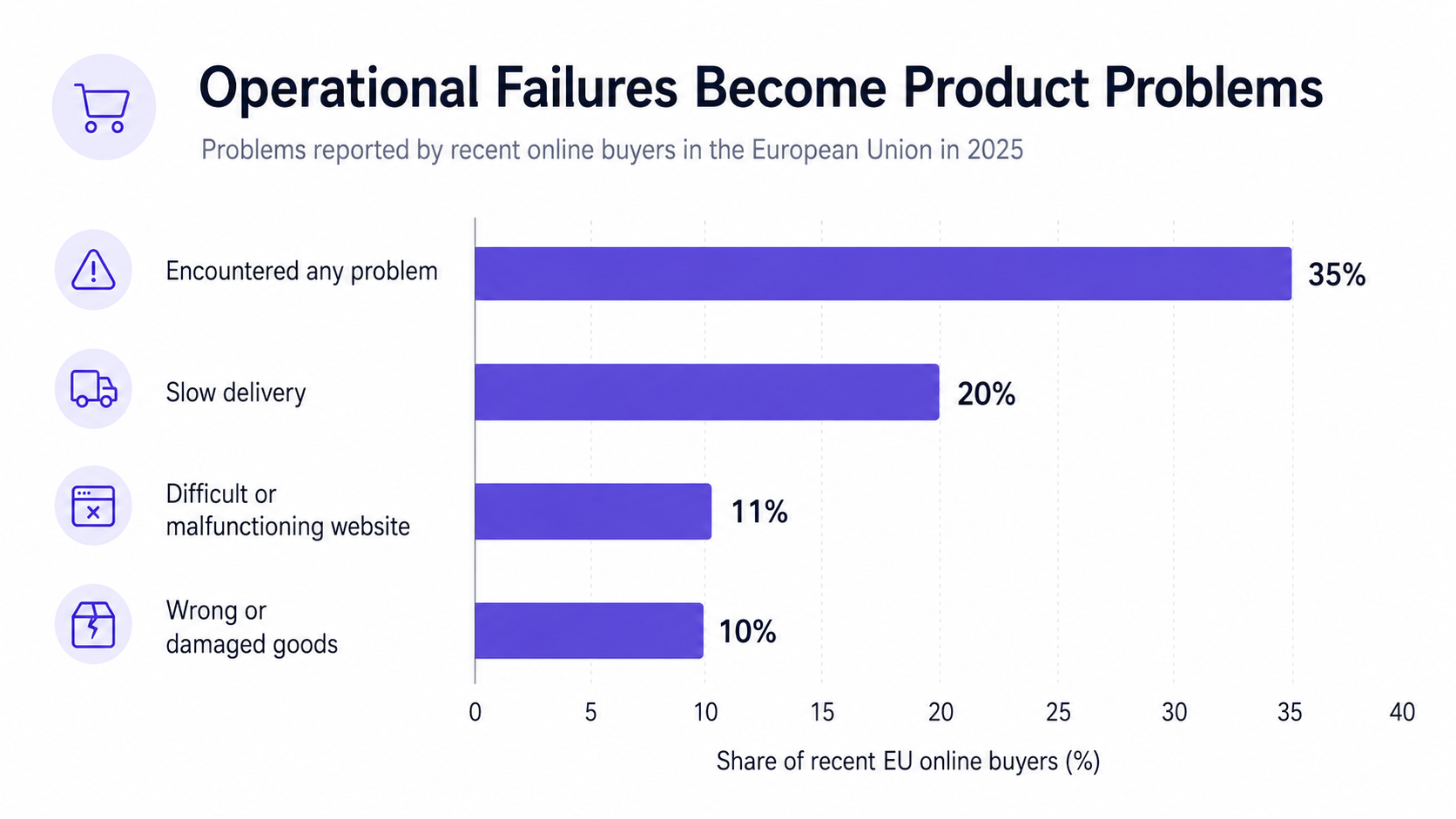
Operational failures become product problems. Eurostat found that 35% of recent EU online buyers encountered a problem in 2025. Slow delivery affected 20%, a difficult or malfunctioning site 11%, and wrong or damaged goods 10%. Order status, support, fulfillment data, and exception handling must match interface promises.
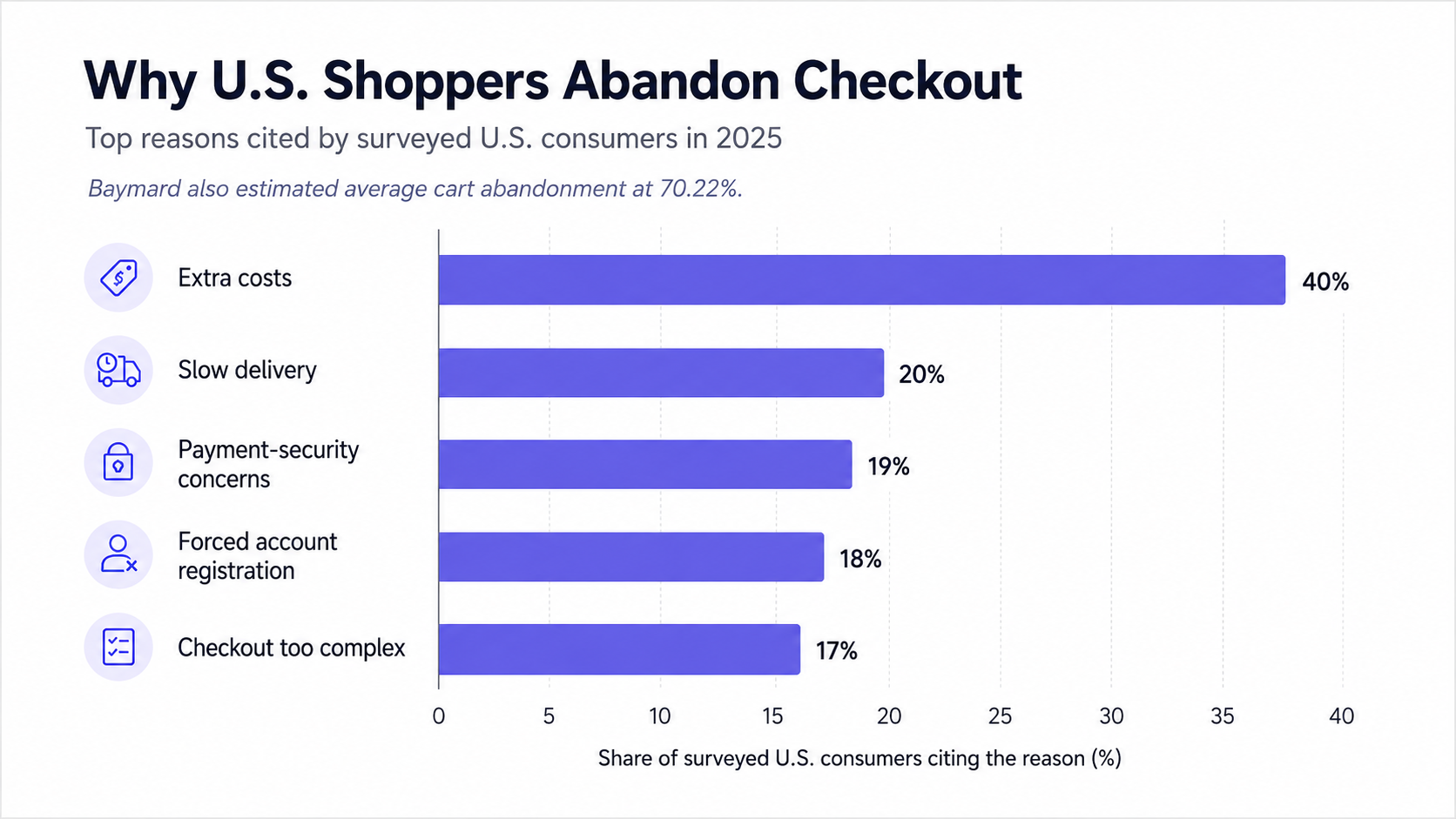
Checkout abandonment remains high. Baymard’s September 2025 aggregation of 50 studies calculated a 70.22% average. In its U.S. survey, 40% cited extra costs, 20% slow delivery, 19% payment-security concerns, 18% forced registration, and 17% a complex checkout; the public summary omits the sample. Show total cost early and request only necessary information.
Digital wallets represented 53% of global ecommerce spending in 2024. Worldpay’s March 2025 report analyzed transactions in 40 markets rather than consumer opinions. Smartphones accounted for 57% of global ecommerce spend. Payment design should reflect local wallets, cards, bank methods, and authentication rules.
AI already supports U.S. shopping research. Adobe’s August 2025 survey of 5,000 U.S. consumers found that 38% had used generative AI for online shopping and 52% planned to use it during 2025. Tasks included research, recommendations, deal finding, lists, gift ideas, and virtual try-on. AI needs current catalog data, a defined task, and a route to conventional search or human help.
Sustainability and resale influence consideration. DHL reported that 72% of respondents considered sustainability, one in three had abandoned a cart over sustainability concerns, and more than half bought preowned or refurbished products. Results cover 24 markets, not every country equally. Support informed decisions with specific material, packaging, repair, and resale information.
Types of Online Shopping Apps
Marketplace apps
Marketplaces connect customers with multiple sellers. Their product work covers inconsistent catalog data, seller information, trust rules, payments, disputes, and status.
Retail and omnichannel apps
Retailer apps join digital shopping with stores, local inventory, loyalty, pickup, delivery, returns, and in-store tools.
Brand-owned shopping apps
A single-brand app can combine commerce with membership, content, customization, release access, and store services.
Fashion and resale apps
Fashion apps emphasize visual discovery, changing assortments, sizing, and saved preferences. Resale adds listings, condition details, messaging, payments, shipping, and protection. Depop and SHEIN represent different structures within this category.
Grocery and on-demand shopping apps
These apps coordinate local assortment, delivery windows, substitutions, pickup, and live fulfillment. Instacart’s defining problem is managing an order whose availability can change after checkout begins.
Some apps fit several categories. Each is placed under the model that best explains its product lesson here.
Marketplace Shopping Apps
1. Amazon Shopping
Category: Marketplace; stores: Shopping
Best for: Broad product selection and repeat purchases
Availability: iOS and Android
App Store: 4.8/5 from 8.4 million ratings
Google Play: 4.4/5 from 4.63 million reviews; 1B+ installs
What the app does
Amazon Shopping is the mobile interface for Amazon’s catalog, checkout, accounts, fulfillment, and support.
Key features
Text, image, barcode, and voice search; reviews; lists and price alerts; 360-degree and supported room views; tracking; biometric sign-in; and live chat. July iOS notes described reorganized access to account, orders, cart, browse, and discovery.
What makes it effective
Product analysis: Several search modes address catalog scale. Lists, order history, and tracking preserve context before and after purchase.
What ecommerce businesses can learn from it
Large catalogs need several discovery methods and a direct route between saved intent, orders, and post-purchase status.
2. eBay
Category: Marketplace; stores: Shopping
Best for: Auctions, resale, collectibles, and specialist goods
Availability: iOS and Android
App Store: 4.8/5 from 5 million ratings
Google Play: 4.6/5 from 5.01 million reviews; 100M+ installs

What the app does
eBay combines fixed-price sales, auctions, and marketplace selling, with buying, listing, offers, shipping, and status tools.
Key features
Image search; condition filters; Watchlist; bid and offer alerts; eBay Live; photo-led listings with AI suggestions; My Garage; and eligible authenticity and money-back programs.
What makes it effective
Product analysis: Listing tools reduce seller work, while condition and protection information address uncertainty around used or unique inventory.
What ecommerce businesses can learn from it
A two-sided marketplace should shorten listing setup without hiding product condition, seller history, protection rules, or dispute paths.
3. Etsy
Category: Marketplace; stores: Shopping
Best for: Handmade, personalized, vintage, and creative goods
Availability: iOS and Android
App Store: 4.9/5 from 7.2 million ratings
Google Play: 4.9/5 from 2.16 million reviews; 50M+ installs

What the app does
Etsy organizes handmade, customized, vintage, home, style, and gift goods sold by independent shops.
Key features
Image search; location and budget filters; customization requests; seller messaging; favorites and gift lists; tracking; reviews and qualifying Purchase Protection; and multiple payment methods.
What makes it effective
Product analysis: Structured attributes make distinctive items searchable, while nearby messaging supports specifications that need agreement before purchase.
What ecommerce businesses can learn from it
Niche marketplaces need structured discovery plus direct communication for products that cannot be represented by standard variants alone.
4. Temu
Category: Marketplace; stores: Shopping
Best for: Price-led discovery across many categories
Availability: iOS and Android
App Store: 4.7/5 from 2.2 million ratings
Google Play: 4.5/5 from 12.4 million reviews; 1B+ installs

What the app does
Temu is a multi-category marketplace centered on price discovery, app offers, checkout, shipping, and returns.
Key features
Category browsing; multi-shop search; daily and app offers; cart and order management; supported payments; shipping; returns; and notifications. Listed free-shipping and 90-day-return terms are conditional.
What makes it effective
Product analysis: Recurring offers increase the need for clear eligibility, timing, shipping, and return information.
What ecommerce businesses can learn from it
Promotion-led apps should place offer conditions beside the promotion rather than relying on policy pages reached later.
Retail and Omnichannel Shopping Apps
5. Walmart
Category: Retail and omnichannel; stores: Shopping
Best for: Store shopping, pickup, delivery, and household reorders
Availability: iOS and Android
App Store: 4.8/5 from 18 million ratings
Google Play: 4.7/5 from 7.27 million reviews; 100M+ installs

What the app does
Walmart combines retail and grocery ordering with stores, fulfillment, pharmacy, payments, lists, and membership.
Key features
Pickup, delivery, Express, and shipping; store maps; live tracking; shared lists and reordering; Walmart Pay and curbside check-in; barcode scanning and eligible Scan & Go; pharmacy tools; and Sparky AI product help.
What makes it effective
Product analysis: One account connects research, local fulfillment, status, payment, and receipts across retail touchpoints.
What ecommerce businesses can learn from it
Omnichannel quality depends on timely local inventory, fulfillment capacity, and order-state data—not interface work alone.
6. Target
Category: Retail and omnichannel; stores: Shopping
Best for: Loyalty, store planning, pickup, and delivery
Availability: iOS and Android
App Store: 4.9/5 from 6.8 million ratings
Google Play: 4.9/5 from 405,000 reviews; 10M+ installs

What the app does
Target links discovery, Target Circle, local stock, same-day services, store navigation, payment, and returns.
Key features
Target Circle deals; Drive Up and same-day delivery; local stock and aisle-aware lists; barcode scanning and Wallet; reviews; returns; supported room visualization; and virtual try-on.
What makes it effective
Product analysis: The app carries a plan through lists, aisle finding, offers, payment, pickup, and returns, tying value to store execution.
What ecommerce businesses can learn from it
Retail apps should connect planning and post-purchase service with the store visit, not stop at browsing and checkout.
7. Sephora US
Category: Retail and omnichannel; stores: Shopping
Best for: Beauty education, assistance, rewards, and pickup
Availability: iOS and Android
App Store: 4.9/5 from 426,000 ratings
Google Play: 3.9/5 from 79,900 reviews; 10M+ installs

What the app does
Sephora’s U.S. app connects beauty commerce with education, membership, pickup, associate support, and store scanning.
Key features
Product, brand, and price search; how-to content and community reviews; associate chat; pickup; in-store scanning; rewards; Foundation Finder; and favorites with stock alerts. July iOS notes described redesigned checkout and clearer order updates.
What makes it effective
Product analysis: Advice, community evidence, and shade tools support the decision, while rewards and pickup connect the account with stores.
What ecommerce businesses can learn from it
High-consideration categories should place education, comparison help, and expert support beside the product decision.
Brand-Owned Shopping Apps
8. Nike
Category: Brand-owned; stores: Shopping
Best for: Membership, releases, customization, and product stories
Availability: iOS and Android
App Store: 4.9/5 from 1.7 million ratings
Google Play: 4.7/5 from 1.07 million reviews; 100M+ installs

What the app does
Nike combines its catalog with free membership, stories, release access, customization, support, and store tools.
Key features
Member profile, rewards, and order history; release notifications; Jordan Mode; Nike By You customization; gift cards; store barcode scanning; Nike Experts chat; and member experiences, favorites, and editorial stories. The latest iOS notes described improved AI product search and personalization.
What makes it effective
Product analysis: Membership connects content, releases, preferences, orders, and store activity. Exclusive access and stories create reasons to open the app before a planned purchase.
What ecommerce businesses can learn from it
A brand app needs recurring utility, service, content, or access that a standard product page cannot provide.
9. ZARA
Category: Brand-owned; stores: Shopping
Best for: Fashion releases connected with store services
Availability: iOS and Android
App Store: 4.8/5 from 413,000 ratings
Google Play: 4.7/5 from 847,000 reviews; 50M+ installs

What the app does
Zara presents its women’s, men’s, and children’s collections with beauty, lingerie, special releases, order service, and store functions.
Key features
New-arrival and category browsing; favorites; tracking and returns; store locator; release notifications; Store Mode at participating locations; Zara QR with e-receipts; and supported store pickup or returns. The latest Android notes highlighted a redesign and new arrivals.
What makes it effective
Product analysis: Account and QR functions connect purchase history and receipts across channels. Store Mode treats the physical location as part of the product context.
What ecommerce businesses can learn from it
Brand retailers should unify receipts, orders, pickups, and returns regardless of where a transaction began.
Fashion and Resale Shopping Apps
10. Depop
Category: Fashion and resale; stores: Shopping
Best for: Peer-to-peer secondhand fashion
Availability: iOS and Android
App Store: 4.8/5 from 926,000 ratings
Google Play: 4.7/5 from 128,000 reviews; 10M+ installs

What the app does
Depop is a peer-to-peer secondhand-fashion marketplace covering discovery, seller shops, listings, offers, messaging, payment, shipping, and status.
Key features
Photo-based selling; AI description and attribute suggestions; offers; favorite sellers and wish lists; direct messaging; in-app checkout; tracking and notifications; and seller tools for payments, shipping, and returns.
What makes it effective
Product analysis: The app reduces the work needed to publish an individual item, then keeps negotiation and transaction communication inside one process.
What ecommerce businesses can learn from it
Resale automation should not replace accurate condition, measurements, imagery, shipping information, or buyer-seller communication.
11. SHEIN
Category: Fashion; stores: Shopping
Best for: High-frequency fashion and lifestyle discovery
Availability: iOS and Android
App Store: 4.7/5 from 3.2 million ratings
Google Play: 4.8/5 from 10.8 million reviews; 1B+ installs

What the app does
SHEIN sells fashion with beauty, home, accessories, footwear, pet products, electronics, tools, and office items. Its merchandising emphasizes frequent assortment changes and promotional browsing.
Key features
New Arrivals, Trends, Categories, and Best Sellers; product-drop and flash-sale alerts; community content; SHEIN LIVE reminders; PayPal, cards, and Afterpay where eligible; 24/7 live chat; order management; and shipping and return tools under current terms.
What makes it effective
Product analysis: Strong taxonomy and several discovery feeds organize a fast-changing catalog. Notifications and live content add entry points, but require relevance and clear promotion terms.
What ecommerce businesses can learn from it
High-velocity merchandising requires disciplined category data, controlled notifications, and easy-to-check discount, shipping, and return conditions.
Grocery and On-Demand Shopping Apps
12. Instacart
Category: Grocery and on-demand; stores: Food & Drink
Best for: Local grocery delivery, pickup, and substitutions
Availability: iOS and Android
App Store: 4.8/5 from 4.7 million ratings
Google Play: 4.8/5 from 365,000 reviews; 10M+ installs

What the app does
Instacart connects customers with local grocery and retail inventory for delivery or pickup, including changes required while an order is being fulfilled.
Key features
Stores by ZIP code; same-day delivery and pickup; scheduling; live shopper chat; substitutions and order changes; deals and coupons; lists and reordering; and nutrition or dietary filters, tracking, and produce-ripeness preferences at select retailers.
What makes it effective
Product analysis: Grocery availability changes during fulfillment. Substitutions, messaging, and live updates are therefore core commerce functions rather than after-order support.
What ecommerce businesses can learn from it
On-demand apps need structured exception handling so customers can approve replacements and understand changes before delivery.
What Successful Online Shopping Apps Have in Common
Several patterns recur across the business models.
Multiple discovery routes. Changing catalogs combine search, filters, visual tools, scanning, recommendations, preferences, or content. The mix depends on whether the customer starts with an item, need, budget, or inspiration.
Persistent intent. Wish lists, carts, followed sellers, reordering, and stock alerts preserve work across sessions.
Specific trust signals. Reviews, seller data, authenticity programs, purchase protection, tracking, and return rules answer different risks. A generic badge cannot replace clear seller, condition, arrival, and remedy information.
Checkout connected with fulfillment. Delivery, pickup, stock, substitutions, tracking, support, and returns belong to the same product experience as payment. Hidden costs or unreliable fulfillment can cancel interface gains.
A defined membership benefit. Rewards, release access, saved history, birthday benefits, fuel savings, or services give registration a customer purpose.
Operational quality behind the interface. Inventory accuracy, payments, seller moderation, store or warehouse execution, service, accessibility, performance, security, and notification control determine whether the app works. Interface quality cannot repair unreliable data or fulfillment.
What to Define Before Building or Redesigning an Ecommerce App
Before development, define the repeat use case, catalog, identity model, payment markets, inventory source, fulfillment, returns, support ownership, notifications, accessibility, analytics, and security. Separate first-release features from those requiring operational preparation.
At Lexogrine, we help ecommerce companies turn product ideas and operational requirements into custom digital commerce solutions. Our team combines product discovery, mobile and web development, backend engineering, cloud infrastructure, and integrations with payment, inventory, logistics, and customer-service systems. We also build AI agents and AI-supported features for product discovery, support, content management, and internal operations.