

AI Search Optimization is the practice of improving the technical, informational, and evidentiary conditions under which AI-assisted search systems can find, retrieve, and represent a company, then measuring whether concrete changes altered those outcomes.
That definition is deliberately broader than “getting cited by ChatGPT.” A company can be accessible to a search crawler and still never appear for an important buyer question. Its page can be retrieved and cited without the brand being named. The brand can be mentioned without being recommended. It can even be recommended without producing a measurable visit.
Those are different events, with different causes and different business consequences. Most weak AI Search strategies start by collapsing all of them into one vague idea of visibility.
The work is real, but it is not a universal list of AI ranking factors. Much of the foundation is familiar SEO, web engineering, information architecture, and editorial quality. The newer part is the need to examine generated answers across several systems, understand how the company is represented beyond its own website, and validate changes in an environment that is only partly observable.
TL;DR
- AI Search Optimization improves how a company can be discovered, retrieved, and represented in AI-assisted search.
- SEO remains the foundation. Crawlability, indexability, rendering, site architecture, and useful content still matter.
- The work goes beyond the company website. Third-party sources, reviews, references, and other public evidence can affect how a business is understood and represented.
- Visibility is not one metric. Retrieval, citations, brand mentions, recommendations, referral traffic, leads, and revenue measure different stages of the journey.
- Monitoring is not optimization. Optimization begins when findings lead to concrete technical, content, information-architecture, or evidence changes that are measured again.
- There are no universal AI ranking factors or guaranteed outcomes. Platform behavior differs, and no responsible strategy can promise citations, mentions, recommendations, or revenue.
What AI Search Optimization is trying to improve
Traditional search reporting encourages a relatively clear sequence: a page is indexed, ranks for a query, receives an impression, earns a click, and contributes to a conversion. That sequence was never perfectly linear, but its stages were visible enough to support established workflows.
AI-assisted discovery adds more possible paths. A system may reformulate a question, run several related searches, retrieve passages from different sources, synthesize an answer, attach citations, name companies, compare them, or recommend one for a specific use case. Some answers generate clicks. Others satisfy the user without a visit.
A useful operating model separates the stages:
access → index or retrieval eligibility → retrieval → source use → citation → brand mention → recommendation → visit → qualified action → revenue
Not every platform exposes every stage, and not every answer follows the whole sequence. The point of the model is diagnostic.
Consider an industrial automation supplier with a detailed compatibility page. The page may be indexed and accessible, yet absent from a generated answer because it does not clearly address the buyer's actual compatibility question. It may be retrieved and cited for one specification while the answer names a distributor rather than the manufacturer. A third-party catalogue may cause the brand to appear, but with an outdated product category. Each outcome calls for a different response.
If the page cannot be accessed, the problem is technical. If it is accessible but irrelevant to the question, the problem may be information coverage or structure. If the brand is described incorrectly, the problem may sit on an owned page, a third-party source, or both. If visibility rises but qualified demand does not, the issue may be measurement, message fit, or the commercial journey after discovery.
This is why “How do we rank in AI?” is usually the wrong first question. A better question is: which stage is failing, what evidence supports that diagnosis, and which part of the system can the company actually change?
Where SEO remains the foundation
For Google, the relationship is explicit. Its generative Search features use the existing Search index and core ranking and quality systems. Pages must meet normal technical requirements, be indexed, and be eligible to appear with a snippet. Google also says there is no special schema, AI-only markup, llms.txt requirement, or mandatory writing format that unlocks AI Overviews or AI Mode.
That makes established SEO work the first layer of the problem:
- Can search systems reach the relevant pages?
- Is the preferred version clear through canonicalization and redirects?
- Can important information be found through navigation and internal links?
- Does the page return useful content without depending on a fragile interaction?
- Is the information specific, current, and relevant to the question being asked?
These checks sound ordinary because they are. AI-assisted search does not make duplicate URLs, blocked resources, broken redirects, weak internal discovery, or inaccessible information less important.
The implementation still needs platform context. Google can process JavaScript, although JavaScript-heavy sites introduce more opportunities for rendering and indexing failures. OpenAI distinguishes between OAI-SearchBot for ChatGPT Search, GPTBot for model training, and ChatGPT-User for user-triggered actions. Perplexity similarly documents separate search and user agents. A team that treats every bot as the same system can easily allow the wrong access, block the relevant crawler, or draw the wrong conclusion from server logs.
This is where technical AI Search work becomes more useful than another generic content checklist. The relevant change may sit in a WAF rule, rendering path, CMS model, canonical setup, internal architecture, or application state rather than in the wording of a paragraph.
SEO remains foundational. It is not a guarantee. Technical eligibility can allow information to enter a retrieval system, but it does not command a citation or recommendation.
The terminology becomes easier once that boundary is clear. Generative Engine Optimization, Answer Engine Optimization, AI SEO, and AI Search Optimization are overlapping labels with no universal operational standard. Google treats optimization for its generative Search features as SEO. The broader term AI Search Optimization is still useful when the work includes non-Google platforms, generated brand representation, third-party sources, and cross-platform measurement.
What changes when discovery becomes generated
The meaningful change is not that every page needs a new format, but that the system can assemble an answer from several queries and sources, while the company sees only part of the path.
Google documents query fan-out, where a broad question can lead to several related searches. ChatGPT Search, Perplexity and Copilot use different combinations of search providers, crawlers and retrieval infrastructure. Their answers can vary across platforms, markets, languages, prompt wording, product versions and repeated runs. Their answers can vary across platforms, markets, languages, prompt wording, product versions, and repeated runs.
That changes the unit of analysis. A conventional rank tracker watches a query and a result position. AI Search measurement may need to preserve the full question, generated answer, cited sources, named companies, recommendation language, market, language, model or product version, and observation time.
It also expands the information environment.
A company website is a self-authored source. Buyers and retrieval systems may also encounter review platforms, partner pages, directories, trade publications, product documentation, communities, videos, conference material, public datasets, and customer accounts. These sources can support the company's claims, introduce useful context, or contradict them.
That does not create one universal “brand authority factor.” Observational studies have found associations between public brand mentions and visibility in AI-generated answers, but association is not a cross-platform causal rule. Manufactured mentions are therefore a weak strategy. The practical objective is to make genuine expertise public, specific, technically accessible, and independently checkable where the category supports it.
The deeper work of building brand authority for AI Search belongs in its own discussion. For this article, the important point is narrower: owned content is only one part of the evidence environment, and optimization may require correcting or strengthening information outside the company website as well as on it.
A professional-services firm, for example, may describe a new specialization accurately on its service pages while partner directories and industry profiles still use its old positioning. A generated comparison can then be factually grounded in public sources and still be commercially outdated. Publishing another blog post will not necessarily fix that mismatch.
Why the popular shortcuts are weak priorities
Every emerging search category produces tactics that are easy to package and difficult to validate. AI Search has already accumulated its share: add an llms.txt file, split every paragraph into a quotable chunk, publish a large FAQ, implement extra schema, move every answer to the first sentence, or rebuild the site with server-side rendering.
Some of these practices can be useful. The problem is the reason given for doing them.
Structured data can help search engines understand eligible content types and support established rich-result features. FAQ sections can answer real questions. Clear headings and direct explanations improve navigation. Server rendering can reduce dependence on fragile client-side execution. A well-maintained machine-readable file may be useful to a system that explicitly supports it.
None of that establishes a universal AI citation factor. Google says its generative Search features do not require special schema, artificial content chunking, AI-only markup, or llms.txt. A 2026 Ahrefs study comparing pages that added JSON-LD with matched controls found little movement in AI citations. A separate 2026 preprint found that several popular page features lost their apparent effect when pages were compared within the same sites, while semantic match and retrieval remained more important in the studied setting.
The practical lesson is about prioritization. A company should implement schema because the markup accurately represents content and serves a supported search or product use case. It should add an FAQ because the questions matter to readers. It should improve rendering because important information is otherwise unreliable or inaccessible. It should write a direct answer because clarity helps the audience.
Doing the same work solely to satisfy an undocumented AI preference is harder to defend. It consumes engineering and editorial capacity that could address a known access problem, missing buyer information, contradictory evidence, or weak measurement.
AI Search Optimization still benefits from clear content and reliable technical delivery. It simply requires a higher standard before calling a useful practice a ranking factor.
What companies can actually optimize
Companies cannot directly set a citation, recommendation, or share-of-answer score. They can improve the conditions from which those outcomes emerge.
The practical work usually falls into four areas.
Access and technical delivery
Important information needs to be available to the systems expected to retrieve it. The exact requirements vary by platform, but the diagnostic questions are concrete:
- Are relevant crawlers blocked by robots rules, WAF settings, authentication, rate limits, or bot protection?
- Does the initial response contain the core information, or does it appear only after a complex client-side flow?
- Are canonicals, redirects, sitemaps, and internal links pointing to the intended version?
- Can the system distinguish primary content from duplicate, obsolete, or parameterized variants?
An equipment manufacturer may place critical dimensions inside an interactive configurator that requires several browser actions before the specification appears. The user experience may be acceptable for an engineer who already knows the product. It can still be a poor retrieval surface. The fix may involve exposing the same approved data in accessible HTML, improving the product model in the CMS, and connecting the specification page to the relevant category and use-case pages.
Information structure and buyer coverage
A site can be technically healthy and still fail to answer the questions that shape a buying decision.
Many established B2B websites describe the company at a high level while leaving important selection criteria implicit. They list capabilities without explaining constraints, compatibility, implementation requirements, market fit, comparison points, or the situations in which the offering is unsuitable.
AI-assisted search makes those gaps visible because buyers can ask long, specific questions. A logistics consultancy may have strong experience in customs operations but no page that clearly explains which trade routes, regulatory environments, or systems it supports. A search system cannot reliably retrieve an answer that has never been made public.
The answer is not to generate a separate page for every prompt variation, but to map the real buyer journey, identify material unanswered questions, and organize the strongest available information around those decisions. Clear relationships between services, industries, use cases, evidence, and technical documentation help people first. They also reduce ambiguity for retrieval systems.
Accuracy and evidence
Specific claims are more useful than broad positioning, but only when the business can support them.
Useful evidence may include documented methods, certifications, compatibility data, implementation constraints, named authors or reviewers, dated product information, original research, detailed case studies, and customer accounts that describe what actually happened. Human editorial review belongs here as a quality-control practice. It improves accuracy, sourcing, scope, and accountability. There is no sound basis for calling it a universal ranking factor.
A regulated supplier has an additional reason to treat this work seriously. If certification details, geographic availability, or product status change, outdated public information can affect buyers even before anyone reaches the company website. The editorial process needs an owner, a review date, and a way to correct material third-party errors where possible.
Wider representation
The company should examine the external sources that repeatedly appear around commercially important questions. The relevant set depends on the category. It may include analyst material, vertical directories, public procurement records, review sites, professional communities, distributors, partners, trade publications, or specialist video channels.
This is not a quota for mentions: the objective is to understand where the market already evaluates the category and whether the company is represented accurately in those environments. Some gaps can be corrected. Others require earning coverage, improving customer evidence, contributing expertise, or accepting that an independent source has reached a different conclusion.
Across all four areas, the same boundary applies: the company controls its implementation, but not the final output of a probabilistic system.
How to measure AI visibility without collapsing the funnel
No single dashboard observes the whole journey. A useful measurement design combines several evidence sources and keeps their meanings separate.
Measurement layer | Useful evidence | What it can answer | What it cannot establish alone |
|---|---|---|---|
Google generative visibility | Search Console generative performance reports | Which pages receive impressions in Google's generative Search and Discover features, segmented by time, country, and device where available | Visibility on other platforms, citations, recommendations, or business value |
Microsoft citation activity | Bing Webmaster Tools AI Performance | Citation totals, cited pages, sampled grounding queries, and trends across supported Microsoft experiences | Rank, authority, placement, persuasion, or a complete query population |
Cross-platform representation | Repeated, preserved responses for a defined prompt cohort | Mentions, citations, portrayal, competitors, and recommendation language across selected systems | Real-user demand, the complete market, or causality |
Website behavior | Analytics and referrer classification | Identifiable visits from supported standalone AI platforms and what those visitors do | Hidden referrals, all embedded AI surfaces, or clean separation of Google AI Overview traffic from standard Google referrals |
Commercial outcome | CRM, sales, and revenue systems | Qualified actions, opportunities, pipeline, and revenue associated with known journeys | Which upstream visibility event caused the outcome without additional analysis |
The first improvement is conceptual: stop treating a citation count as a business result.
Microsoft's Bing Webmaster Tools explicitly warns that citation totals do not indicate ranking, authority, placement, or the role of a page inside an answer. That is a useful constraint. A page can be cited as background evidence while a competitor receives the recommendation. A brand can be named without a link. A buyer can be influenced without clicking anything.
The second improvement is methodological. Generated answers vary. One screenshot can reveal a problem, but it cannot establish a stable rank or durable trend. A defensible monitoring design preserves the prompt and response, repeats observations, records the platform and market, and keeps the comparison set stable long enough to interpret movement. If monitoring is automated, use an approved API or another access method permitted by the relevant platform’s terms, technical instructions, and rate limits.
A brand's Google generative impressions may rise while its recommendation presence in ChatGPT falls and identifiable AI referral sessions remain flat. That is not necessarily a contradiction. The measurements describe different systems and different stages.
For teams that need recurring evidence rather than occasional screenshots, AI visibility monitoring can provide a controlled baseline across selected buyer questions, competitors, markets, languages, and platforms. The useful output is not one opaque score. It is a record of what changed, where it changed, and which changes may deserve action.
Monitoring finds the problem. Optimization changes the system.
Monitoring is necessary because the environment moves. Models change, retrieval systems change, competitors publish new information, third-party pages are updated, and the company itself changes.
Monitoring alone is still observation.
Our view is that the useful boundary is operational: optimization begins when evidence changes what the company does. A team alters crawler access, rendering, site architecture, content coverage, factual information, or the wider evidence environment, then measures the relevant stage again.
A practical operating loop is:
diagnosis → prioritization → implementation → validation
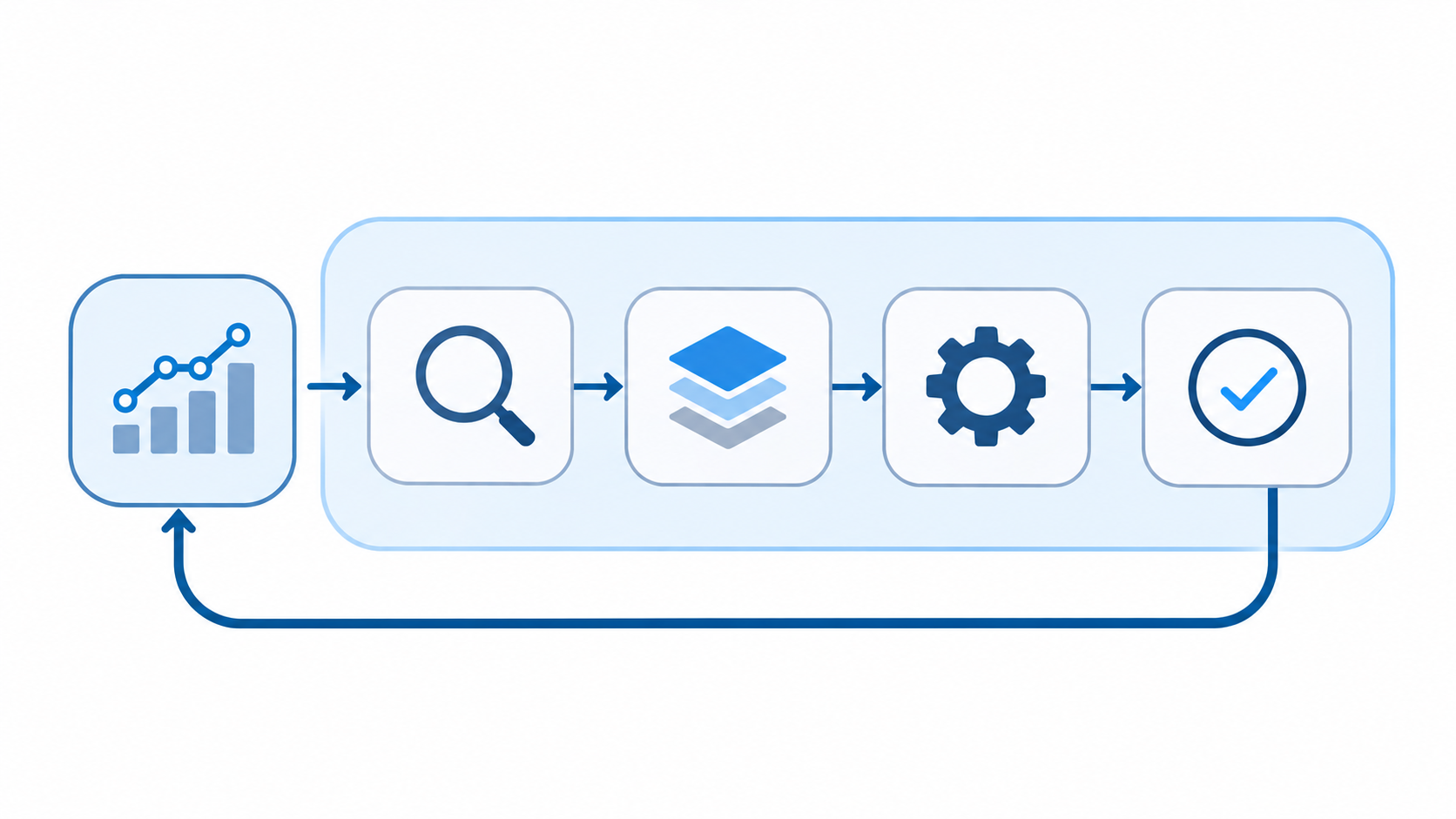
Diagnosis protects the team from acting on noise. A missing citation in one response may not be a persistent issue. A recurring factual error across several platforms and markets is a stronger signal.
Prioritization connects the finding to business relevance, evidence strength, implementation effort, and risk. A technically easy change may not matter to any important buyer journey. A commercially important representation problem may require coordination across product, marketing, engineering, legal, and external partners.
Implementation creates an intervention. Without a real change, the organization is still measuring.
Validation repeats the relevant measurement and asks whether the intended stage changed. It should also look for alternative explanations. The platform may have updated its model. A competitor may have changed its site. A high-frequency source may have disappeared. The prompt cohort may no longer represent the same buyer need.
Suppose repeated answers misstate a product's regional availability. The team finds the same ambiguous wording on an owned product page and a frequently surfaced distributor listing. It corrects both, documents the effective date, and repeats the same questions across the same markets and platforms. If the representation improves, the result is encouraging. It is still a before-and-after observation unless the measurement design can rule out other changes.
This level of discipline sounds slower than publishing a list of hacks. It is also much more useful. It turns AI Search Optimization into an operating practice rather than a collection of folklore.
A focused project or an ongoing program?
The right scope depends on the diagnosed problem. An ongoing program is not automatically better than a bounded project.
A focused audit or implementation project is usually enough when:
- the main problem is a known rendering, indexing, migration, canonical, or crawler-access issue
- the company needs a baseline and prioritized roadmap before committing to implementation
- the scope is limited to one site, market, language, or product line
- the internal team can implement the work and continue monitoring after handoff
- the buyer environment changes slowly and the commercial risk of drift is limited
An AI Search Audit is a logical starting point when the company does not yet know which stage is failing. The audit should separate observed facts from hypotheses, compare relevant competitors and sources, examine technical constraints, and produce a prioritized implementation plan rather than just another score.
An ongoing program is more defensible when:
- several platforms, markets, or languages materially affect discovery
- products, claims, integrations, regulations, or commercial priorities change frequently
- competitors and influential sources move quickly
- the work requires coordinated technical, editorial, product, and external-source changes
- the organization needs repeated measurement to distinguish persistent movement from noise
- inaccurate representation or exclusion from high-value buyer journeys carries material commercial risk
Even then, continuity should be earned by the work. The program needs a stable measurement design, a prioritized backlog, implementation capacity, and explicit validation. Recurring reporting without meaningful interventions is monitoring, not optimization.
No responsible provider can guarantee a citation, mention, recommendation, ranking, or revenue outcome. The systems are probabilistic, platform behavior changes, and important variables sit outside any one company's control. What a company can demand is a clear diagnosis, evidence proportional to the claim, real implementation, and honest measurement of what happened next.
Organizations that need that full improvement loop can evaluate AI Search Optimization services for B2B companies. The decision should follow the diagnosis, not precede it.
The practical starting point is simple: identify the stage that is failing, improve the system or evidence that governs that stage, and validate the result without pretending the measurement says more than it does.
Frequently asked questions
What is AI Search Optimization?
AI Search Optimization is the practice of improving the conditions under which AI-assisted search systems can discover, retrieve, and represent a company. It combines established SEO foundations with work around information accuracy, external evidence, cross-platform monitoring, and validation.
Is AI Search Optimization different from SEO?
It builds on SEO rather than replacing it. Technical accessibility, indexing, site architecture, and useful content remain important, but AI Search Optimization also considers how a company is represented across multiple AI systems and third-party sources.
What can a company actually optimize for AI Search?
A company can improve crawler access, rendering, site structure, content coverage, factual accuracy, and the public evidence available about its products, services, and expertise. It cannot directly control whether an AI system cites, mentions, or recommends it.
How should AI Search visibility be measured?
There is no single universal metric. Useful measurement may combine generative-search reporting, citation and mention tracking, repeated platform testing, referral traffic, CRM outcomes, and revenue data. Each measures a different stage of the journey.
Does AI Search Optimization require an ongoing program?
Not always. A focused audit or implementation project may be enough when the problem is clearly defined and limited in scope. Ongoing work becomes more useful when several platforms, markets, languages, changing products, or external sources need repeated monitoring and coordinated optimization.
Sources we used to prepare this article
- Google's Guide to Optimizing for Generative AI Features on Google Search: Google Search Central, accessed November 22, 2026. https://developers.google.com/search/docs/fundamentals/ai-optimization-guide
- Introducing Search Generative AI performance reports in Search Console: Google Search Central, June 3, 2026; worldwide rollout noted August 31, 2026. https://developers.google.com/search/blog/2026/06/gen-ai-performance-reports
- Overview of OpenAI Crawlers: OpenAI, accessed November 22, 2026. https://developers.openai.com/api/docs/bots
- Perplexity Crawlers: Perplexity, accessed November 22, 2026. https://docs.perplexity.ai/docs/resources/perplexity-crawlers
- Introducing AI Performance in Bing Webmaster Tools Public Preview: Microsoft Bing, February 10, 2026. https://blogs.bing.com/webmaster/2026/2/Introducing-AI-Performance-in-Bing-Webmaster-Tools-Public-Preview/
- AIPlatform and PaidAIPlatform: Microsoft Learn, last updated September 23, 2025. https://learn.microsoft.com/en-us/clarity/insights/ai-channel-group
- Frequently asked questions: Microsoft Clarity, accessed November 22, 2026. https://learn.microsoft.com/en-us/clarity/faq
- What Drives AI Citations? Content, Retrieval and Model Knowledge in Generative Engine Optimization (GEO): Mahe Chen and Nick Koudas, arXiv preprint, October 10, 2026. https://arxiv.org/abs/2610.15033
- Don't Measure Once: Measuring Visibility in AI Search (GEO): Julius Schulte, Malte Bleeker and Philipp Kaufmann, arXiv preprint, April 8, 2026. https://arxiv.org/abs/2604.07585
- We Tracked 1,885 Pages Adding Schema. AI Citations Barely Moved.: Ahrefs, May 11, 2026. https://ahrefs.com/blog/schema-ai-citations/
- An Analysis of AI Overview Brand Visibility Factors (75K Brands Studied): Ahrefs, May 26, 2025. https://ahrefs.com/blog/ai-overview-brand-correlation/
- Rustem Kakimov, Xing Tan, Jonathan Gillham and Narcis Bejtic "Auditing Citation Behavior in AI-Generated Search Summaries: A Framework and a Case Study of Google AI Overviews": Proceedings of the 39th Canadian Conference on Artificial Intelligence, PMLR 318:224–235, May 25–29, 2026. https://proceedings.mlr.press/v318/kakimov26a.html