
How to Choose a React Development Company in 2026
Choosing a React development company requires evidence of production delivery, not a long technology list. The strongest candidate should understand the product, explain trade-offs, work effectively with the backend and infrastructure, and leave code another capable team can maintain.
What Does a React Development Company Actually Do?
A React.js development company may provide a focused frontend team or own most of product delivery. Typical work includes discovery, UI implementation, frontend architecture, TypeScript, API integration, identity flows, state and data management, accessibility, testing, deployment, monitoring, modernization, and React application maintenance.
For a new SaaS product, the team may help define roles, workflows, integrations, and the first viable release. For an existing application, it may audit the codebase, upgrade dependencies, replace outdated tooling, improve tests, or migrate features incrementally.
React is a UI library, so routing, data loading, caching, errors, permissions, deployment, and release management still need explicit choices. React now recommends a production framework for many new applications, while documenting Vite, Parcel, and Rsbuild for custom client-side setups.
When Does Hiring a React Development Company Make Sense?
An external React development team makes sense when the work needs several skills or sustained ownership. Common cases include:
- building a SaaS platform, MVP, or complex internal application;
- modernizing an older frontend without stopping operations;
- integrating a new interface with an existing API or enterprise system;
- adding experienced React developers to an internal team;
- taking over an unstable or poorly documented application;
- preparing a product for more users, roles, integrations, or compliance needs.
A full company may be unnecessary for a small, isolated task with a clear specification and strong internal technical ownership. A capable freelancer or internal engineer can be more efficient for one component, a short prototype, or a contained fix. Choose according to delivery risk and the breadth of expertise required.
How to Evaluate a React Development Company
1. Look Beyond “Years of React Experience”
Years are easy to state and hard to interpret. A developer may have spent six years building similar marketing interfaces, while another has spent three years handling complex permissions, real-time data, migrations, and production incidents.
Ask about the complexity and ownership behind the experience. Did the team define the architecture or only implement tickets? Did it work inside an existing system? Did it operate the application after release? Can it explain a decision that reduced future maintenance or a decision it later changed?
Long-term ownership is especially valuable. A team that has supported the same product through new features, framework upgrades, incidents, and changing requirements has seen the consequences of its earlier choices.
2. Evaluate Modern React and TypeScript Expertise
Strong React expertise in 2026 covers component purity, state ownership, effects, loading and error states, rendering, data fetching, accessibility, and understandable boundaries. The official Rules of React emphasize pure components and Hooks, immutable inputs, and correct Hook usage because these affect correctness and automatic optimization.
For TypeScript, look for strict checking, clear domain models, typed component contracts, safe nullable-data handling, API types where appropriate, and runtime validation at untrusted boundaries. TypeScript 7.0 arrived in July 2026 with modern defaults, although some tools may still need the TypeScript 6 API. Upgrade judgment matters more than claiming the newest compiler.
Ask how the team separates local UI state, shared client state, and server data; handles forms and failed requests; prevents effects from hiding application logic; structures components; evaluates React Compiler; and selects, pins, and upgrades dependencies. A fixed stack presented as the answer to every project is a warning sign.
3. Ask How They Make Architecture Decisions
A credible React development partner starts with product constraints. Public content pages, an authenticated dashboard, a collaborative editor, and an internal operations system may all use React, but they need different rendering and hosting choices.
Ask the team to compare the relevant options: a client-rendered SPA; a framework such as Next.js; static generation; server rendering; mixed server and client components; or integration into an existing backend, CMS, or application shell.
Next.js is a React framework for full-stack applications and supports server and client components plus several deployment forms. That does not make it the default. Hosting, team skills, caching, SEO, authentication, data sensitivity, and operating complexity should drive the decision.
Before a large engagement, request a short architecture note covering assumptions, components, data flows, deployment, risks, and open decisions. A diagram without trade-offs is decoration.
4. Check Whether They Understand the Backend Too
React applications depend on API contracts, identity, data rules, third-party services, and operations. A frontend team that treats the backend as an opaque endpoint may miss authorization gaps, inconsistent errors, pagination issues, race conditions, or incomplete workflows.
The company does not need to use Node.js. It should integrate React with REST, GraphQL where justified, and existing Node.js, Python, .NET, Java, PHP, or other backends. Ask about authentication, authorization, token refresh, API versioning, validation, idempotency, uploads, real-time updates, and failing third-party services.
Lexogrine works in full-stack TypeScript environments with React and Node.js development, while also integrating other backend stacks. The key capability is understanding the contract between browser, API, data, and infrastructure.
5. Review Real Projects, Not Just Visual Portfolios
Screenshots reveal little about maintainability, permissions, integrations, testing, or production stability. For each relevant project, ask:
- What problem and workflow did it address?
- Which parts did the company own?
- What constraints shaped the work?
- Which architecture was selected and why?
- How was the application tested and released?
- What changed after launch?
- Did the company maintain or scale it?
- What difficult issue did the team resolve?
An NDA may prevent source-code or metric disclosure. The vendor should still explain its contribution, process, and reasoning.
6. Examine Testing and Quality Assurance
A useful QA plan maps test depth to business risk. Unit tests protect isolated logic, component and integration tests cover user-visible behavior, and end-to-end tests verify critical flows in real browsers. Manual QA still helps with exploration, visual issues, unusual devices, and new workflows.
Testing Library favors tests that resemble real use, Playwright supports end-to-end checks across Chromium, WebKit, and Firefox, and CI can run type checks, linting, builds, and tests on each pull request.
Ask for the Definition of Done. It should cover code review, automated checks, acceptance criteria, browser scope, QA ownership, defect handling, and release approval. “We test everything” is not a process.
7. Ask About Performance and Web Vitals
Performance work should reflect actual users, devices, routes, and networks. A public acquisition page has different priorities from a data-heavy internal dashboard.
The team should discuss JavaScript and CSS size, code splitting, images, request waterfalls, caching, rendering, unnecessary updates, long tasks, and production measurement. React Compiler may reduce avoidable rerenders, but profiling and testing still matter.
For public pages, Core Web Vitals cover LCP, INP, and CLS. Google’s “good” thresholds are LCP at 2.5 seconds or less, INP at 200 milliseconds or less, and CLS at 0.1 or less at the 75th percentile. They are reference points, not universal promises.
Ask how the vendor will establish a baseline, set route-specific goals, collect field data, and prevent regressions. A guaranteed perfect Lighthouse score should reduce confidence.
8. Do Not Ignore Security
React does not remove application-security responsibilities. Ask which requirements enter the backlog and acceptance criteria. Verify that authorization is enforced on the server, secrets stay out of browser bundles and repositories, dependencies are monitored, and security fixes have an owner. The OWASP Top 10:2025 is a useful reference for common web risks.
Patch discipline deserves direct attention. React advisories in late 2025 and January 2026 required immediate updates for affected React Server Components packages covering remote code execution, denial of service, and source exposure. Client-only applications without those server packages were not affected, so the team must understand the actual architecture.
Accessibility should also be specified and tested. WCAG 2.2 is the current W3C reference for web accessibility requirements and techniques.
9. Evaluate Communication and Project Management
Poor communication creates engineering risk because decisions stay implicit, blockers surface late, and scope changes enter development without cost or architecture review.
Ask who makes day-to-day product and technical decisions, how often stakeholders see working software, and whether the client can speak directly with the engineers. Clarify project management, product, tech-lead, QA, design, and DevOps responsibilities; small projects may combine roles, but accountability should remain clear.
Look for a visible backlog, written acceptance criteria, regular demos, decision logs, documented estimate assumptions, and an escalation path. Status reports should explain outcomes, risks, decisions needed, and forecast changes rather than list hours.
10. Understand Their Development Process
A sensible flow is:
Discovery → requirements and scope → UX/UI where needed → architecture → implementation → QA → deployment → monitoring → iteration
Depth should match the project. A contained integration may need a short workshop; a new product with uncertain users, workflows, and integrations may need structured product discovery. Discovery should produce decisions and artifacts, not an open-ended consulting phase.
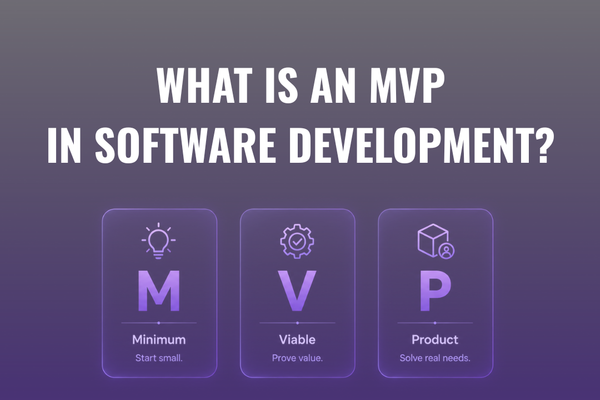
Useful outputs include prioritized scope, user flows, acceptance criteria, architecture notes, integration plans, milestones, risks, estimate assumptions, and release criteria. An MVP should be narrow enough to learn from real use while meeting necessary security and reliability requirements. See our guide to MVP development.
11. Ask What Happens After Launch
Post-launch work should be discussed before development begins. The contract or proposal should explain:
- the defect-fix or warranty period;
- monitoring and incident responsibilities;
- support hours and response expectations;
- dependency, React, and framework updates;
- security patching;
- performance review and regression handling;
- feature development and technical-debt planning;
- repository, cloud, analytics, and domain access;
- documentation and knowledge transfer if the relationship ends.
Ask who receives alerts, who can deploy, how releases are rolled back, and how production issues are prioritized. A company that builds the first version but cannot describe application maintenance is offering an incomplete service.
12. Understand the Pricing Model Before Comparing Quotes
The commercial model should match the certainty of the work.
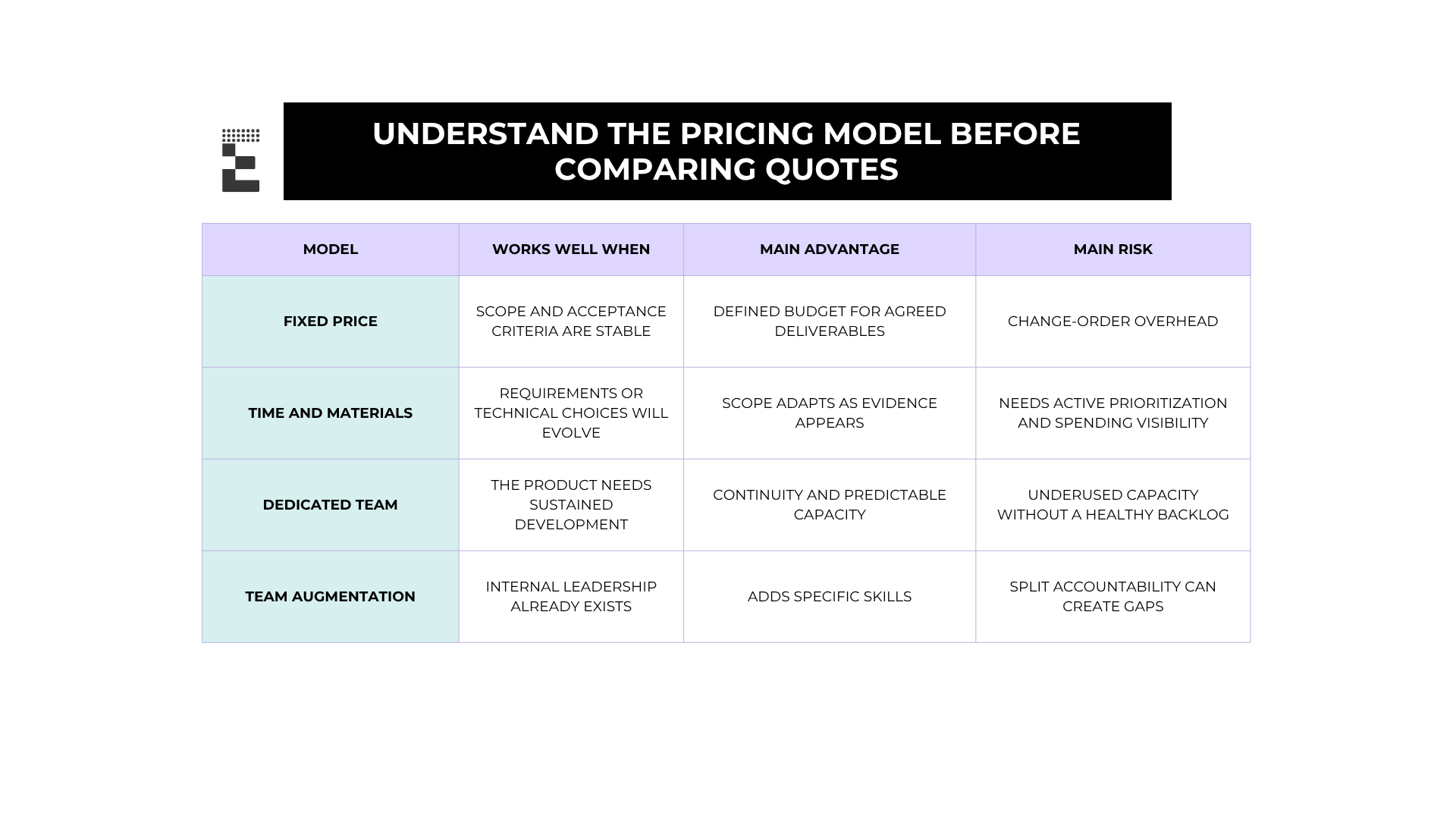
Compare totals only after proposals state scope, exclusions, assumptions, team composition, QA, management, deployment, documentation, and support. The lowest hourly rate may not produce the lowest total cost: rework, weak architecture, delayed feedback, defects, and poor handover can consume the saving.
For budgeting context, see our guide to website and web application development costs. The project estimate should still reflect the actual product.
Choosing Lexogrine as Your React Development Partner
Lexogrine builds custom web products with React, TypeScript, Node.js, AWS, and related technologies. The team can handle frontend delivery, broader full-stack implementation, integration with existing backend environments, modernization, and support after the first production release.
See Lexogrine’s React development services for the service scope, or review its broader web development capabilities. To discuss a new application, an existing React codebase, or a modernization plan, contact Lexogrine with the product goals, current constraints, and the decision that needs to be made first.
FAQ
How do I choose a React development company?
Compare evidence across comparable projects, architecture reasoning, React and TypeScript capability, testing, security, communication, pricing assumptions, code ownership, and post-launch support. Ask who will work on the project and request a written explanation of the proposed solution and its trade-offs.
How much does React development cost?
There is no reliable universal price. Cost depends on scope, design maturity, backend work, integrations, user roles, security requirements, testing depth, migration needs, deployment, team seniority, geography, and the commercial model. Compare like-for-like scope and total delivery responsibility rather than hourly rates alone.
What should I look for when hiring React developers?
Look for production experience, modern React and TypeScript practices, clear component and state boundaries, API and authentication knowledge, testing discipline, performance measurement, accessibility awareness, code review habits, and the ability to explain decisions without hiding behind jargon.
Should I hire a React development company or freelancers?
Choose a company when the work requires several disciplines, backup coverage, coordinated delivery, or long-term ownership. A freelancer can be a better fit for a small, well-defined task or a specific skill gap when internal product and technical leadership already exist.
Is React still a good choice for web development in 2026?
Yes, React remains actively maintained, with React 19.2 as the current stable feature line and React Compiler 1.0 available as a stable optional tool. Suitability still depends on the product, team, rendering needs, hiring plan, and operating model. React should be selected because it fits those constraints, not because it is familiar.
What is the difference between React and Next.js development?
React is the UI library used to build components and interactions. Next.js is a React framework that adds application structure and features such as routing, server and client components, data handling, rendering options, and deployment conventions. A React application does not automatically need Next.js; the choice depends on requirements and trade-offs.
How long does it take to build a React application?
A credible timeline requires scope, design, integrations, technical risk, team capacity, testing, and release requirements. A focused prototype and a regulated multi-role platform cannot share a useful standard estimate. Ask for a milestone-based forecast with assumptions, dependencies, and a process for updating the forecast as risks are resolved.