What Is an MVP in Software Development?
MVP is one of the most misused terms in software planning. Some teams use it to describe a cheap application, a rushed release, or a backlog with most features removed. Those interpretations produce weak estimates and products that teach the company very little.
An MVP, or minimum viable product, is the smallest usable release that solves a specific problem for a defined user group and produces credible evidence about an important assumption. An MVP for startups and new corporate products must deliver enough value for realistic use, then capture data or feedback that supports the next decision.
Lean Startup materials frame the MVP as a way to begin validated learning, while Steve Blank warns against treating it as a cheaper copy of the planned final product. The experiment should match the question the company needs to answer.
What Is MVP in Software Development?
A minimum viable product is a real release with deliberately limited scope. A user can complete the main task, receive a useful outcome, and judge whether the product deserves further use or payment.
Working definition: An MVP is the smallest reliable version of a product that lets a defined user complete a valuable task and gives the team credible evidence about a critical product or business assumption.
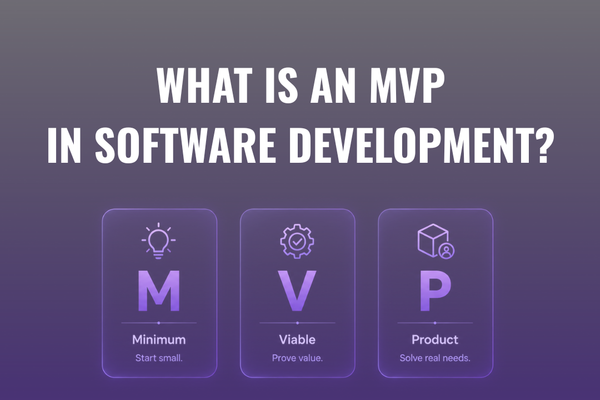
The MVP meaning in software development becomes clearer when each word is examined separately.
Minimum
Minimum refers to the smallest scope needed to test the main assumption, not the fewest screens or the lowest acceptable quality. A feature belongs when removing it would block the intended outcome, corrupt the evidence, or create an unacceptable security, privacy, compliance, or operational risk.
Viable
Viable means the product works for the intended user and setting. The core workflow should be understandable, stable, and complete. Critical data must be protected, payments handled correctly when relevant, and severe known defects resolved. Visual detail, reporting, and secondary workflows may remain limited.
Product
A product delivers an outcome through a usable workflow. Disconnected screens, a technical demo, or a static design do not meet that standard.
Eric Ries also stresses that MVP scope is not formulaic. One product may need two weeks of implementation, while another may need months because the assumption cannot be tested without integrations, data, security controls, or hardware.
What an MVP Is Not
An MVP is not automatically any of the following:
- a prototype or clickable design.
- a proof of technical feasibility.
- a landing page collecting email addresses.
- a buggy application released before testing.
- a full product with every planned feature implemented shallowly or with reduced polish.
- code written only for a presentation.
Landing pages, concierge services, spreadsheets, and manual workflows may be correct pre-development tests. In delivery plans, calling them validation experiments separates market evidence from a deployable product.
Steve Blank gives a useful test: build the experiment that answers the commercial question, even when that means performing part of the service manually before engineering the full process.
Prototype vs MVP, Proof of Concept vs MVP, and MVP vs Full Product
These approaches answer different questions. Atlassian describes a proof of concept as a feasibility test, a prototype as a draft used to test design or interaction, and an MVP as a functional release tested with real users.
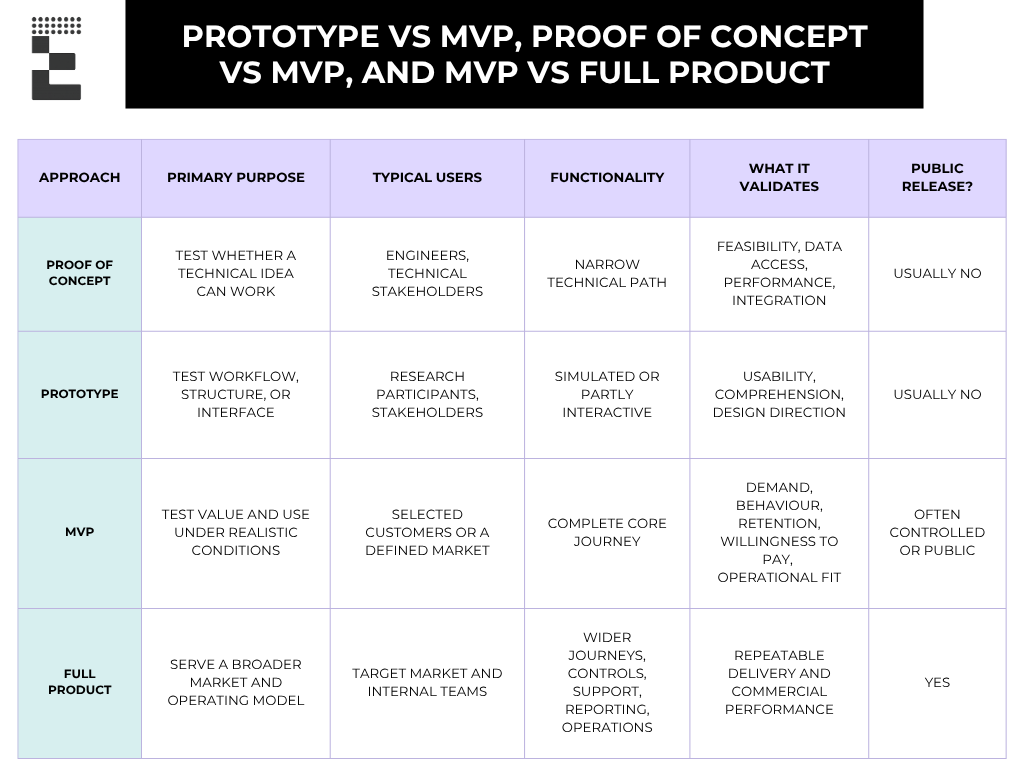
A familiar product may move from discovery and prototype to an MVP. A regulated AI product may first need a data study, proof of concept, safety review, and controlled pilot.
Why Companies Build MVPs
An MVP can test whether users experience the problem as expected, complete the proposed workflow, return after the first use, or agree to pay. It can also expose incorrect assumptions about onboarding, pricing, integrations, sales, support, or internal operations.
The smaller scope limits investment before those questions have evidence. Usage data can also make stakeholder or investor discussions more concrete. The Lean Startup build-measure-learn loop places measurement and learning after release, using metrics that can connect product changes with user behaviour.
An MVP does not guarantee product-market fit, investor interest, or lower total cost. Weak research, the wrong audience, poor distribution, or an unfairly low-quality release can still produce misleading results.
The MVP Development Process
A useful MVP development process starts before the first sprint. Product discovery identifies what the team needs to learn and which risks deserve early testing. SVPG groups product risk into value, usability, feasibility, and business viability. That model is practical for deciding whether the next step should be research, a prototype, a proof of concept, or production software.
Find out more about the Product Discovery Phase.
1. Define the user and problem
Choose a narrow user group, describe the job they are trying to complete, and document the current alternative. “Small businesses” or “people who need healthcare” is too broad for an initial release.
2. Identify the riskiest assumptions
List what must be true for the product to work as a business, then rank assumptions by uncertainty and consequence. Demand, data access, legal permission, performance, pricing, or distribution may be riskier than feature design.
3. Conduct discovery and market research
Interview target users, review current workflows, map substitutes, inspect available data, and confirm operating constraints. Discovery should produce decisions, not a document that repeats the original idea.
4. Define the core user journey
Map the shortest complete path to the promised outcome, including failure states, permissions, support, and any human work behind the interface.
5. Prioritize the first scope
Keep features that enable the core outcome, test the assumption, or satisfy a mandatory control. Defer secondary personas, channels, reports, configuration, and edge-case automation unless they affect the test.
6. Select technology and architecture
MVP software development still needs technical planning for authentication, data, integrations, monitoring, deployment, and ownership. The architecture should fit expected use and likely next steps without copying an enterprise platform design prematurely.
7. Design the experience
Create and test the main flow before implementation. Cover task completion, empty states, errors, permissions, responsive behaviour, and relevant accessibility needs.
8. Build and test the MVP
Implement the thin end-to-end journey, add analytics, test critical paths, review security and privacy controls, and prepare release procedures. Participants must be able to evaluate the product fairly.
9. Release to a suitable group
A controlled pilot often produces cleaner evidence than an unrestricted launch. Recruit matching users, define onboarding and support, and set the observation period.
10. Measure and decide
Compare results with thresholds agreed before launch. Continue, revise, narrow, change audience, test again, or stop. Adding features without interpreting evidence turns the MVP into an ordinary backlog.
How to Choose Features for an MVP
Feature selection should begin with the user outcome and the assumption being tested. Competitor checklists are poor substitutes for that work.
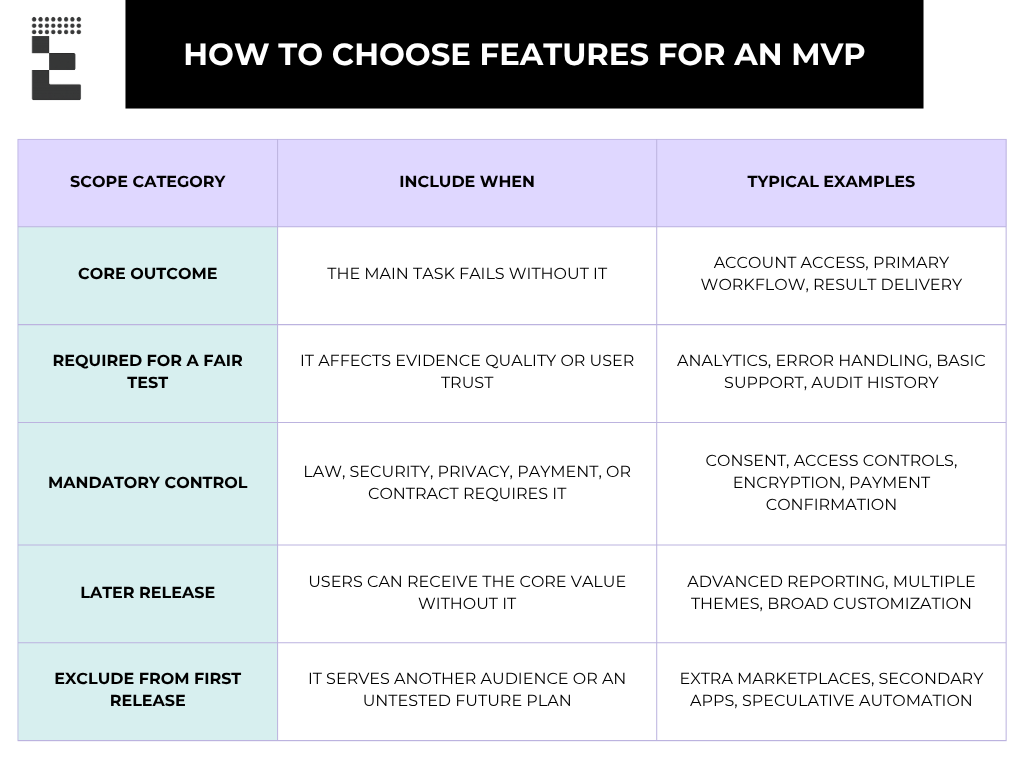
Questions that expose unnecessary scope include:
- Can the user complete the main task without this feature?
- Does it test a high-risk assumption?
- Is it required for security, privacy, compliance, or payment?
- Can a team member perform this step manually during the pilot?
- Is it present because users need it, or because a competitor has it?
MoSCoW, RICE, and impact-versus-effort models can make trade-offs visible. They do not decide which assumption deserves testing. Atlassian lists these as prioritization frameworks, each using different criteria such as impact, confidence, reach, effort, or release necessity.
A Realistic Software MVP Example
Useful software MVP examples show a complete thin slice rather than a miniature version of every planned module.
Original idea: An AI support platform for ecommerce companies, covering email, chat, social messages, voice, autonomous replies, workforce planning, quality reviews, multilingual support, and customer analytics.
Main user problem: Support agents spend too much time classifying repetitive tickets and drafting answers that already exist in the company knowledge base.
Riskiest assumption: Agents will trust AI-generated classifications and drafts enough to use them repeatedly, with measurable time savings and no unacceptable increase in incorrect replies.
MVP scope:
- connect one support inbox.
- classify three common ticket categories.
- draft replies using an approved knowledge base.
- require human approval before sending.
- record sources, edits, errors, and final actions.
- provide basic admin settings and usage analytics.
Excluded: autonomous sending, voice, social channels, multilingual support, custom model training, mobile apps, advanced billing, workforce planning, and broad CRM integrations.
Post-launch measures: draft approval rate, amount of editing, classification accuracy on reviewed samples, median handling time, weekly use per agent, error and escalation rate, and willingness to continue as a paid pilot.
High approval with no time saving points toward the workflow. Time saving with frequent factual errors points toward retrieval or controls. Low repeat use may reflect weak demand, poor onboarding, or poor fit with daily tools.
MVP Development Cost
There is no universal MVP development cost. Delivery platform, user roles, backend logic, integrations, AI, payments, design, data migration, compliance, testing, discovery readiness, team structure, and location all affect the estimate.
Clutch lists many software firms at $25–$49 per hour, while some exceed $150. Its mobile pricing data places many app projects in the $10,000–$49,999 bracket. DesignRush reports many software builds around $60,000–$250,000 and gives $60,000–$100,000 for a light SaaS MVP example. The project mixes differ, so these are reference points, not price promises.
The following planning bands are a synthesis of those market references and common delivery scopes. They are not industry averages or quotations for a specific product.
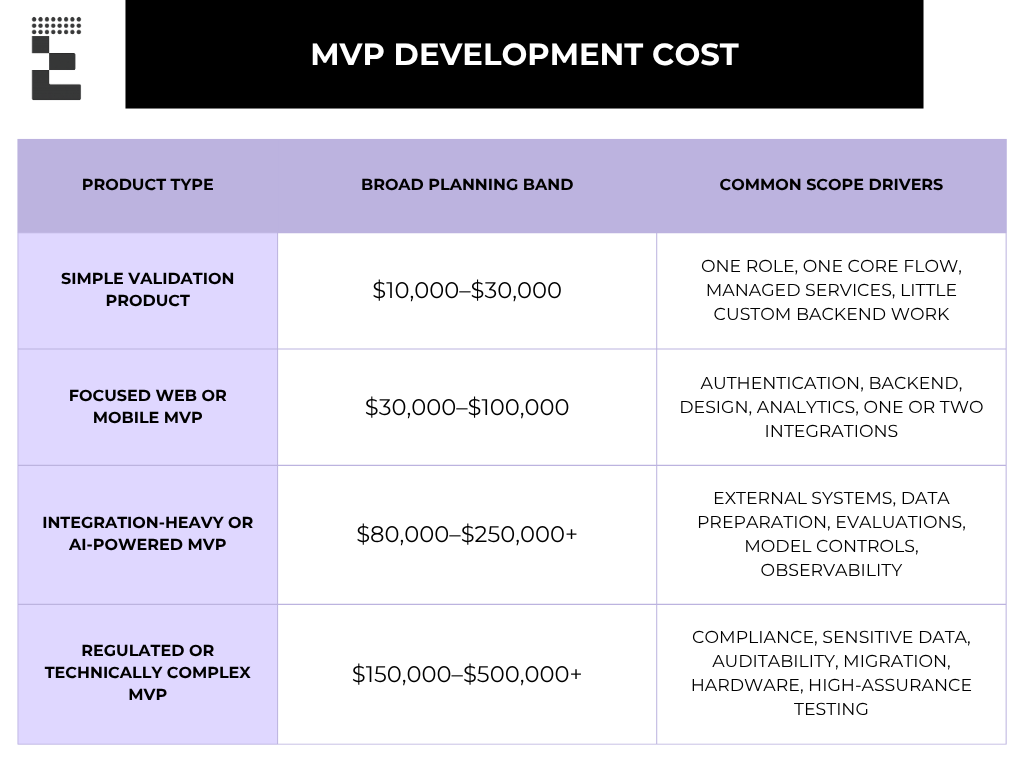
A low quote may exclude discovery, UX research, quality assurance, infrastructure setup, analytics, security work, deployment, platform submission, documentation, or support after release. Compare proposals by included outcomes, responsibilities, and the total shown on the first page.
How Long MVP Development Takes
Scope readiness sets the schedule. A narrow web product with completed discovery and standard infrastructure may reach a controlled release in roughly 8–16 weeks. A standard mobile or multi-role product often needs 4–8 months. Integration-heavy, regulated, hardware-linked, or data-intensive products may require 6–12 months or longer.
These are planning ranges, not commitments. Current Clutch guidance places a typical mobile app project at 20–40 weeks across planning, design, development, testing, deployment, and early support. DesignRush gives about six months for its light SaaS MVP example.
A delivery plan should include discovery, requirements, UX/UI design, architecture, implementation, testing, deployment, analytics, documentation, and release support. Mobile schedules may also include store preparation and review. External API access, security reviews, data procurement, stakeholder availability, and pilot recruitment can take longer than coding.
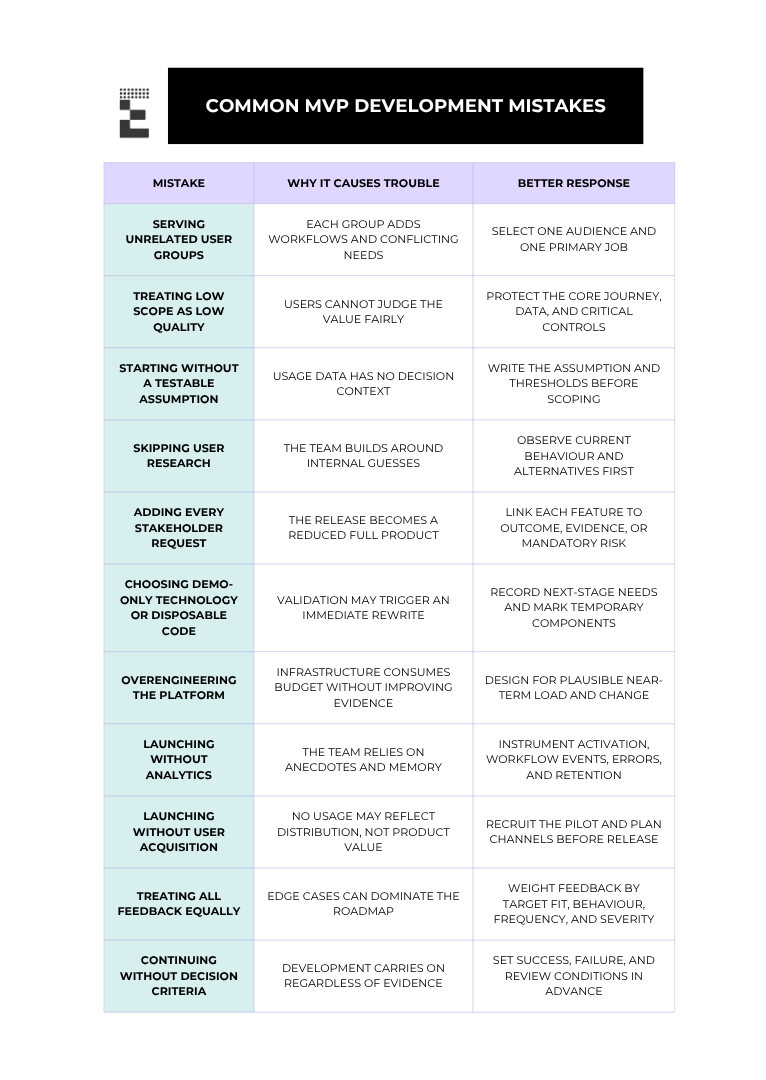
Common MVP Development Mistakes
How to Measure Whether an MVP Is Working
Metrics should correspond to the assumption. A marketplace may track completed transactions and repeat activity. Internal automation may require successful workflows, time saved, correction rate, and sustained use. Paid SaaS may need activation, retention, conversion, and renewal intent.
A practical measurement plan can include:
Examples of MVP metrics linked to user outcomes, repeat usage, commercial intent, process improvement, and operational reliability.
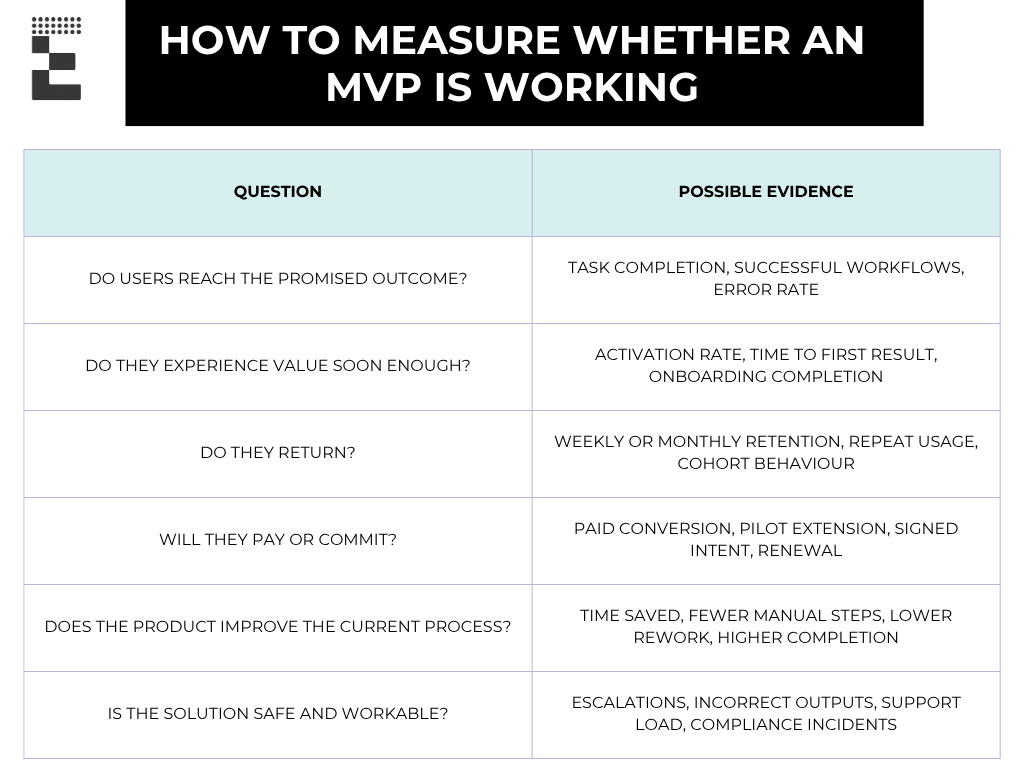
Traffic, downloads, registrations, and social attention measure acquisition or interest, not delivery of the promised outcome. Interviews can explain behaviour, but stated enthusiasm should be separated from repeated use or payment.
What Happens After an MVP Launch
The team should review evidence and choose a direction:
- continue with the same audience and improve the workflow.
- change the target user or use case.
- revise pricing or the value proposition.
- remove features that add effort without affecting outcomes.
- run another validation cycle.
- replace selected technical components.
- pause until data, regulation, or distribution constraints are resolved.
- stop development because the main assumption was not confirmed.
A negative result can protect the company from a much larger investment. It is useful only when the test was fair, the audience was appropriate, and the evidence can be linked to the assumption.
When You Should Not Build an MVP Yet
Writing production code is sometimes the wrong first validation method.
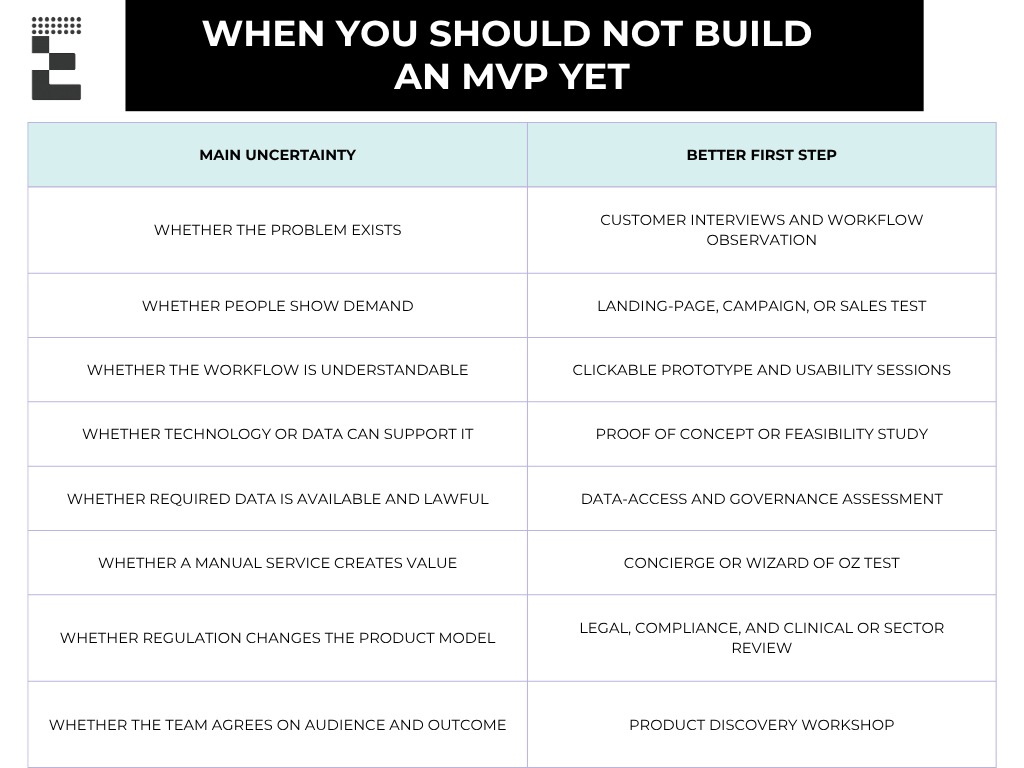
These methods may show that software should be built, that the concept needs revision, or that the first release should take a different form.
How to Choose an MVP Development Company
An MVP development company should contribute product judgment alongside implementation capacity. A team that accepts every requested feature may produce a larger estimate without better evidence.
Assess whether a potential partner can:
- facilitate discovery and challenge unsupported assumptions.
- connect scope decisions to user outcomes and business questions.
- present architecture choices and consequences in plain language.
- cover UX/UI, web, mobile, cloud, AI, analytics, testing, and deployment as required.
- define ownership, communication, decision rights, and change control.
- plan security, privacy, compliance, monitoring, and support.
- design a realistic roadmap through launch and post-validation development.
The Main Lesson
An MVP is the smallest reliable product that tests whether a company can deliver meaningful value to a specific user group. It should collect credible evidence while controlling initial investment. Scope may be narrow, but the tested workflow must remain usable, safe for its context, and complete.
Teams that know the user, assumption, success threshold, and next decision can discuss how to build an MVP. Others may gain more from discovery, research, a prototype, or a proof of concept first.
Build Your MVP with Lexogrine
Lexogrine supports product discovery, MVP planning, UX/UI design, web and mobile development, cloud architecture, AI agent development, deployment, and continued product development after market validation.
Planning an MVP? Talk to Lexogrine about turning your product idea into a focused, testable first release.
Frequently Asked Questions
What does MVP mean in software development?
MVP means minimum viable product: the smallest reliable release that delivers a useful outcome and generates evidence about an important assumption.
What is the main purpose of an MVP?
Its purpose is to test assumptions through real behaviour so the team can continue, revise, narrow, or stop.
Is an MVP the same as a prototype?
No. A prototype simulates a workflow or interface. An MVP provides a functional core journey for real users.
How many features should an MVP have?
There is no target number. Include what the core outcome, credible measurement, and mandatory controls require.
How much does it cost to develop an MVP?
A narrow product may cost tens of thousands of dollars. An integration-heavy, AI-powered, or regulated release may reach six figures. Estimation requires defined scope and risks.
How long does MVP development take?
A focused web MVP may take several months. Mobile, regulated, hardware-linked, or integration-heavy products often take longer, including discovery and release work.
Can an MVP become the final product?
Yes, when the codebase was designed and tested for continued use. Some components may still need replacement as operating requirements grow.
Do all startups need an MVP?
No. Interviews, demand tests, prototypes, proofs of concept, concierge services, data studies, or regulatory work may come first.
What comes after an MVP?
The team may improve the product, change direction, test again, rebuild selected components, pause, or stop according to agreed evidence criteria.
How do you know whether an MVP is successful?
Success means the test produced credible evidence and met thresholds tied to its main assumption. Completion, repeat use, payment, or time saved usually matters more than downloads.