RevolutionizingCS2 broadcastswith AI & deeplearning
Scout AI
Gaming & Entertainment
B2B
Scout AI is an advanced broadcast companion
designed specifically for Counter-Strike 2, representing a
paradigm shift in automated esports production.
Built entirely in-house by Lexogrine, this
module leverages custom neural networks to analyze game
state, predict outcomes, and automate camera movements with
human-like intuition.
As a core component of the
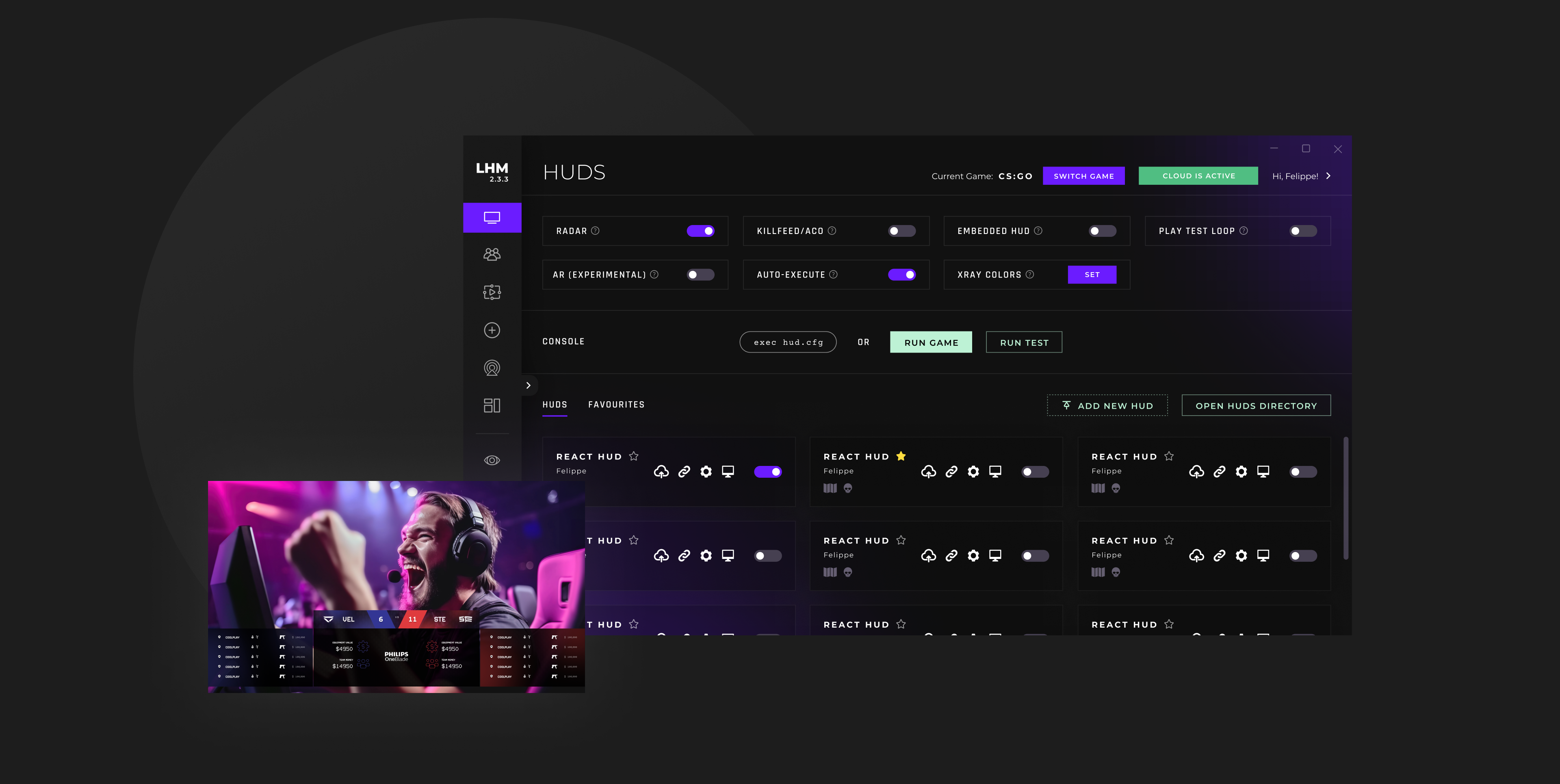
LHM.gg
(Lexogrine HUD Manager) ecosystem,
Scout AI demonstrates our ability to merge
high-performance software engineering with complex Machine
Learning pipelines. From the initial architecture design and model training
to the final integration with the CS2 engine,
Lexogrine delivered a solution that
transforms raw game data into a cinematic viewer experience.
Challenges
Building an AI capable of understanding the tactical depth of Counter-Strike 2 presented unique technical hurdles. We had to balance the speed required for live broadcasting with the heavy computational load of deep learning models.
Real-time data processing & latency
In a fast-paced shooter like CS2, a delay of even 500ms makes an automated observer useless. The primary challenge was analyzing hundreds of game events per second: player positions, health status, economy, and grenade trajectories, and making a camera decision instantly. The architecture targets a sub-20ms inference time to ensure the camera cuts to the action before it happens, not after.
High computational cost management
Running complex prediction models continuously is resource-intensive. We faced the challenge of preventing exponential cloud costs while maintaining high availability. The solution required building a highly optimized inference pipeline that could deliver accurate predictions without requiring expensive GPU instances in production.
Seamless game engine integration
Interacting with Counter-Strike 2 requires precision to ensure reliable camera control during live broadcasts. We leverage CS2's game state integration for real-time data access and HLAE (Half-Life Advanced Effects) for direct in-game camera control. For tournament setups where HLAE isn't available due to specific configuration requirements, we include a fallback option that simulates keypresses to switch camera POV, ensuring compatibility across any broadcast environment.
Training data diversity
A neural network is only as good as its dataset. To create a model that understands crucial moments, we couldn't rely on simple heuristics. The challenge lay in curating and processing terabytes of demo files from both CS:GO and CS2. We had to teach the model to distinguish between a passive rotation and a tactical lurk, requiring a diverse dataset to prevent overfitting to specific maps or playstyles.
Optimizing for entertainment, not metrics
Traditional AI systems optimize for measurable objectives,
but broadcast observation is inherently subjective. The
challenge was defining what makes a camera cut "good" when
there's no single correct answer. We couldn't rely purely on
neural network predictions, as raw data alone doesn't
capture the nuance of what makes a moment worth watching.
The solution required blending machine learning with
handcrafted algorithms that encode the
intuition of experienced observers - understanding that a
tense 1v1 clutch deserves different treatment than a chaotic
five-player engagement, even if both register similarly in
raw game data.
Solution
To solve these challenges, Lexogrine engineered a hybrid architecture that combines the raw speed of compiled languages with the flexibility of modern AI frameworks.
Custom neural network architecture
We bypassed off-the-shelf solutions in favor of a custom architecture built with PyTorch. By exporting our models to ONNX (Open Neural Network Exchange), we achieved a highly optimized runtime environment. This allowed us to deploy lightweight, high-speed prediction models that run efficiently on standard hardware, minimizing the latency between data ingestion and inference output.
Hybrid cloud architecture on AWS
We built a streamlined cloud infrastructure where all analytical tasks run on AWS. The communication layer relies on optimized WebSockets, allowing the Node.js backend to handle complex computation efficiently. Our highly performant, low-requirement backend solution achieves excellent performance on standard EC2 instances, keeping infrastructure costs manageable without sacrificing speed or reliability.
Automated "Director" logic
Scout AI goes beyond simple player tracking. We implemented a "Director" logic algorithm that evaluates the entertainment value of the current game state. This system automatically triggers Action Cinematics - dynamic camera angles that capture grenade lineups or bomb defusals - and seamlessly transitions between the most relevant player POV and third-person establishers, mimicking a professional human observer.
DVC for model versioning
To maintain code craftsmanship standards in our ML pipeline, we integrated DVC (Data Version Control). This allowed our data science team to version control large datasets and model experiments alongside the source code. It ensured reproducibility of results and facilitated a continuous integration pipeline where model improvements could be tested and deployed to the LHM platform rapidly.
Tech Stack
The Scout AI project leverages a high-performance stack designed for AI in esports, deep learning, and real-time prediction models.

Python


PyTorch

ONNX

DVC

Node.js

WebSockets

AWS
The brain of the operation - from Python to Node.js
The core of Scout AI is a sophisticated data pipeline
designed for speed.
The process begins with the Python-based AI engine, which
ingests raw game data via Valve's GSI. Using our custom
PyTorch/ONNX models, the system calculates
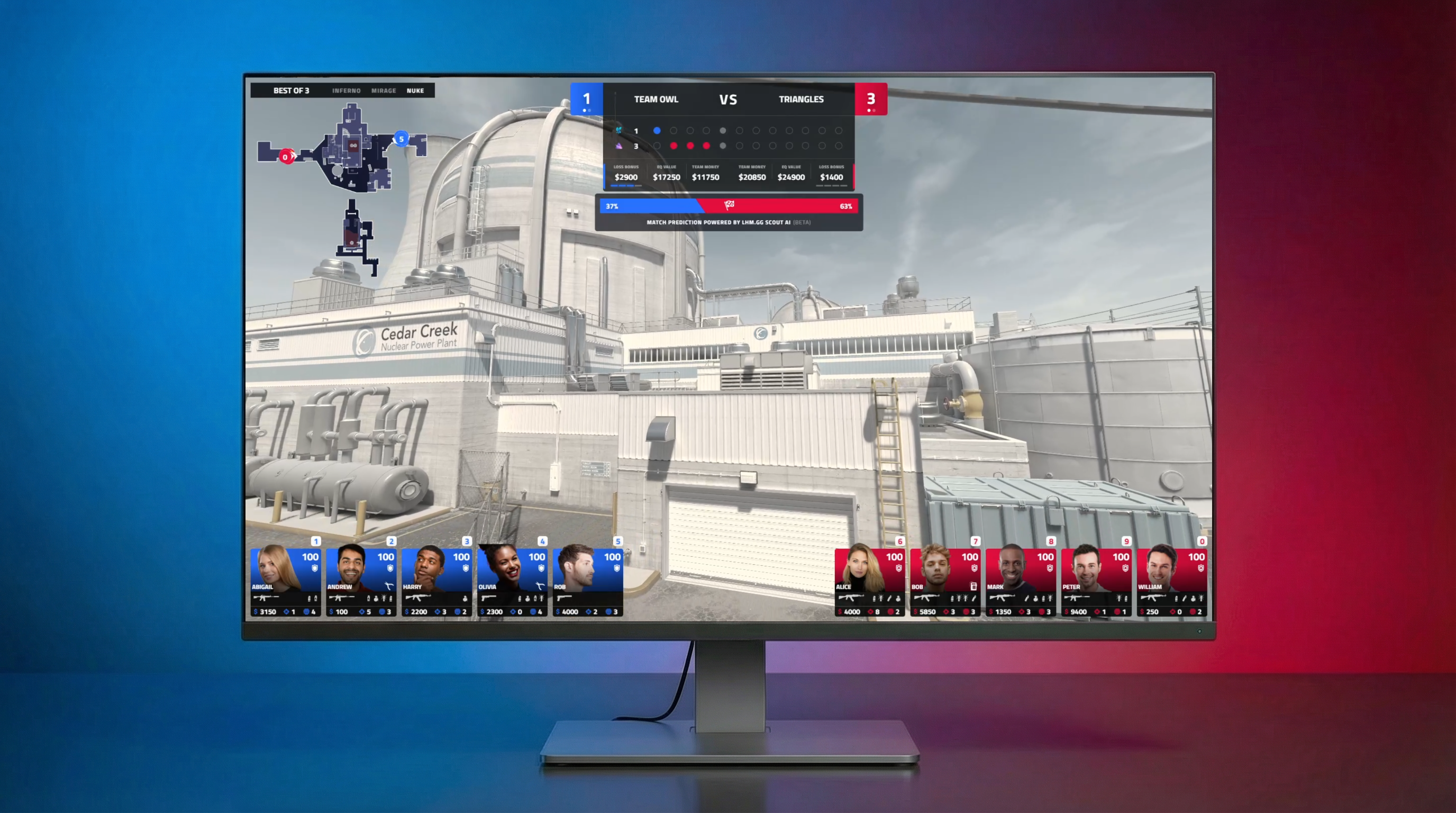
win probabilities (Scout Predict) and
determines the "Focus Score" of every player on the server in
real-time.
Once the optimal target is identified,
this decision is serialized and transmitted via
high-performance Websockets to the main
Node.js backend of the
LHM application. The Node.js layer acts as
the conductor, translating these abstract AI decisions into
concrete console commands. It instructs the
LHM CS2 integration layer to execute camera
shifts or trigger UI overlays. This entire loop - from game
event to camera switch - happens in milliseconds, creating a
seamless viewer experience indistinguishable from a human
operator.
Cinematic immersion via algorithms
One of the most innovative features is
Scout Cinematic, which solves the problem of
"downtime" during matches. We developed an algorithm that
parses the 3D geometry of CS2 maps to understand navigable
space.
Instead of static cameras, Scout AI generates smooth,
spline-based campaths (camera paths)
dynamically. This was further evolved into
Action Cinematic, where the AI identifies
specific tactical events and creates temporary, dramatic
camera angles to highlight the strategy, significantly
enhancing the production value of the broadcast.
Results
Scout AI: has successfully bridged the gap betweenmanual production and scalable automation.
Market Standard: Established a new benchmark forautomated observing, utilized by tournamentorganizers to maintain high production value withoutmanual labor.
Cost Efficiency: Drastically reduced production costs forTier 2 and Tier 3 tournament streams by eliminating theneed for dedicated human observers for every match.
Viewer Engagement: The real-time prediction models (Scout Predict) have increased viewer retention byproviding instant, data-driven context to roundoutcomes.
Scalability: The architecture, powered by AWS andoptimized Node.js services, allows the system to handlemultiple concurrent matches, making it a viable solutionfor large-scale league operations.